An exceptional, tight exhibition with its finger uncomfortably on the zeitgeist
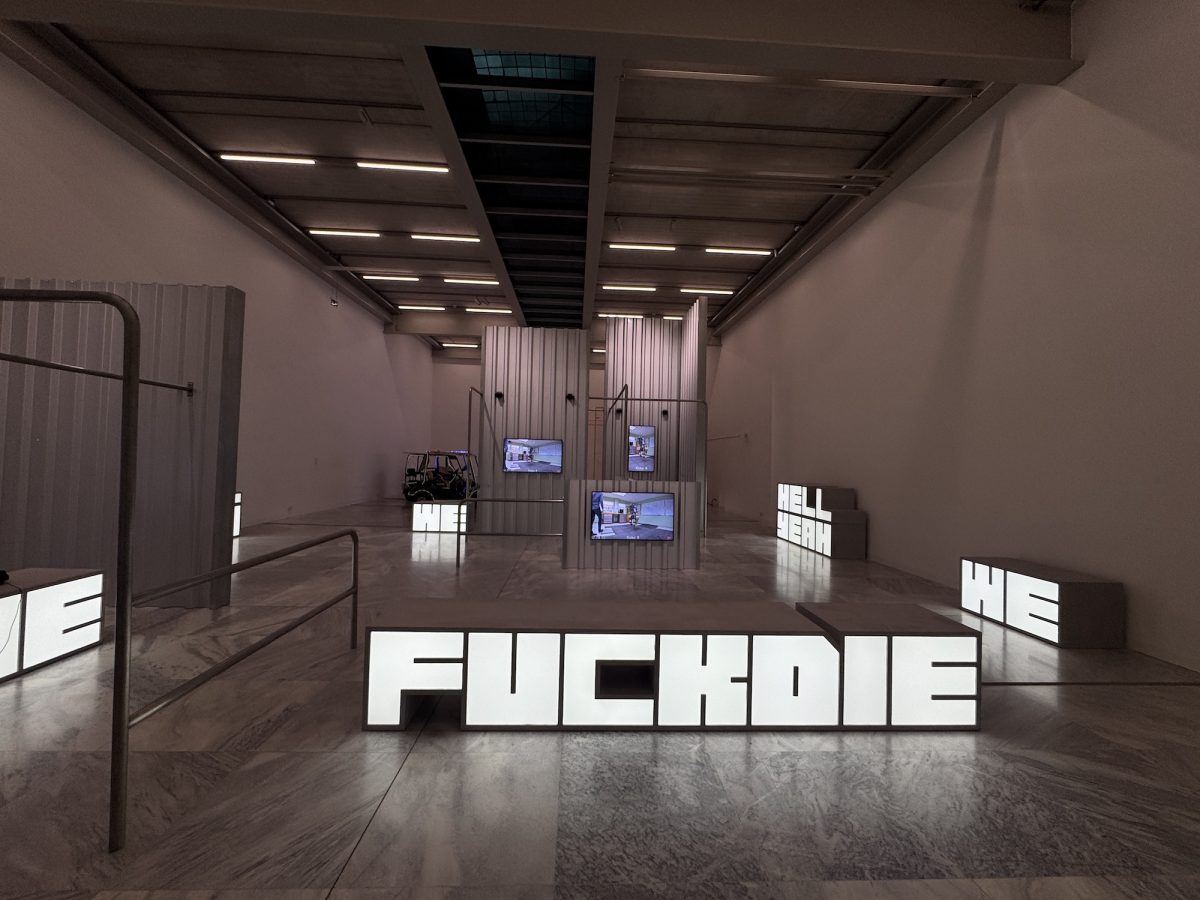
The first thing you notice as you enter the exhibition space – the hook, if you will – are the words Hell Yeah We Fuck Die, the most commonly used English words in the music charts in the 2010s according to one magazine. The brash words, all up in your face, give way to an abrasive but still nuanced exhibition.
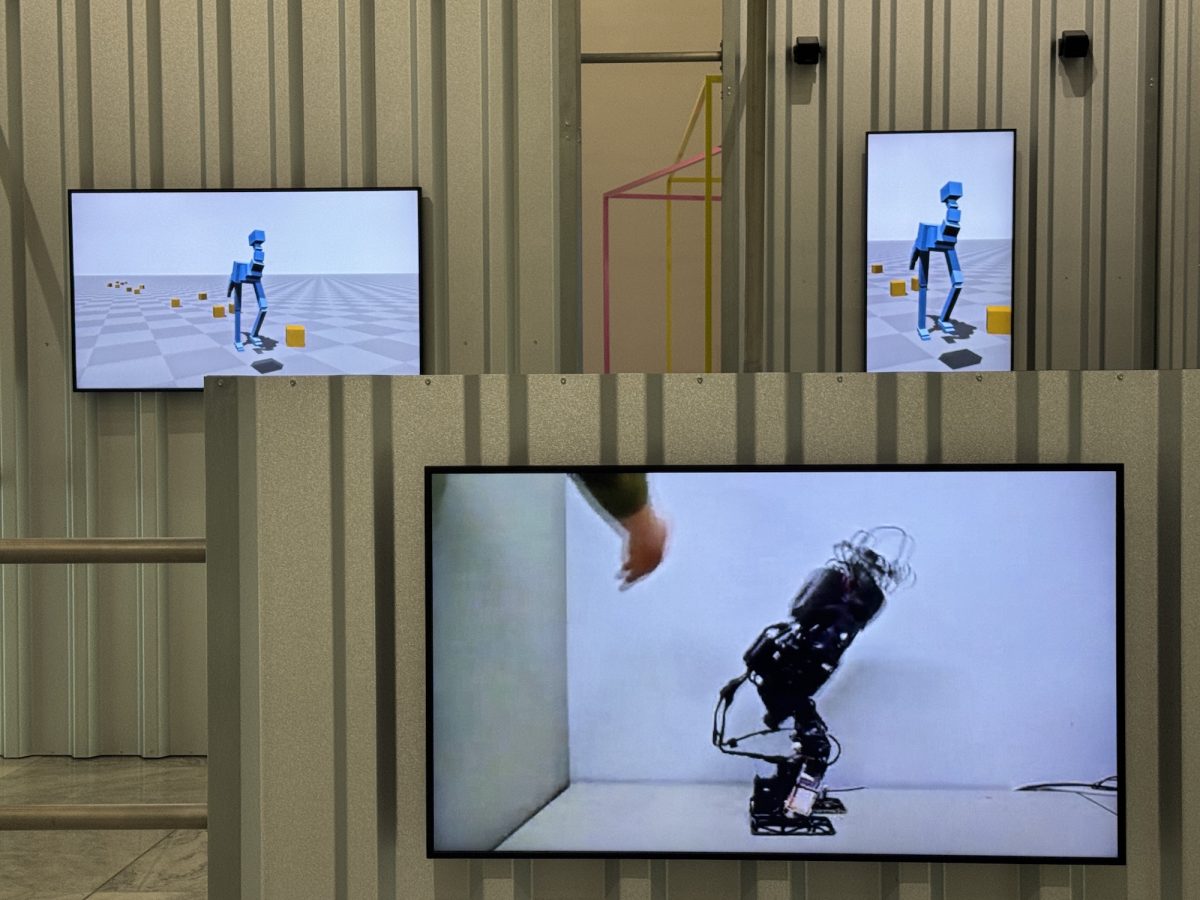
Next, you are immediately drawn into viddying (cf. A Clockwork Orange) multiple monitors in front of you depicting labs in which experimenters are testing the robots they are developing by kicking them over. This kind of violence against inanimate object that cannot feel has a visceral, mystifying effect. It reminds me of stories I hear about people trying to be polite to Amazon Alexa – in fact, I heard about someone who broke up with her partner because of their rudeness toward it. Kicking over robots will not hurt their feelings, but elicits the kind of reaction that sets the stage for the rest of the exhibition.
Hito Steyerl is prolific, having written several books over her long career. I won’t delve into all of it here, instead restricting the focus primarily to this exhibition.
For this review, I will follow David Berman’s philosophy:
I am trying to get at something so simple
that I have to talk plainly
so the words don’t disfigure it,
and if it turns out that what I say is untrue,
then at least let it be harmless
like a leaky boat in the reeds
that is bothering no one.
Wandering to a partly enclosed area to the left, you see a monitor portraying a destroyed, war-torn city. A child asks Siri questions: “Siri, who destroyed this city?” In typical, incompetent Siri fashion, the response is “I’m not sure whether I understand your question.” One of the most impressive aspects of this work is that I had no idea that it is a decade old. It goes without saying that works focused on technology, AI, robots, etc. tend to age poorly, and I had assumed the work was very recent. Much in the same way that the H.A.L. 9000 computer in 2001: A Space Odyssey turned out to be terrifyingly prescient, Steyerl probes how H.A.L.’s relative’s response to difficult questions/situations with banal platitudes and scare-quoted “misunderstandings.”
And then the pièce de resistance: you take a seat in a comfy golf cart and watch it all come together on a large screen in Mechanical Kurds – a play on words referring to the “Mechanical Turk,” a device invented in 1770 which purported to play chess without human involvement—but was actually powered by a person hidden inside. Mechanical Turk, importantly, is also the brand name used by Amazon for their data labelling/AI training platform. Now, Steyerl winks at us, the person behind the scenes is instead a Kurdish woman—whom we meet with her coworkers, labelling data.
The works string together disparate moments in our human existence that are worth unifying. The people working for Mechanical Turk and other machine learning training companies may not know what will be done with their work. Much like the unclear chatter in THX 1138 or the “mysterious and important” work in the show Severance, the implications are not immediately known. One scene even portrays the workers making guesses of the images the coworkers are seeing – is it in China? Germany? Switzerland? The US? Each coworker proffers a guess, stabbing for meaning.
The workers see a narrow slice of corporate requirements – “identify shampoo containers” – or the like. But as the work unfolds, it dawns on the viewer (with a grimace ranging from slight to stark) that these underpaid Kurdish employees in Iraq are a cog in the wheel of our late-stage, violent capitalist condition.
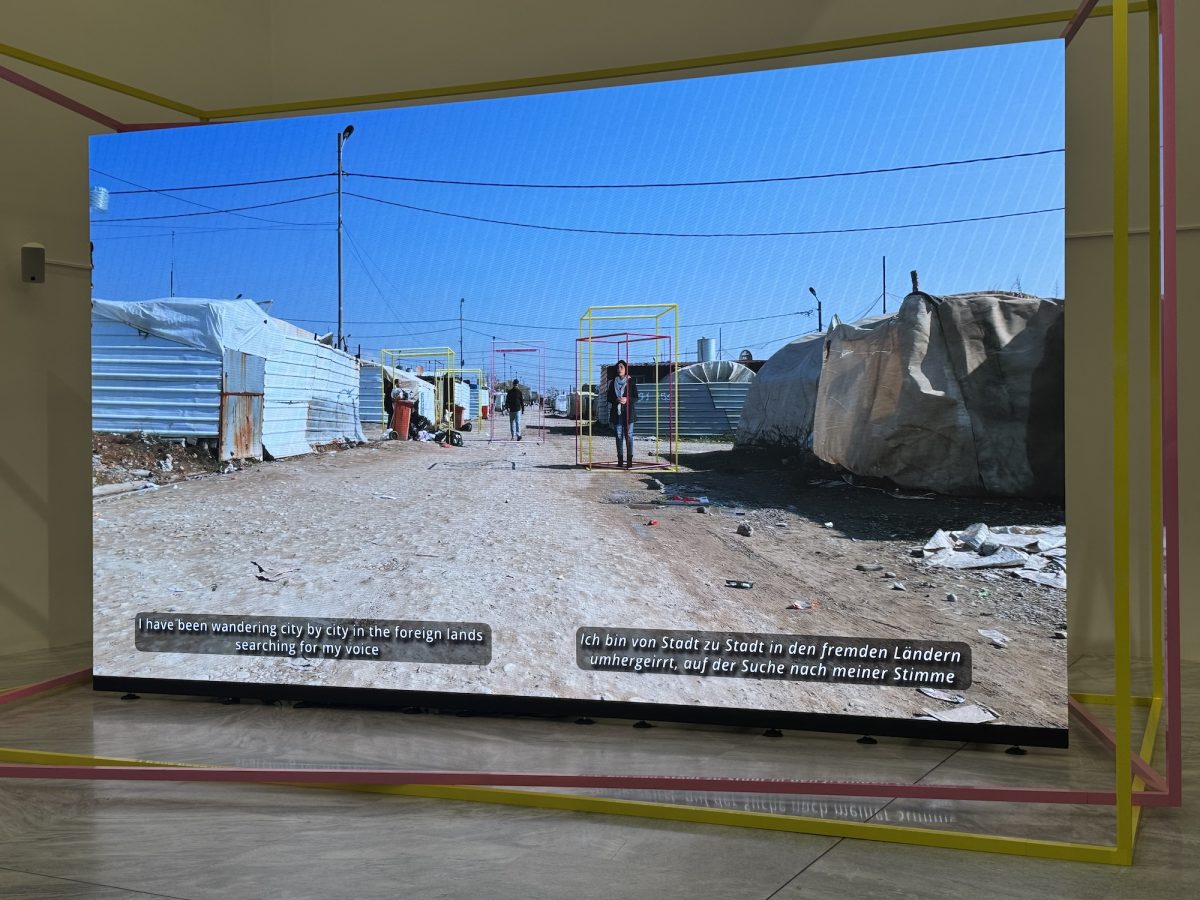
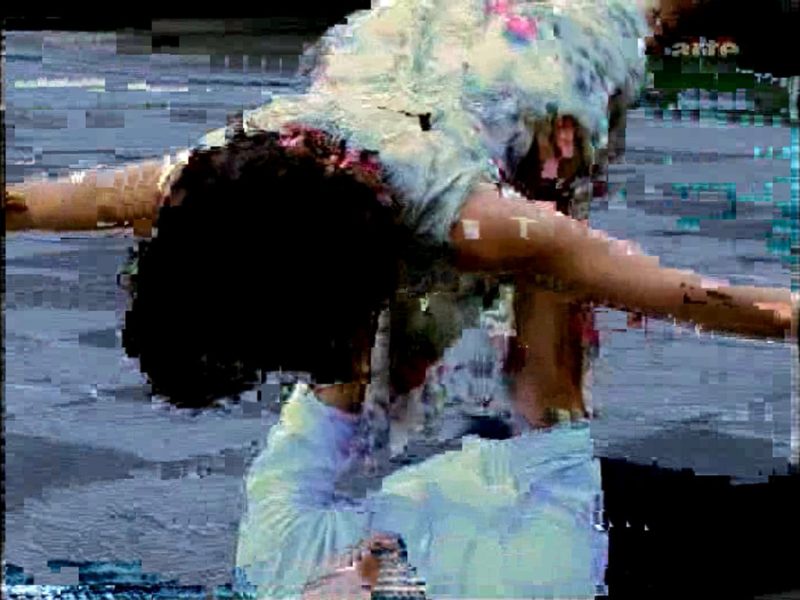
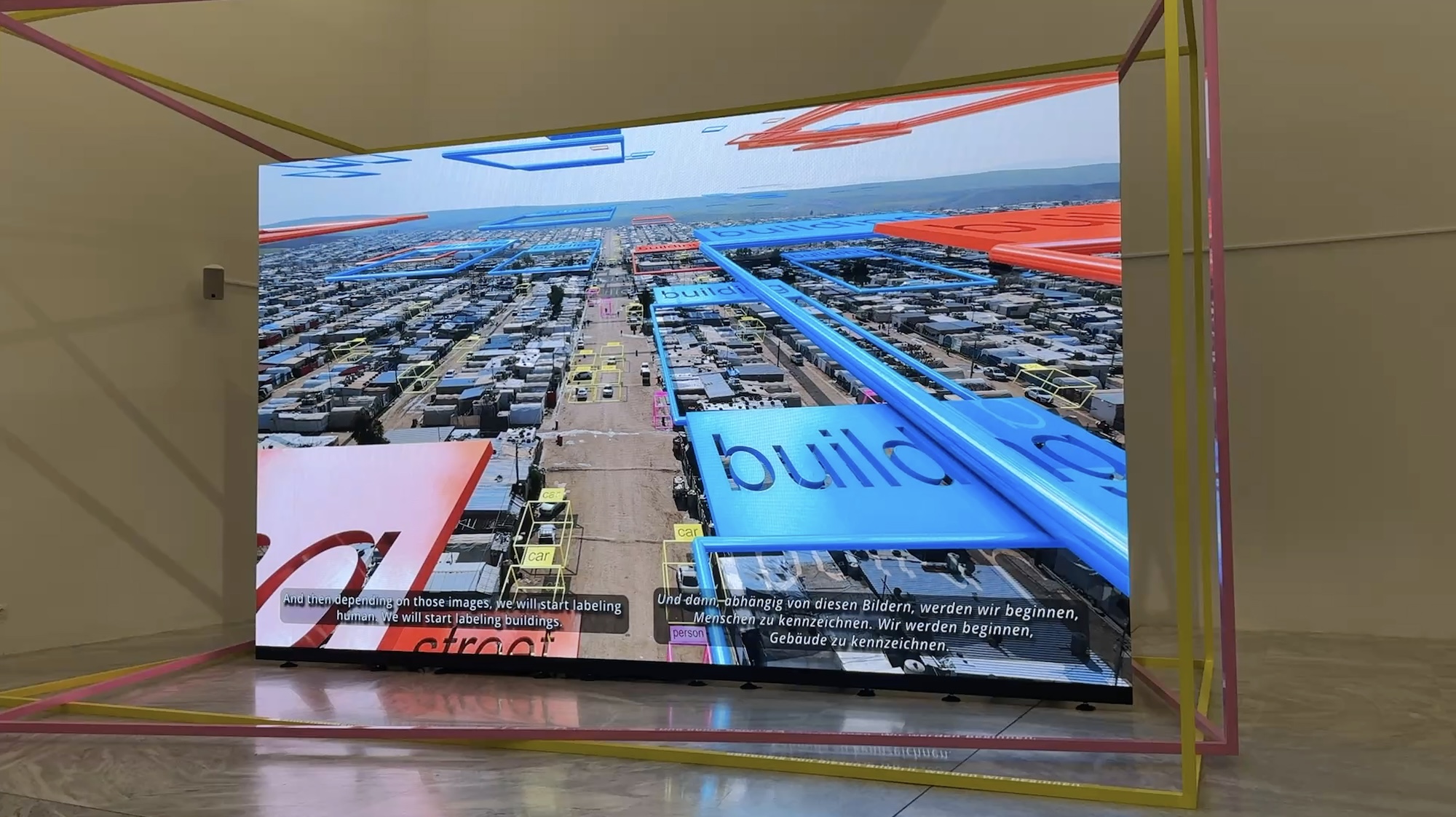
In Mechanical Kurds, Steyerl uses a visual device that is highly effective: taking the bounding boxes, well known to anyone who has dealt with AI training data (as I painfully did as a data scientist), and repurposing them, imbuing them with the life of a three-dimensional incarnation (shown above). Steyerl focuses on Kurdish women in northern Iraq, where who are hired to tag images for self-driving cars. Walking down the street in the film, we see three dimensional bounding boxes imprisoning people, vehicles, etc.
But the brilliance of this visual feat is that, in high definition video, Steyerl brings to life the relationships and individuals that are coolly “encoded” by AI. As the film smoothly traverses the street, a woman enclosed in a bounding box hauntingly sings to us as the training process—an inevitable juggernaut—proceeds apace, viciously encoding its surroundings in a way that will make it easy for a self-driving car – or a bomb-strapping drone – to perform its rigid mission effectively, efficiently, perhaps fatally.
Bringing the implications into focus, in one scene, an Iraqi Kurdish man describes being in his car when it is suddenly engulfed in flames. “Inside the car it all became dark and fire,” he says to us. He realises that he has been the victim of a drone attack by the Turkish government. (The topic is very personal to Steyerl, whose activist friend Andrea Wolf was killed in the Kurdish region of Turkey while fighting for the PKK.)
I previously worked as a technical consultant for Google Waymo, the self-driving car company. Mistakes always had the potential to escalate to deadly territory. It’s interesting, in a blood-chilling way, to explore the negative consequences of mislabelling data: Uber, a Waymo competitor, allegedly mislabelled a person as a plastic bag and ran over them, ending their entire self-driving car programme for years.
The exhibition is a perfect balance of provocation and nuance. The initial shock gives way to a realization that something substantive and important is being said about our times. This isn’t “art for art’s sake” or decorative blather. Fortunately, it also isn’t provocation for the sake of an eyebrow raise followed by a smh (even smdh) moment with some accompanying descriptive drivel. Steyerl masters the high and the low, the deep and the shallow. It’s a tight story largely without effluvia. I sense Jenny Holzer’s philosophy here: “…I want people to get what I put out, or at least be constructively mystified” (emphasis added for clarity).
Much more can be said about the exhibition – focusing on Marx’s alienation of workers from their work, Giorgio Agamben’s discussion of the state of exception and the homo sacer – a person who can be killed but not sacrificed, or what it is to be identified, bound, seen, surveilled, targeted. There are many directions of inquiry worthy of further consideration. Some of these topics I address in my own work, and it’s wonderful to see them handled so adeptly by Steyerl.
In all, the exhibition everything great art should be: informative, provocative, dark but also funny, yet overall nuanced and sometimes open to interpretation.
Rating: 5/5 voids
Hito Steyerl, Humanity Had the Bullet Go In Through One Ear and Out Through the Other – November 1st, 2025 MAK Museum
All Photos © Michael Garner