EAF 2025 presents a trio of international women artists who offer achingly tender, exquisitely evocative but fiercely powerful solo shows around the city.
Aqsa Arif, Raindrops of Rani @ Edinburgh Printmakers
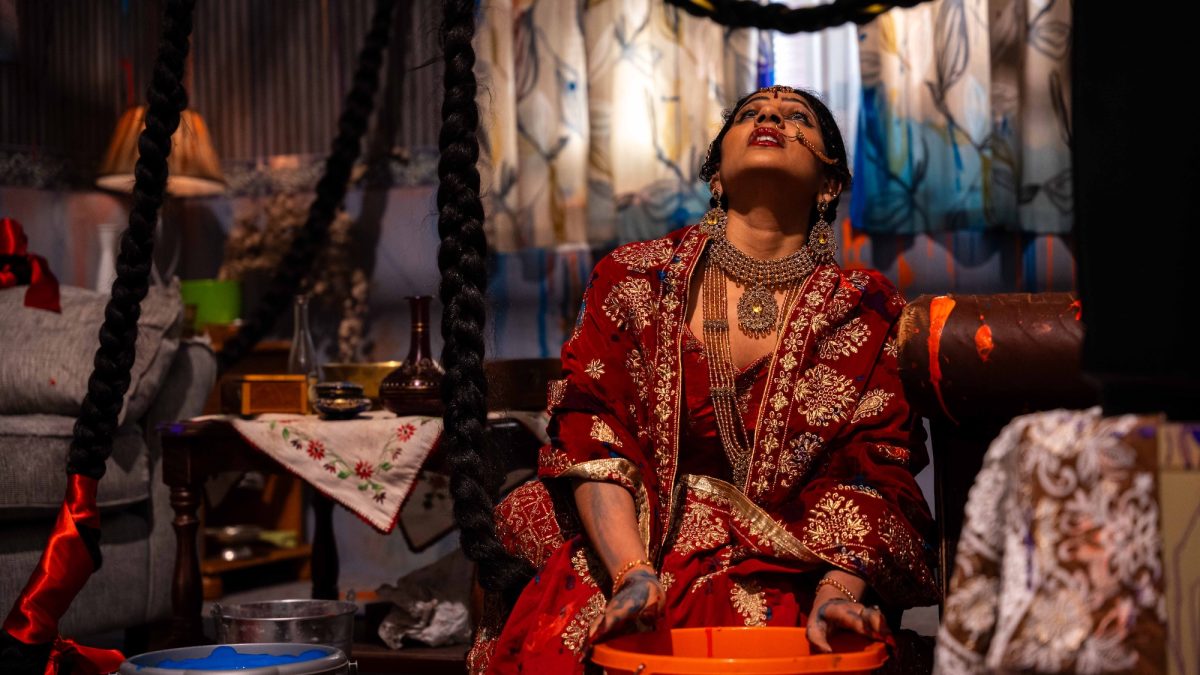
Central to Aqsa’s exhibition is a spectacular, surrealist and autobiographical film exploring her relationship with her mother and their experience as asylum seekers in Glasgow’s Southside.
After settling in Scotland, Arif and her mother were then displaced from their first home to create Jonathan Glazer’s £2 million Sony advertising campaign, a capitalist and callous eviction of marginalised groups for an advertising spectacle speaking very much to the experience of the powerless.
Arif reclaims frames of the advertisement and weaves them with a narrative inspired by a Punjabi love story. The story follows a mother (Heera) and daughter forced from their home by a flood (a flood of lurid paint- referencing the advert) and relocated in a council flat in Scotland.
The narrative traces each of their journeys in a land that ignores or rejects them. Their diverse experiences- the mother alone and struggling, clinging on to traditions such as hair oiling and braiding – her surrealist plait becoming longer and longer- entombing and paradoxically protecting her in their council flat, while the daughter attends school and is forced to assimilate and cut her hair to avoid the abuse ubiquitous to any ‘other’ in the system.
Adopting an ominous clown figure in reference to the name of the area – Prospecthill Circus- and the unnerving character from the paint advert- Arif highlights the fear andmuncertainty in seeking refuge but also the ridiculous nature of the immigration system asylum seekers must navigate.
Whilst presenting the challenges of her experience Arif also acknowledges the duality of reality and takes a “subversive approach to displacement by also viewing it through a lens of “resilience and reconnection”
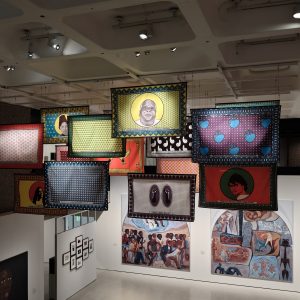
Adorning vividly painted walls (again reflecting the paint exploded onto the building after the family had left) are Arif’s striking sculptures. Like widows into a portal, they encapsulate images somewhere between dream, memory and the imagination. Encrusted with jewels, braiding and embroidery the printed textiles depict manipulated stills from the film and are framed with vibrant acrylic shapes mimicking the paint and traditional South Asian imagery.
Arif attributes the multimedia nature of her work to her hybrid identity and the place of imagination a way to explore reality. Perhaps this is best demonstrated in her sumptuous velvet curtain composed of a captivating, interwoven scene of tartans and figures from the film, Arif suggests a comfort and interplay in her two identities- each enhanced by the other. The sweeping image, mirroring the domesticity of the scenes in the film, swathes us in a darkness allowing us to reflect fully on Arif’s thought- provoking, physically and psychologically multilayered exploration of identity, displacement and family.
Aqsa Arif Raindrops of Rani at Edinburgh Printmakers Until November 2 nd 2025
Aubrey Levithal, Mirror matters @ Ingelby Gallery
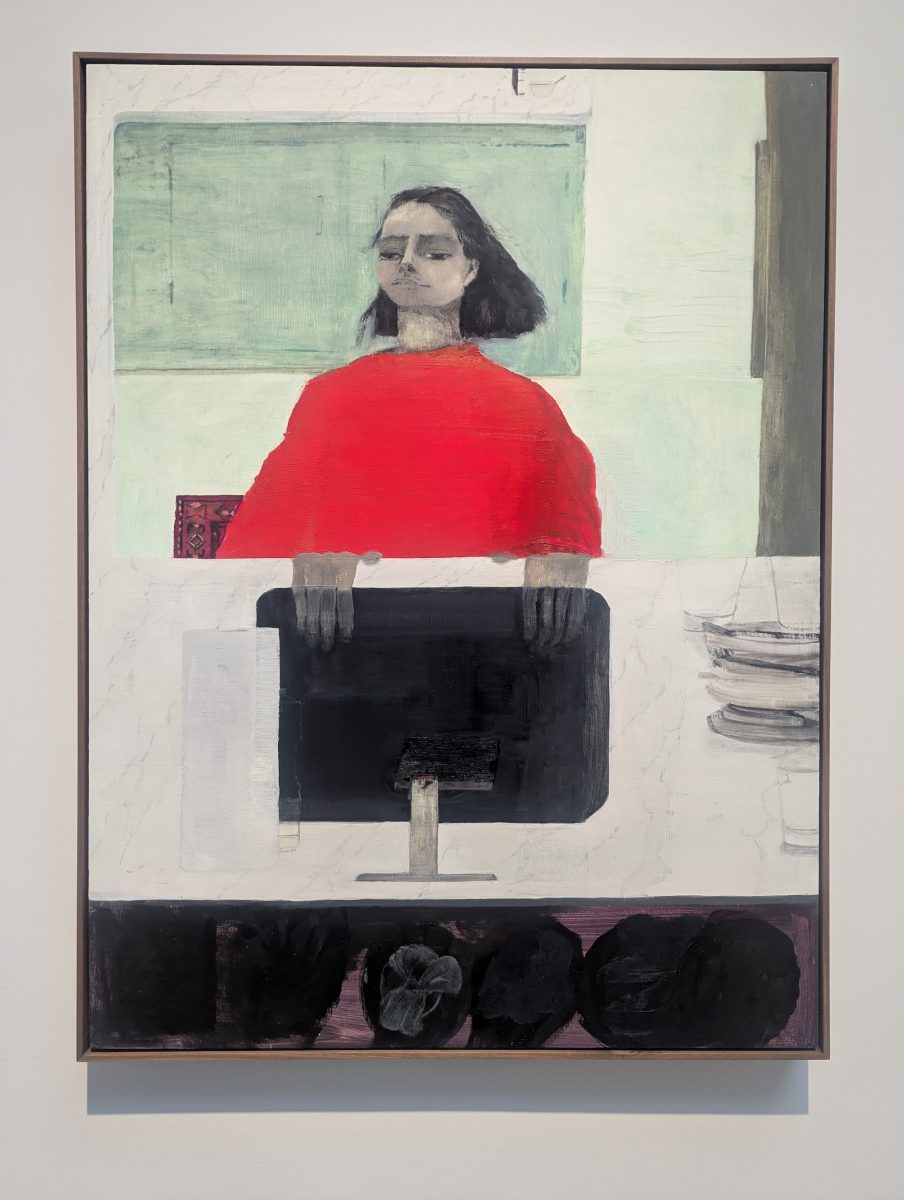
Across the city Pennsylvanian born artist Aubrey Levinthal also investigates motherhood, place and time in her first solo show at the Ingelby Gallery. On first glance Levinthal’s work seems to capture the everyday, the ordinary and the mundane. Jennifer Higgie titled her essay on the exhibition A Kind of Hush4 and this perfectly captures the stillness and silence conveyed in Levinthal’s monumental solo show at Ingelby Gallery. “A category A listed former place of worship” the history of the Ingelby also lends a solidity and tranquillity which commands a reverence of both the work and the setting. We are allowed time and space to slip into Levinthal’s world which on closer inspection is anything but mundane.
Given time, we enter an arresting universe of enlarged limbs, of dark shapes which could be laptops or sinks or stomachs, of reflections and distortions of reality and perspective which Levinthal uses to “better express the way [she] feels… in [her] own life” and to “talk about her experiences”. Talking of Late Table (2022) she explains that everything is seen from the perspective that serves it best.” A seemingly simple tenet but one which adopted universally could conceivably change the world?
Levinthal often references Bonnard when she talks about her work and like the French master’s paintings, inhabiting Levinthal’s experiences is akin to waking in a dream or a memory. Her thin washy application of paint, then scrapped back, the melting of a foot into a shadow, the way faces take on the colour of the backgrounds of her work, the confusion of the perspective all conjure up something otherworldly and simply magical that you cannot stop looking at.
Traditionally Levinthal is known for her muted tonal colours but in Mirror Matters she departs from this with remarkable success. The celebratory, cadmium red of Birthdays (2024) translates into a cautious warning in Sink Stomach (2021). I have to confess that I have a personal aversion to red in paintings- it generally makes me feel tense and I recoil from even the thought of it. But Levinthal has a way with colour and Sink Stomach (2021) was one of my favourite paintings in her show. Perhaps it has something to do with how “She questions how colour can “become, psychologically [her] own”. Another confession… I’m not entirely sure what she means by this but whatever she’s doing she certainly own it and it works.
Another favourite was Worry Woman (2025). The composition is daring. To put the figure and namesake of the title in a sliver at the top of the painting and fill most of the surface with acres of mauve quilt shows real thought and skill. The figure sit on the margins of the picture, suggesting she is a bystander to her life perhaps? She inhabits a darkness- a literal and psychological darkness? And in an act of kindness Levinthal gives us the gently sleeping old dog at the base of the bed like a guardian promising that everything will be ok- I hope.
Levinthal discusses the device of inserting large swathes of domestic space in-between living things as a way of suggesting the passing of time. Our eye must travel from something in the foreground to another in the background. And again, it’s a truly contemplative choice which make her paintings so intriguing and unique.
I could write forever: about her beautiful handling of motherhood, of her exciting inclusion of technology and introspective use of mirrors and reflection. But I will leave these things for you to discover as you should and must explore Levinthal’s work for yourself.
Aubrey Levinthal Mirror Matters at Ingelby Gallery Until 13th Sept 2025
Mercedes Azpilicueta, Fire on the Mountain, Light on the Hill @The Collective
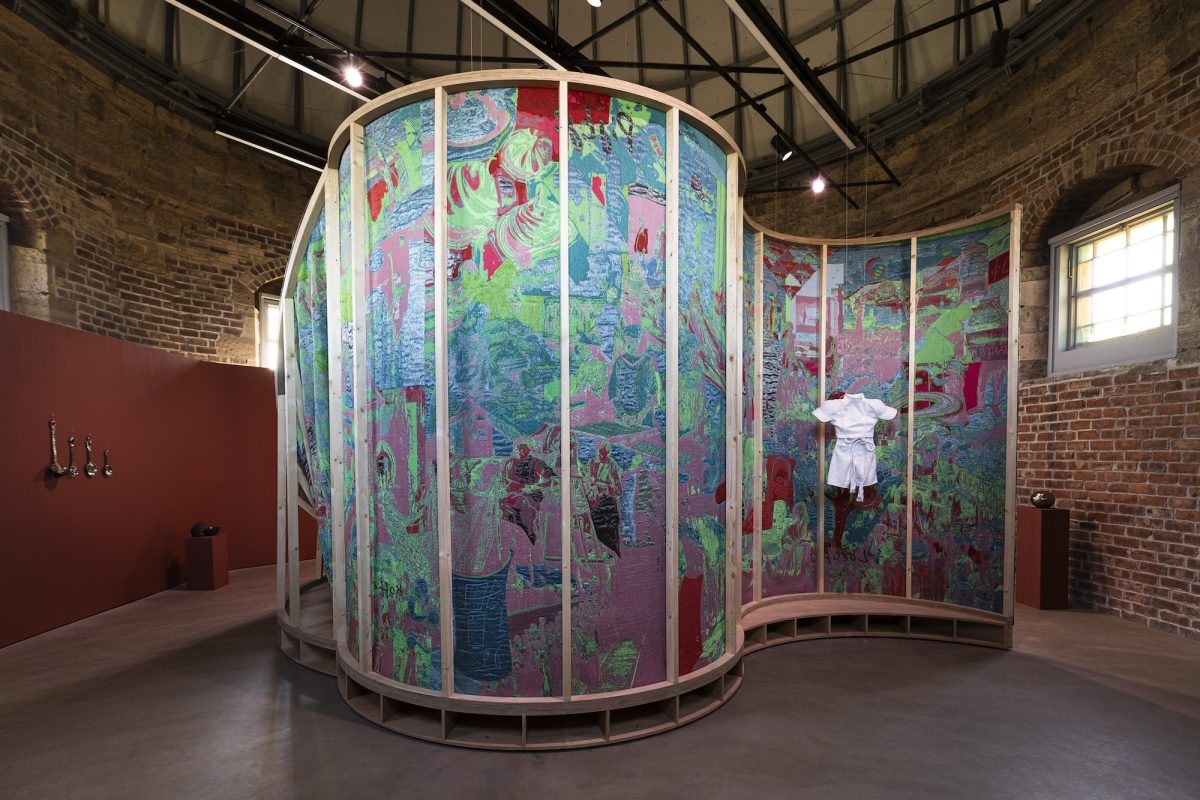
Finally, after a literal and metaphorical struggle up Carlton Hill I am rewarded with a compelling and poignant celebration of women past and present. Mercedes Azpilicueta shines a light on underrepresented stories and lights a fire for action in her site-specific response at Edinburgh’s Collective.
Reminiscent of a traditional mural, the softness of Azpilicueta’s jacquard tapestry, Potatoes, Riots and Other Imaginaries (2021) is a subversion of the cool permanence of a painting on concrete. It is a salute to women’s work- beautiful textiles and art with a purpose, often undervalued as a mere ‘craft’ – and the women who created these. The gentle curve and rippling swathe of the fabric offers comfort and an embrace, it mirrors the curves of the female form and the circular shape of the City Dome only serves to enhance the tender wave of the tapestry, the historic nature of the space reflecting the work’s ties to the past.
In a reverential celebration of the process, and construction of the frame that supports it, the woodwork is open to reveal the hidden work and forgotten labour of the weaving.
This too is a central theme which is reflected in the research and imagery of Azpilicueta’s work. The first being a commemoration of the 1917 potato riots which took place in the artist’s adopted home in the Jordaan, Amsterdam. In an act of care, resistance and a demonstration of power, women rioted against the authorities during WWI when they exported potatoes whilst their families starved. Despite being over 100 years ago Azpilicueta explains the importance of this history in conversation with curator Sorcha Carey saying “Histories play a role in how I encounter what surrounds me”.
The composition weaves together these archival images of women protesting and Azpilicueta’s own documentation of her involvement with the Ni Una Menos (‘not one less’) collective in her home, Argentina. For me, one of the most striking and affecting images is the screen shot from 2020 celebrating the new abortion law- the juxtaposition of this freedom with the regression of women’s rights internationally, in just 5 years, is devastating, to say the least.
We also get a sense of who Azpilicueta is as a person when she includes an image of herself and a technician creating the work together. She is someone who cares about the past, someone who acknowledges the hidden work of others and who fights for the rights of others. Of course, there is the argument of should we separate the work from the creator, but we really don’t need to consider this when the artist seems such a genuine and considerate soul.
The use of textiles continues in the costumes she created with artist Anna Leoni Klas. Tying in with the theme of care and labour they are created with domestic items such as dish cloths and make up sponges. These intelligent and witty collaborations also reference the bringing together of the past and the present, asking us to look closely at their construction and references. A traditional looking bonnet is created from a baseball cap and a soft white outfit alluding to care and purity, borrows structural
elements from military uniform subverting our initial reading completely.
Oversized tools nod to the care of food and serving others but the torturous claw-like end to one of these ‘utensils’ is akin to a weapon and reminds us of the power and strength of women and how they have consistently demonstrated this over the years.
The final collection of costumes could at once be a child’s space pack, cobbled together from the fabric scraps and a very glamorous gardening ensemble but clearly reference Azpilicueta’s designs for “practical tools for protest, doubling up as carriers for belongings and supplies.”
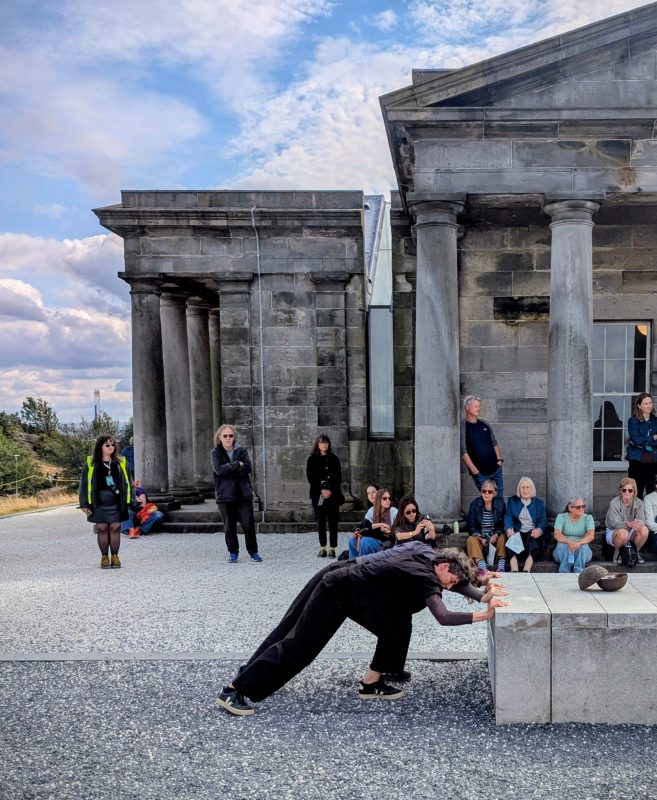
Fire on the Mountain, Light on the Hill not only gives us hope in stories of struggle and triumphs of the past but she also gives us tools for the battles that we are yet to face. The light and fire Azpilicueta brings to Edinburgh this year will continue to burn long beyond the exhibition’s run at EAF. All that remains to be seen is what the costumes and tools will bring in the live performance on the 22nd August.
Mercedes Azpilicueta Fire on the Mountain, Light on the Hill at Collective until 7th Sept 2025