Hilary Lloyd will present a major new commission that considers the scope and spirit of the trailblazing playwright, television dramatist and writer Dennis Potter (b 1935–d 1994).
Lloyd’s layered installation will combine audio-visual elements with archival materials and performative interludes, staging a non-linear encounter with Potter’s work for and on television. Engaging with the themes, confrontations and atmospheres that defined Potter’s work, the exhibition will navigate his explorations of chronic illness, death, sex, abuse of power and class.
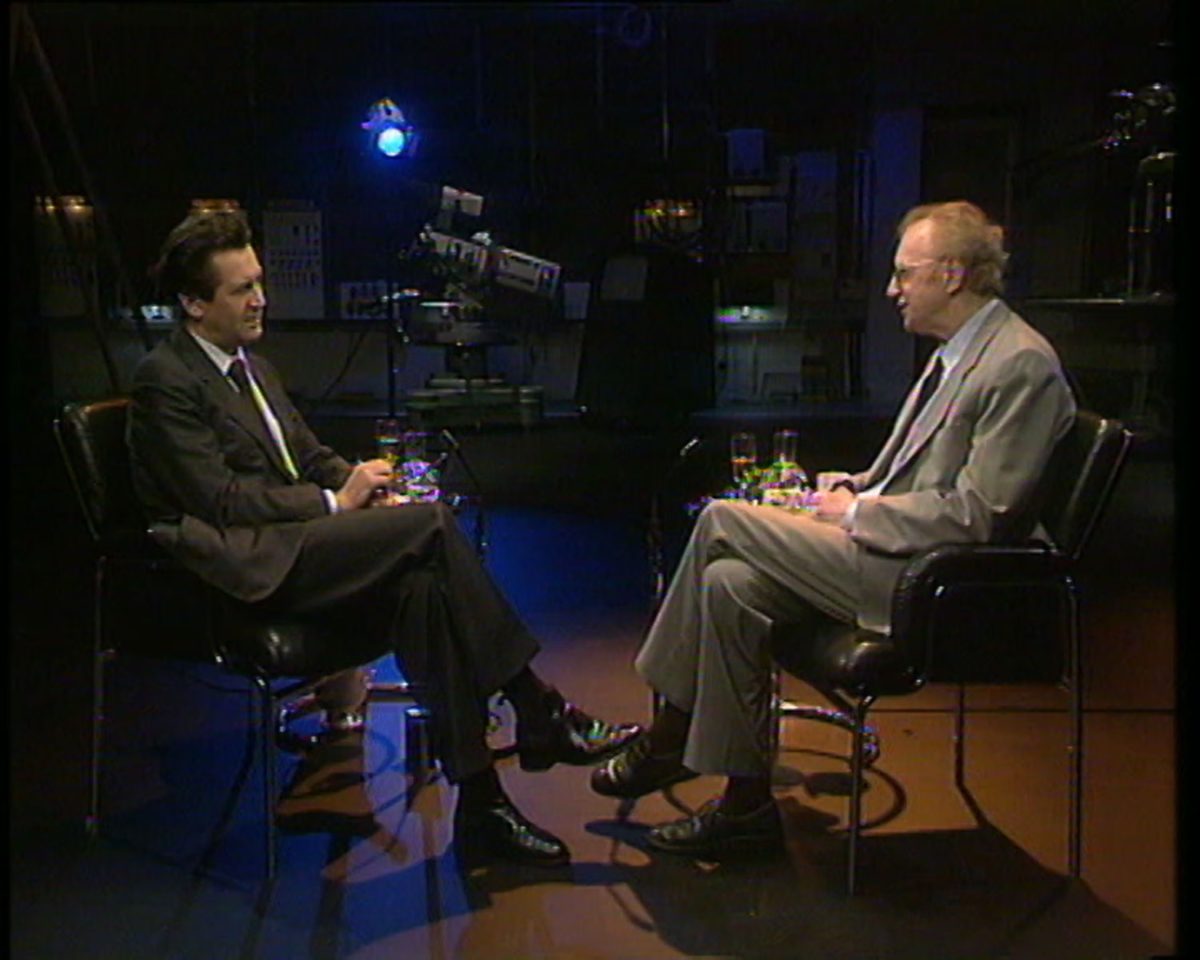
Key to Lloyd’s exhibition is a new series of short films featuring actors, producers and collaborators connected to Potter’s work and life. A film with broadcaster Melvyn Bragg explores Potter’s ‘final interview’ (conducted by Bragg), which originally aired on Channel 4 just weeks before his death in 1994. Bragg reflects on the extraordinary interview, which examined the 1945 post-war settlement, the impact of media on democracy and Potter’s own mortality. More than thirty years later, the interview’s analysis of public life and political discontent crackles with prescience.
In another, producer Ken Trodd, Potter’s most significant collaborator, reflects on their 30- year relationship. These conversations and filmed vignettes form an impressionistic biography of the dramatist, shaped through Lloyd’s distinct lens. Potter has been lauded as Britain’s most pioneering playwright, television dramatist and writer. Best known for his TV serials, his Brechtian techniques brokered a Hilary Lloyd, work in progress, 2025.
Potter has been lauded as Britain’s most pioneering playwright, television dramatist and writer. Best known for his TV serials, his Brechtian techniques brokered a meaningful and daring relationship between experimental theatre and television. Challenging the then-dominant naturalism of terrestrial television dramas, Potter successfully pioneered a multitude of dramatic devices to blur fantasy and reality, including intertwined flashback and fantasy sequences, direct-to-camera address, lip-syncing, musical interludes and the use of adult actors to play children. Although celebrated for his creativity as a screenwriter and journalist, Potter’s work and personal life were not without controversy and several of his screenplays were banned by the BBC for decades.
Constructing an environment that reinterprets Potter’s impact and influences, Lloyd’s exhibition will encompass a broader installation that draws from theatre sets and studios. In an attempt to avoid conventional approaches to dramaturgy and performance, her installation will resist standard notions of narration. Instead, the exhibition will function as a tableau to be encountered, placing the audience within a choreographed experience.
A second installation will explore Potter’s life as a public performer and intellectual, including Alan Yentob’s 1987 BBC Arena documentary, a 1977 interview with Ludovic Kennedy and Potter’s first-ever television appearance in the 1958 documentary Does Class Matter?.
The accompanying screening programme includes his earliest dramas for the BBC’s Wednesday Play and Play for Today series and his most celebrated TV serials The Singing Detective (1986), Pennies from Heaven (1978) and Lipstick on Your Collar (1993) alongside the television plays Blue Remembered Hills (1979) and Brimstone and Treacle (1976).
Lloyd’s exhibition and accompanying public programme offer an opportunity to critically reflect on Potter’s enduring relevance to contemporary culture. Potter’s formidable influence across theatre, media, art and popular culture from Twin Peaks (1990) to Mad Men (2007) appears indivisible from his belief that television could be a powerful vehicle for artistic expression.
As Potter said in his 1993 James MacTaggart Memorial Lecture,
“Here was a medium of great power, of potentially wondrous delights that could slice through all the tedious hierarchies of the printed word and help to emancipate us from many of the stifling tyrannies of class and status and gutter-press ignorance.”
Joe Scotland, Director of Studio Voltaire, says,
“Lloyd is uniquely positioned to unspool Potter’s relevance and legacy for contemporary audiences. We share a long fascination with Potter’s work and the surreal, genre-blurring qualities and dramatic devices he pioneered, tackling darkly challenging themes on a mass audience platform.”
Hilary Lloyd, Very High Frequency, 10th September 2025–11th January 2026 Studio Voltaire
Dennis Potter Screening Programme at Studio Voltaire: INFO
Nicola Wright, Curator (Exhibitions) leads an introduction to Hilary Lloyd’s Very High Frequency, discussing the context and development of the commission alongside Dennis Potter’s legacy and work for television. INFO
About the artist
Hilary Lloyd (b. 1964, Halifax, England) lives and works in London. With interests in architecture, fashion, textiles and colour, Lloyd’s work centres on film and video whilst also invoking sculpture, painting and installation. Engaging directly with their sites of production or of exhibition making, the films resist conventional notions of ‘duration’, instead representing filmic tableaux’s to be encountered. Some are almost devoid of movement or incident, while others employ a rapidly panning or shifting point of view. The work involves a tension between an ambiguous, seemingly casual subject matter and a precise arrangement of images and installation equipment.