

Tate Modern presents Europe’s first major solo exhibition dedicated to one of the most extraordinary figures in international contemporary art, Emily Kam Kngwarray (c.1914-1996). A senior Anmatyerr woman from the Sandover region in the Northern Territory of Australia, Kngwarray translated her ceremonial and spiritual engagement with her ancestral Country, Alhalker, into vivid batik textiles and monumental acrylic paintings on canvas. Taking up painting in her 70s and devoting her final years to creating a large body of art, Kngwarray forged a path for Aboriginal and Torres Strait Islander artists, women artists and Australian artists, and continues to entice audiences around the world three decades after her passing. Organised in collaboration with the National Gallery of Australia, this extensive survey brings together over 80 works from across her extraordinary career. Showing many pieces outside Australia for the first time, the exhibition offers European audiences a once in a lifetime chance to experience Kngwarray’s powerful batiks, paintings and vibrant legacy.
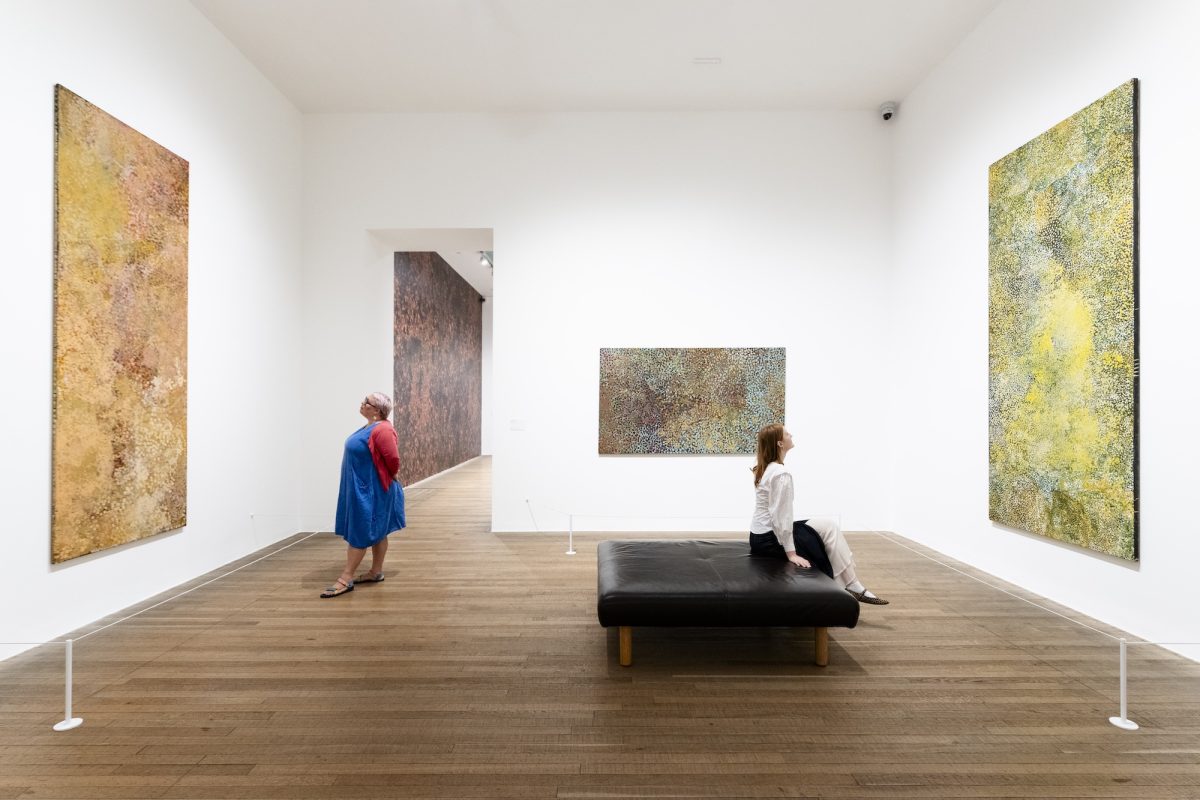
Kngwarray began experimenting with new art media at Utopia Station in the 1970s. After learning the technique of making batik, in the late 1980s she transitioned to painting in acrylic on canvas. Her practice was shaped by her intimate knowledge of her Country and by her role in women’s ceremonial traditions of ‘awely’, which encompass song, dance and the painting on bodies with ground ochres. She sat on the ground when she painted, much in the same way she would sit to prepare food, dig yams from the earth, tell stories by drawing on the sand or ‘paint up’ for awely ceremonies. Her deeply personal approach to painting was developed in isolation from the European and North American artistic practices of her time. This exhibition will present Kngwarray’s work through the lens of her own world, showcasing her as a matriarch of her community, storyteller, singer, visual artist, and custodian of Country.
Encapsulating the ecology of her homeland, Kngwarray’s work features motifs derived from native plants, animals and natural forms. She regularly depicted the pencil yam (anwerlarr) and its edible underground tuber and seedpods (kam), after which she is named, as well as the emu (ankerr), reflecting the animal’s significance to Aboriginal Peoples. The exhibition opens with three acrylic paintings acquired for Tate’s collection in 2019 – Untitled (Alhalker) 1989, Ntang 1990, and Untitled 1990 – featuring densely layered fields of dots representing native seeds. These are accompanied by Awely 1989, inspired by designs women paint on each other’s bodies before performing awely. Two of Kngwarray’s early batiks join Emu Woman 1988, her first ever work on canvas that attracted widespread national attention. These introductory rooms trace the evolution of the artist’s visual language, grounded in her detailed knowledge of the desert ecosystems of Alhalker.
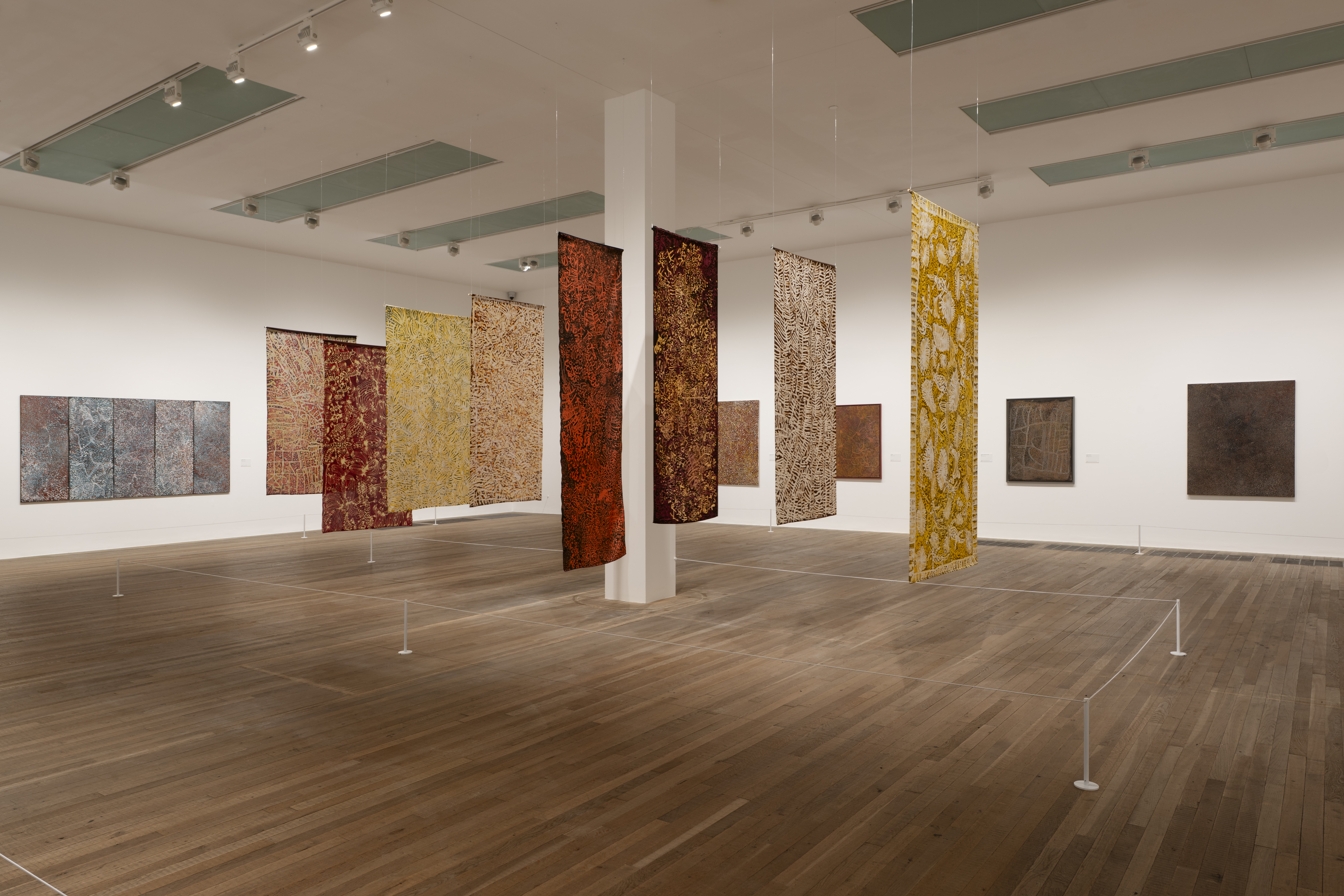
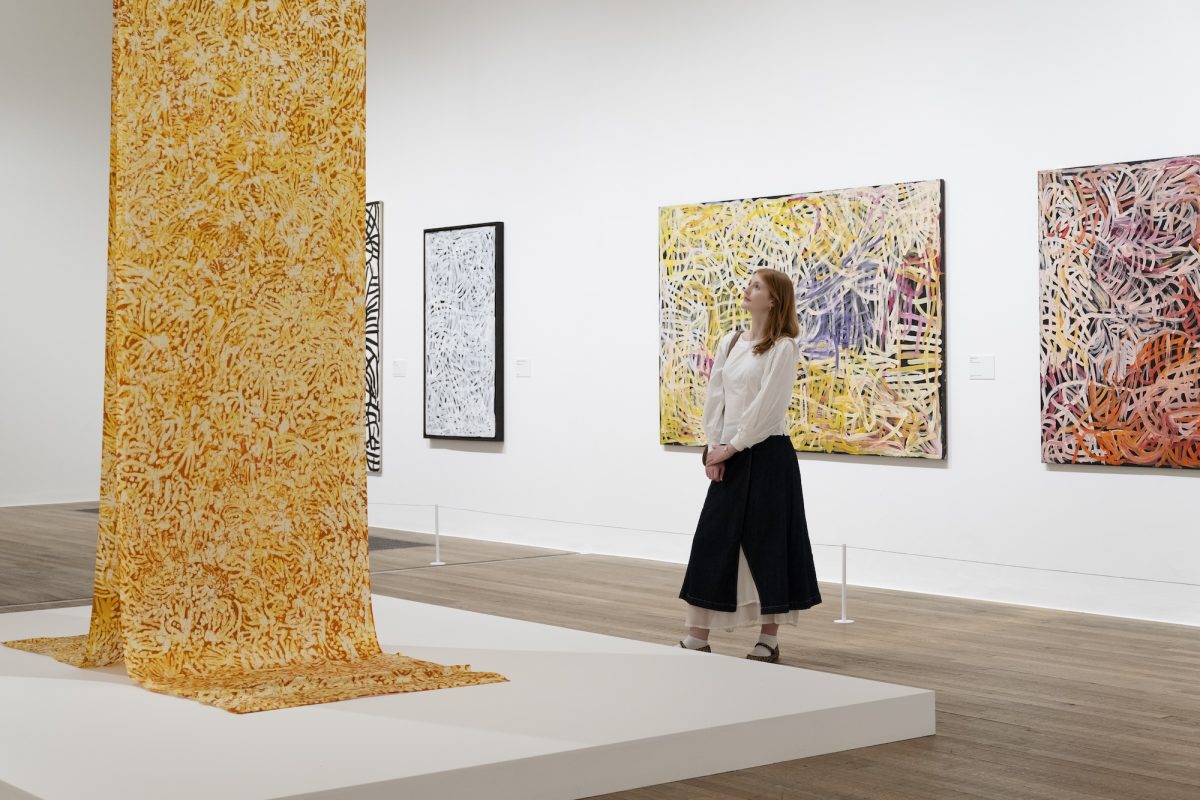
Works from the early phase of Kngwarray’s painting career are shown alongside a striking display of batiks on silk and cotton that hang from floor to ceiling and immerse visitors in the artist’s vivid evocations of her Country. These works are often rooted in the Dreaming (Altyerr), the eternal life force that created the land and its myriad living forms and defined the social and cultural practices of people. Ntang Dreaming 1989 depicts the edible seeds of the woollybutt grass (alyatywereng), while Ankerr (emu) 1989 maps a path of emu footprints travelling between water sources. Larger canvases, including the three-metre Kam 1991, demonstrate how Kngwarray began working on monumental paintings and employing a brighter colour palette.
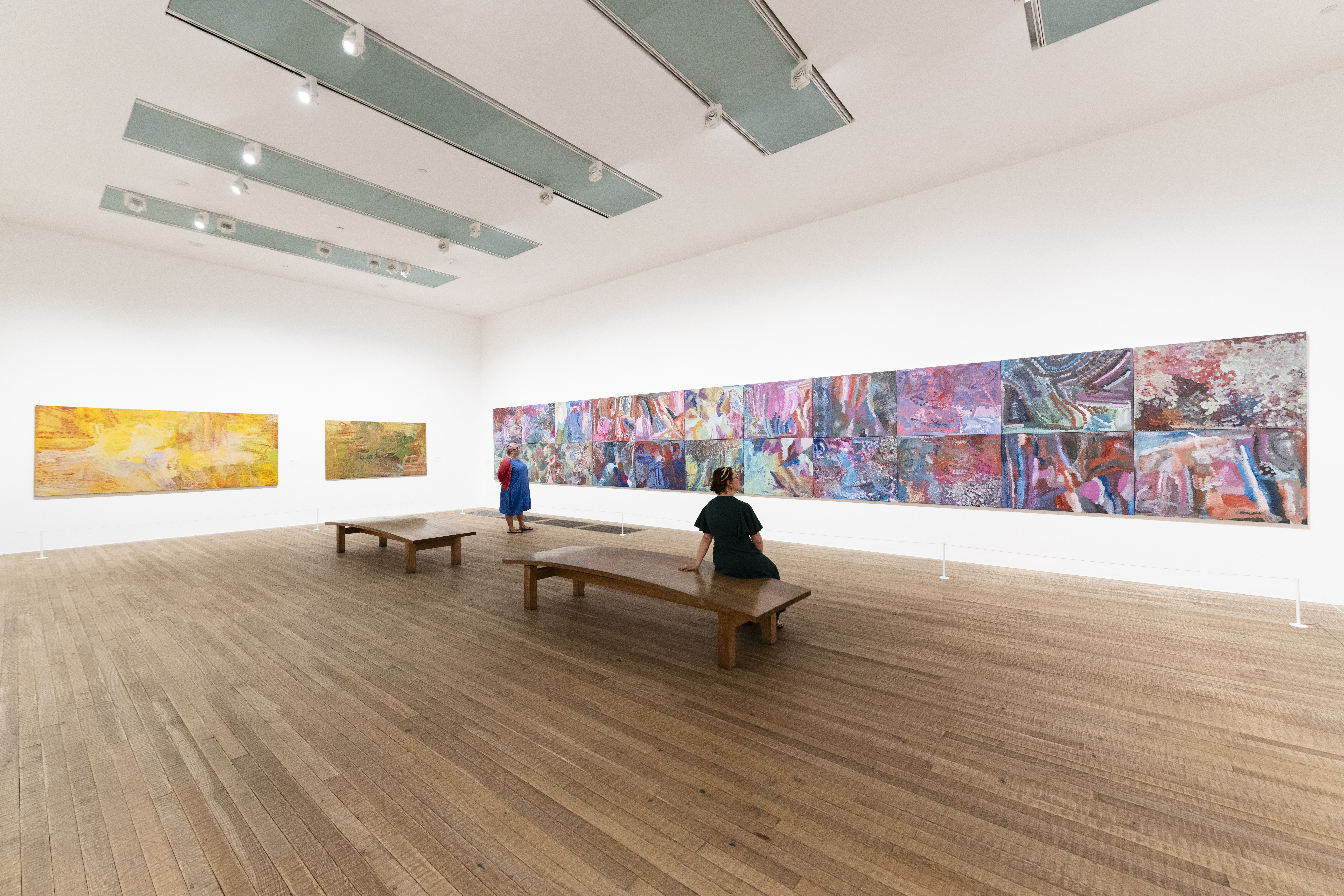
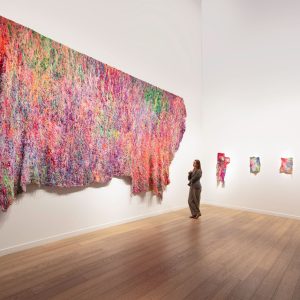
At the heart of the exhibition is The Alhalker Suite 1993, one of Kngwarray’s most ambitious works on loan from the National Gallery of Australia. Produced at the height of her painting career, it offers a vibrant portrait of Alhalker Country across 22 canvases. Revealing Kngwarray’s broadened colour spectrum and techniques, bright pastel pinks and blues evoke the wildflowers which carpet the landscape after rainfall, and collections of merging dots represent the rockfaces and grasslands of Alhalker. The artist did not impose any limitations for the configuration of the panels, so a new way of seeing her land is possible each time the work is displayed- an ongoing reminder that the stories and places she painted are very much alive.
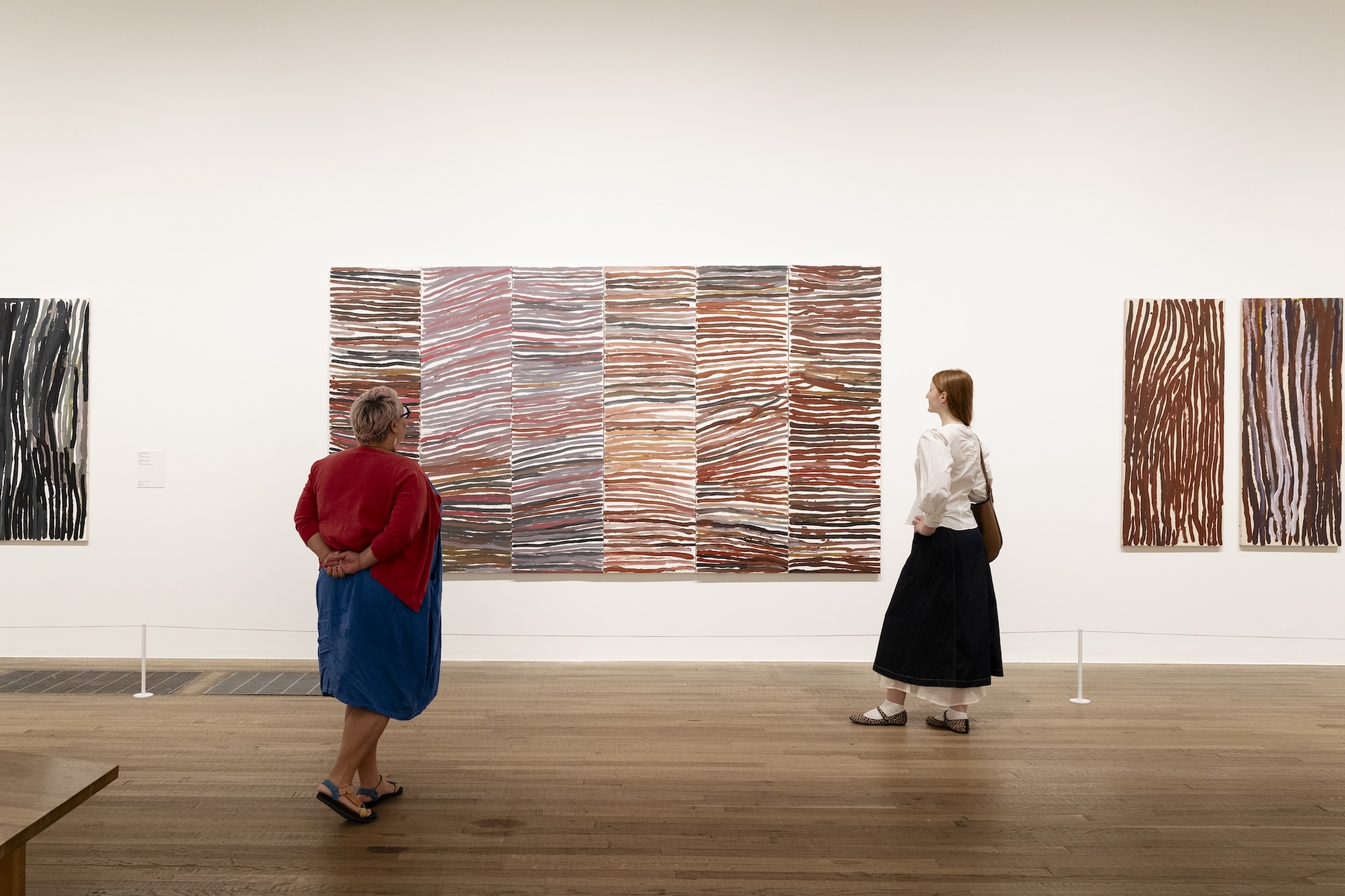
In her final years, Kngwarray made an abrupt stylistic change, creating a suite of works comprising bold parallel monochrome lines in her familiar palette of reds and yellows, painted on white paper or canvas. Tate Modern presents Untitled (Awely) 1994, a six-panel work originally shown as the centerpiece of the Australian Pavilion at the 1997 Venice Biennale. The evident tactile quality with which Kngwarray applied the paint evokes the gesture and intimacy of painting on the body for awely ceremonies. Moving away from lines and dots during this late period, Kngwarray developed gestural paintings with fluid brushstrokes that burst with energy. Closing the exhibition, Yam Awely 1995 with its intricately painted twists of white, yellow and red intertwined with linear markings of grasses, yams, roots and tracks signifies the timeless connection between Kngwarray and her Country.
Curated by Kelli Cole, Director of Curatorial & Engagement, National Aboriginal and Torres Strait Islander Art Gallery of Australia project, with Kimberley Moulton, Adjunct Curator, Indigenous Art, Hyundai Tate Research Centre: Transnational; Charmaine Toh, Senior Curator, International Art, Tate Modern; Genevieve Barton, Assistant Curator, International Art, Tate Modern and Hannah Gorlizki, Exhibitions Assistant, Tate Modern.
Emily Kam Kngwarray, 10th July 2025 – 11th January 2026 Tate Modern
Following its presentation at Tate Modern, the exhibition will tour to Fondation Opale, Switzerland in a new iteration developed in collaboration with curator Kelli Cole.
Emily Kam Kngwarray is presented in The Eyal Ofer Galleries. The exhibition is in partnership with the National Gallery of Australia and Wesfarmers Arts. Further lead support from Fondation Opale. With additional support from Bloomberg Philanthropies. Also supported by the Emily Kam Kngwarray Exhibition Supporters Circle, Tate International Council, Tate Patrons, Tate Americas Foundation, National Gallery of Australia Foundation and Tate Members.
Research supported by Hyundai Tate Research Centre: Transnational in partnership with Hyundai Motor.
Exhibition organised by Tate Modern and the National Gallery of Australia based on an exhibition curated by Kelli Cole, Warumungu and Luritja peoples and Hetti Perkins, Arrernte and Kalkadoon peoples.
About
The National Gallery, Australia’s national visual arts institution, is dedicated to collecting, sharing and celebrating art from Australia and from around the world. The national collection is the most valuable collection of art in Australia and comprises over 155,000 works of art, including the world’s largest collection of Aboriginal and Torres Strait Islander art. From its origins in 1914 as a Western Australian farmers’ cooperative, Wesfarmers has grown into one of Australia’s largest listed companies. The National Gallery of Australia and Wesfarmers Arts have built Australia’s pre-eminent First Nations Arts Partnership over the last 15 years, supporting and celebrating Aboriginal and Torres Strait Islander art, artists and culture through education, public programming, international and national exhibitions. Wesfarmers Arts has generously supported the Emily Kam Kngwarray exhibition at the National Gallery of Australia in 2023/24 and Tate in 2025.
Established in 2018 in Lens/Crans-Montana (Switzerland), Fondation Opale is the only contemporary art centre dedicated to the promotion of Indigenous Australian art in Europe. It strives to facilitate dialogue between peoples and cultures through art. The foundation is based on the Collection Bérengère Primat, including 1,900 works by more than 440 artists, making it one of the most important collections of contemporary Aboriginal artworks in private hands.
Over the past, two decades Tate’s collection, displays and programmes have expanded beyond Europe and North America to be more open, inclusive and reflective of its audiences. Hyundai Tate Research Centre: Transnational marks a next step on this journey by placing the exchange of ideas between art and artists from around the world at the very core of Tate. The Centre’s vision is to offer new perspectives on global art histories, transforming how Tate develops and shares knowledge about multiple art histories with individuals and organisations around the world. It has supported key scholarship ahead of Tate Modern’s Emily Kam Kngwarray exhibition, including new research from Kimberley Moulton, Adjunct Curator, Indigenous Art (Hyundai Tate Research Centre: Transnational) looking at Indigenous Australian art with key themes of transnational kinship and new readings of Indigenous art. The Centre previously supported research towards a free exhibition A Year in Art: Australia 1992, in which Emily Kam Kngwarray’s works were central. Upcoming events throughout 2025 will profile Kngwarray and Indigenous art more broadly, focusing on Indigenous perspectives around embodied knowledge and futurisms – more information on further research events including annual symposia, seminars, performances and workshops at Tate and beyond can be found at tate.org.uk/transnational. Hyundai Motor’s support for the Centre began in January 2019, in addition to their support of Tate Modern’s annual Hyundai Commission.
Emily Kam Kngwarray Edited by Kelli Cole, Hetti Perkins and Jennifer Green Hardback £40; Paperback £32 A large scale publication accompanying a major exhibition celebrating the monumental art of Emily Kam Kngwarray. Based on the original publication by the National Gallery of Australia, this generously illustrated edition brings together Kngwarray’s most significant works and includes archival material and a visual record of community consultations and visits to her Country. Featuring additional contributions from Stephen Gilchrist, Kimberley Moulton, Judy Kngwarray Greenie, Jedda Kngwarray Purvis, Jennifer Kngwarray Purvis, Josie Petyarr Kunoth, Barbara Kngwarray Long, Melissa Kngwarray Long, Patsy Kemarr Long, Sophia Lunn, Chrischona Schmidt, Dylan River and Brenda Thornley.