Estimate: £1.5-2 million
Oasis to headline Sotheby’s major June sales-
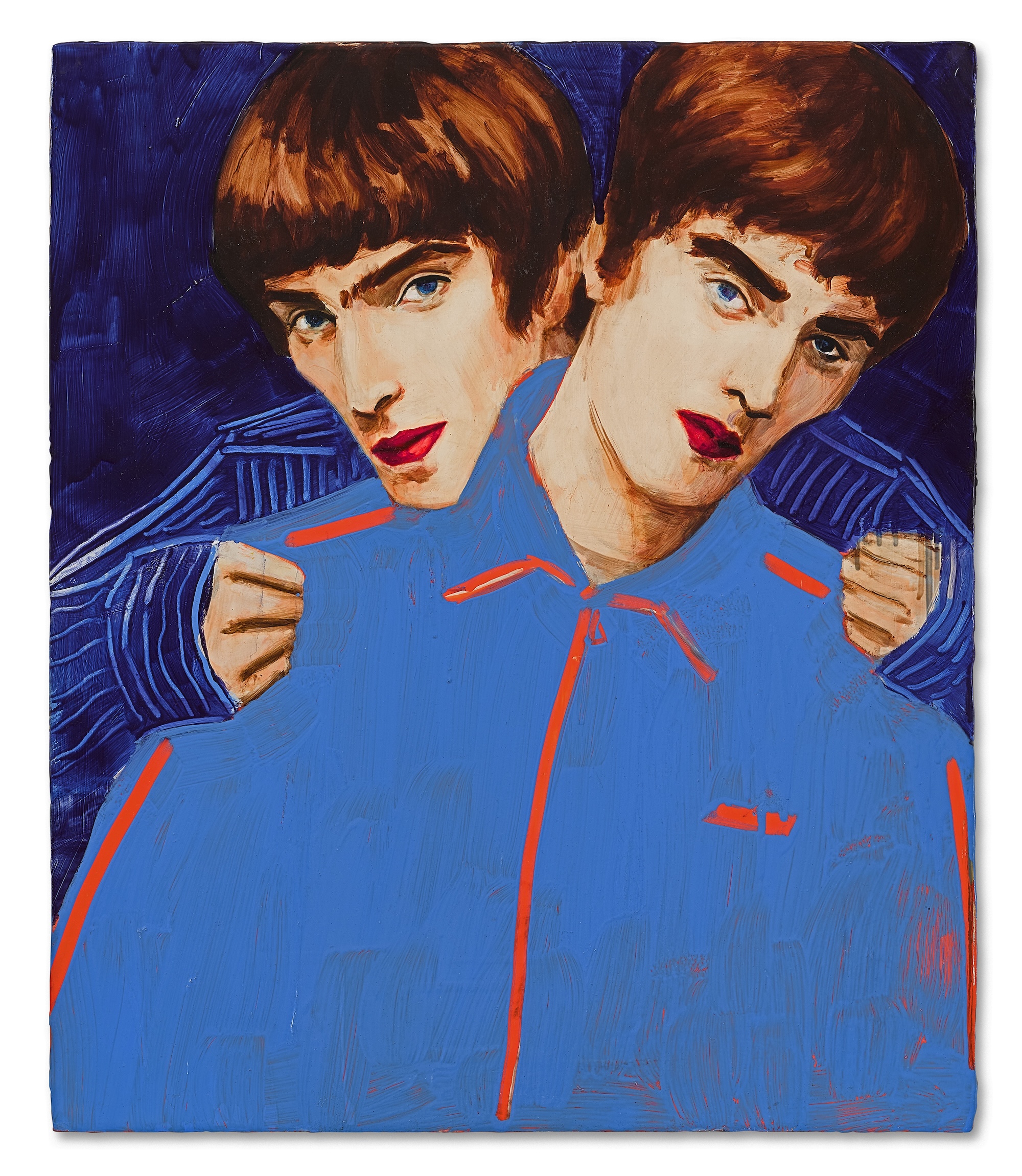
As Oasis’ summer tour is set to reignite full-blown Britpop mania a portrait of the Gallagher brothers is set to highlight Sotheby’s major June sales.
The work in question is by Elizabeth Peyton and stands amongst the largest and certainly the most accomplished of her Gallagher portraits. (There are four portraits of the brothers together in total, one of which resides at SFMOMA, and some individual portraits too, including Liam which sold for $4.1m, an auction record for Peyton, last Nov.)
Liam + Noel (Gallagher) will be offered at £1.5-2m – among the highest estimates ever placed on a work by Peyton.
Elizabeth Peyton’s electric Liam + Noel (Gallagher) is among the most ambitious and psychologically nuanced portraits the artist produced of the Britpop era, capturing the Oasis frontmen at the apex of their fame and cultural potency. Painted in 1996, the work belongs to a pivotal series in Peyton’s oeuvre, created in the wake of the band’s meteoric rise and against the backdrop of a moment that came to define British cultural identity. Executed in the aftermath of Oasis’s record-breaking concerts at Knebworth Park – in which 250,000 tickets were sold within 24 hours amid a staggering 2.5 million applicants – the present work reflects not only the fervour surrounding the band, but also Peyton’s singular ability to capture the psychological undertow behind public image.
“Making art is making something live forever. Human beings especially – we can’t hold on to them in any way. Painting is a way of holding onto things and making things go on through time.”
The Artist Quoted in: Jarvis Cocker, “Elizabeth Peyton,” INTERVIEW MAGAZINE, 26th
November 2008 (online)
As Britpop ascended to global prominence, Oasis occupied a central role, their success marking a transatlantic shift in musical identity at a time when the provocative rise of the Young British Artists dominated British art. Released in the Autumn of 1995, (What’s the Story) Morning Glory? had catapulted to number one in the United Kingdom and number four in the United States, where it remained in the charts for ten consecutive weeks, propelling the group to international stardom and embedding the Gallaghers into the mythology of British music. That another painting of the Gallagher brothers is held in the permanent collection of the San Francisco Museum of Modern Art, underscores the lasting institutional significance of Peyton’s motif, and lasting cultural weight of a moment when music, art, and celebrity fused to define the spirit of the 1990s.
Peyton’s portrait offers a compelling counterpoint to the widely circulated media narratives of the brothers as combative and volatile. Rather than foregrounding their notoriety, the painting frames Liam and Noel in a moment of intimacy and repose. Based on a promotional image by the late Belgian photographer Stefan De Batselier, the composition features the two brothers posed in casual attire – an oversized tracksuit and collared shirt – encapsulating the working-class cool that became a hallmark of the Oasis aesthetic. Yet Peyton’s translation of this promotional imagery transcends its source: through her luminous palette, diaphanous brushwork, and refined sense of composition, the portrait transforms an image of celebrity into a poetic meditation on kinship, fame, and vulnerability.
Rendered with Peyton’s signature economy of line and exquisite mark making, the brothers appear almost indistinguishable; mirroring each other in their matching haircuts, aquiline profiles, and delicately flushed complexions. Liam’s chin rests gently on Noel’s shoulder, a pose of physical proximity and emotional ambiguity that destabilises their hard-edged public personas. In Peyton’s vision, they are not rock stars but siblings: elfin, tender, and introspective. As art critic Jon Savage has observed, an essential dimension of Peyton’s practice lies in her ability to inhabit the space between public persona and private self, between the abstraction of the icon and the raw intimacy of the human subject. “An unashamed fan,” Savage writes, Peyton applies “an idiosyncratic, feminine gaze” to the often hypermasculine figures of contemporary pop, inviting the viewer to encounter these icons not as caricatures, but as individuals caught in the tensions of visibility and myth. (John Savage, “Boys Keep Swinging, Elizabeth Peyton,” Frieze, November – December 1996 (online))
“It’s all right for disco divas to take off the slap when they get home, but rock stars have to be who they are, offstage and on. This absurd state of affairs crucifies lives and stunts individual and collective growth. Peyton is careful to emphasize male tenderness.”
Jon Savage, “Boys Keep Swinging, Elizabeth Peyton,” FRIEZE, November –
December 1996, Online
This duality between projection and interiority is central to the potency of Liam + Noel (Gallagher). At the time of its making, the brothers’ increasingly strained relationship had become tabloid fodder, a counterpoint to their musical success. Peyton subtly channels this undercurrent of discord: though the painting depicts a moment of connection, it is laden with the knowledge of fracture to come.
The delicacy of Peyton’s brushwork and the almost translucent rendering of the figures serve to heighten this emotional tension, creating a visual atmosphere that is as ephemeral as it is evocative.
Throughout art history, the double portrait has served as a powerful site for exploring relationships: familial, fraternal, romantic, and psychological. Peyton’s Liam + Noel (Gallagher) certainly participates in this lineage. From Jan van Eyck’s Arnolfini Portrait (1434) and Frida Kahlo’s The Two Fridas (1939) to David Hockney’s Christopher Isherwood and Don Bachardy (1968), the format offers a unique lens through which to examine identity not as singular, but as relational. Artists utilising this device have continued to foreground intimacy and psychological nuance, probing the subtle tensions and affections between sitters. Andy Warhol reimagined the double portrait through radically different means: his screen-printed images emphasised surface and repetition, reducing figures to icons. In contrast to Warhol’s cool detachment, Peyton’s approach is unabashedly emotional, suffused with a fan’s devotion and an artist’s eye for transformative detail. In her hands, stardom becomes something
fragile, luminous, and deeply human.
Liam + Noel (Gallagher) occupies a critical place within Peyton’s pantheon of muses, which includes both cultural legends – Kurt Cobain, Jarvis Cocker, Sid Vicious, David Bowie – and historical figures such as Ludwig II and Napoleon. Painting her friends and public figures with equal reverence, Peyton enacts a quiet but radical flattening of social hierarchy. Her portraits suggest not only who is worthy of depiction, but how. Indeed, the icon in pop culture is never static; it evolves through successive acts of reinvention and reinterpretation. Ahead of their eagerly anticipated world tour, due to kick off in July this summer, Peyton’s Liam + Noel (Gallagher) captures one such moment – poised on the edge of change, still radiant in its immediacy. In doing so, the work affirms Peyton’s singular position as one of the most perceptive chroniclers of fame and cultural mythology.
The Summer Season at Sotheby’s:HERE