With no portfolio, no photos allowed in her exhibitions, and no personal details shared, Florence Jung’s life and practice is shrouded in mystery. Even her website simply contains a web link that reads: “This file may contain what you’re looking for” which directs visitors to a PDF document of recent exhibitions and articles. So, this begs the question: “What are we looking for?”
What are our expectations when we walk into an exhibition space? Do we expect the room to be full of art? A text near every piece of work explaining it in detail? Florence Jung, who pushes the boundaries of a white cube space with her imagined scenarios at the Fondation Pernod Ricard, might just change your mind.
The concept for Florence Jung’s solo show, in dialogue with Ima-Abasi Okon, is relatively straightforward—a white cube space, alphabetical letters on the floor, a paper with phrases (each corresponding to a letter), and a train station below. No art on the walls and no photographs inside.
The scenarios conceptualized by Jung, seemingly unconnected and ranging from witty to weird to wonderful, roll around in the mind’s eye as we circulate the blank space guided by letters on the cement beneath our feet. Some phrases are neutral, while others provoke. The possibility of acquiring painkillers from the front desk is suggested. Do we dare ask? Would you?
Letter D informs us that the janitorial staff no longer cleans the floor, but it is washed once a week with “a mixture of rain, the bath water of a middle-aged man, and the liquid from the fish tank of a restaurant that allows customers to choose their own shellfish for their meal”. Our minds race to puzzle-piece together the plausibility of this being true. We don’t know if what we are reading is imaginary or real. Does it matter? The artist works in the ephemeral and situational—as long as we are in the room, we too enter into that reality.
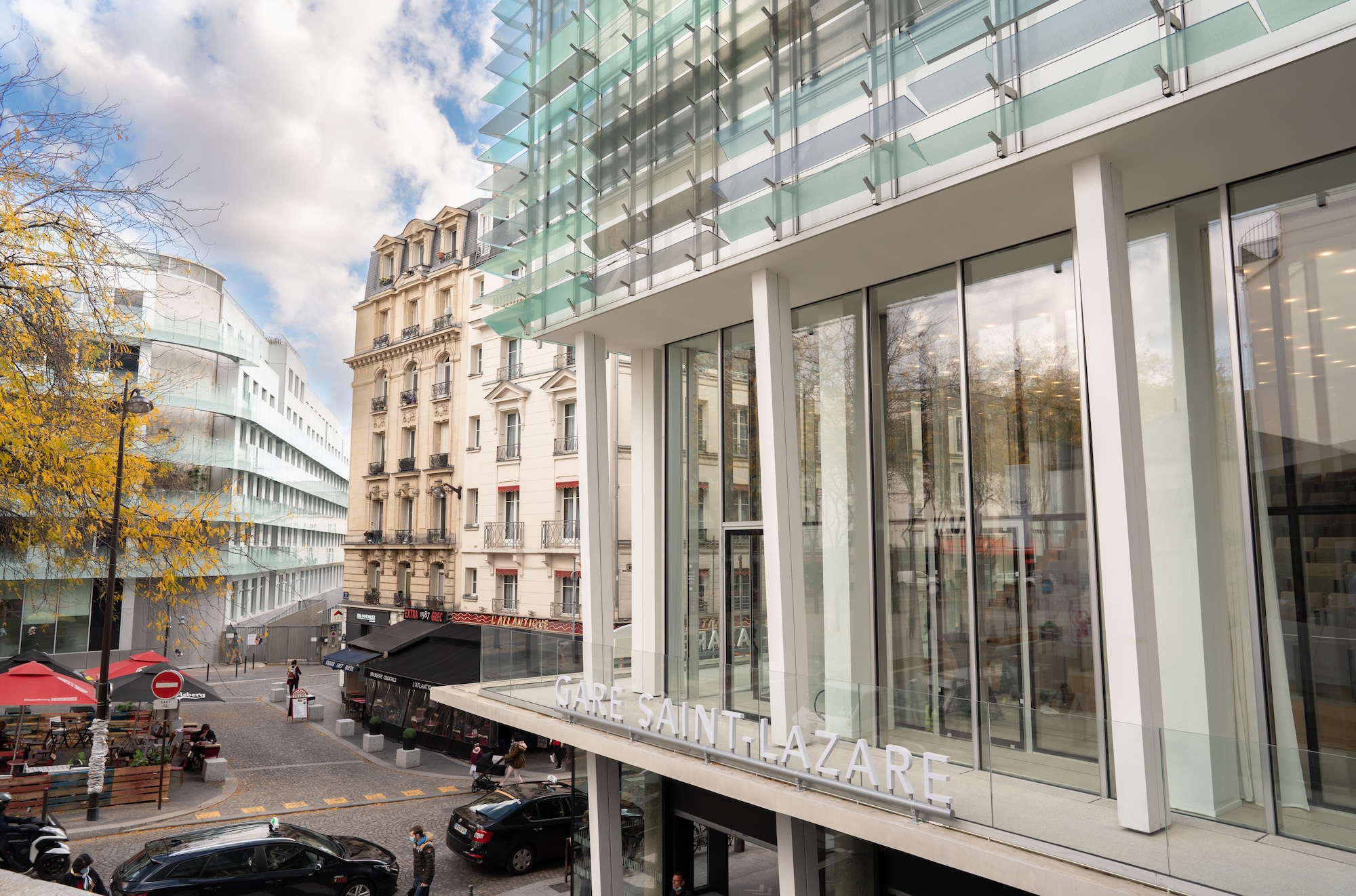
Alongside the written word, Jung speaks most clearly through her use of “silence as emphasis” in the exhibition space, as Ana María Gómez López states in her exhibition essay. Jung’s use of architecture at the Fondation Pernod Ricard is remarkable in its simplicity. The floor to ceiling window panes on the back wall offer a privileged, almost voyeuristic view of the bustling Gare de Paris Saint Lazare below. Walking within the space, we are provided with no guidelines or text, other than indeterminable phrases in the accompanying pamphlet. Thus, our attention is not focused only on the walls, but rather our relationship to the space, to our reactions, and to the people below in the train station—especially as we are caught in the act of looking. For an artist like Jung, who often uses her practice to draw emphasis to social dynamics, this effect is not simply created by chance. Like Rauschenberg’s White Paintings, the blank rooms function as a backdrop sensitive to viewers’ movements and behaviors. Jung essentially turns the white cube into a liminal space where question marks exist without a need for immediate answers.
In a world where wall text does the talking and visitors are spoon-fed what to think about their own art-viewing experience, Florence Jung refuses to fill in the blanks. Rather, she dilates white space, draws attention to the blanks, welcomes ambiguity, and embraces the absurd uncertainty of it all. Perhaps this new year, we can take note from Florence Jung and do the same.
Florence Jung, on view until Feb 1st at
Fondation Pernod Ricard
1 Cours Paul Ricard, Paris 8th (Saint-Lazare Station) Free admission From Tuesday to Saturday from 11 am to 7 pm Late-night opening on Wednesdays until 9 pm Mondays by appointment Guided tours on Wednesdays at noon and on Saturdays at noon
*No exhibition photos per artist’s parameters