Nick Hornby’s first solo exhibition in China, COPY THAT at the Ningbo Museum of Art, runs until 20th November 2026.
After years of working in tonnes of steel, British sculptor Nick Hornby has spent a month in China making work from paper, air and moving images. Developed during a residency at Ningbo Museum of Art, COPY THAT is his first solo exhibition in China, bringing together an unlikely cast of characters from Michelangelo to Cindy Crawford.
Hornby’s recent public commissions in London include Power over Others is Weakness Disguised as Strength (2023), a five-metre Corten steel sculpture at Orchard Place, Westminster, which reworks the equestrian monument. In Ningbo, that experience of making large, enduring objects gives way to materials that seem much less certain of their own permanence.
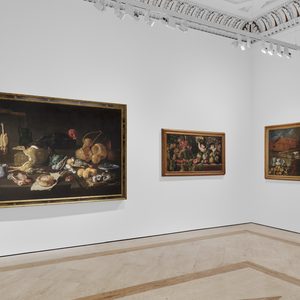
Working between digital models and physical objects, Hornby brings familiar images from art history into new materials and situations. Objects from Dutch still-life paintings become shallow 3D-printed reliefs used to make drawings; architectural engravings by William Chambers return to China as moving digital models; and a photograph of Cindy Crawford stretches across a reclining, Moore-like form. Copying becomes a way of examining what happens to an image as it changes medium, acquires volume or loses it.
Where did the exhibition title come from?
The title, COPY THAT, came out of two misinterpretations I made when I first arrived in Ningbo. Two misunderstandings about copying: I’d received information, but I hadn’t understood it.
At Tianyi Pavilion, China’s oldest surviving private library, I came across a carved stone tablet, a stele, displayed alongside paper rubbings taken from it. A beautiful object, flat, with text carved into it. I assumed it worked like conventional printing, applying ink to the stone surface and pressing paper down to receive the ink.
Later, I stumbled across a full-size bronze David in Ningbo. With so many Davids scattered around the world, I took it for an unofficial copy.
However, the rubbing process is quite different, and it turned out that David was an official gift from Florence.
I’d misunderstood the mechanics of one copy and the provenance of the other. These two misreadings became the starting point for this body of work. COPY THAT means “received, understood”, but taken literally it’s also an instruction: “make a copy of that”. There is a considerable difference between recognising an image and knowing what you are looking at.
You developed and produced an entirely new body of work during a month-long residency in Ningbo, culminating in a solo exhibition at the museum. What was that compressed period of research, experimentation and fabrication like?
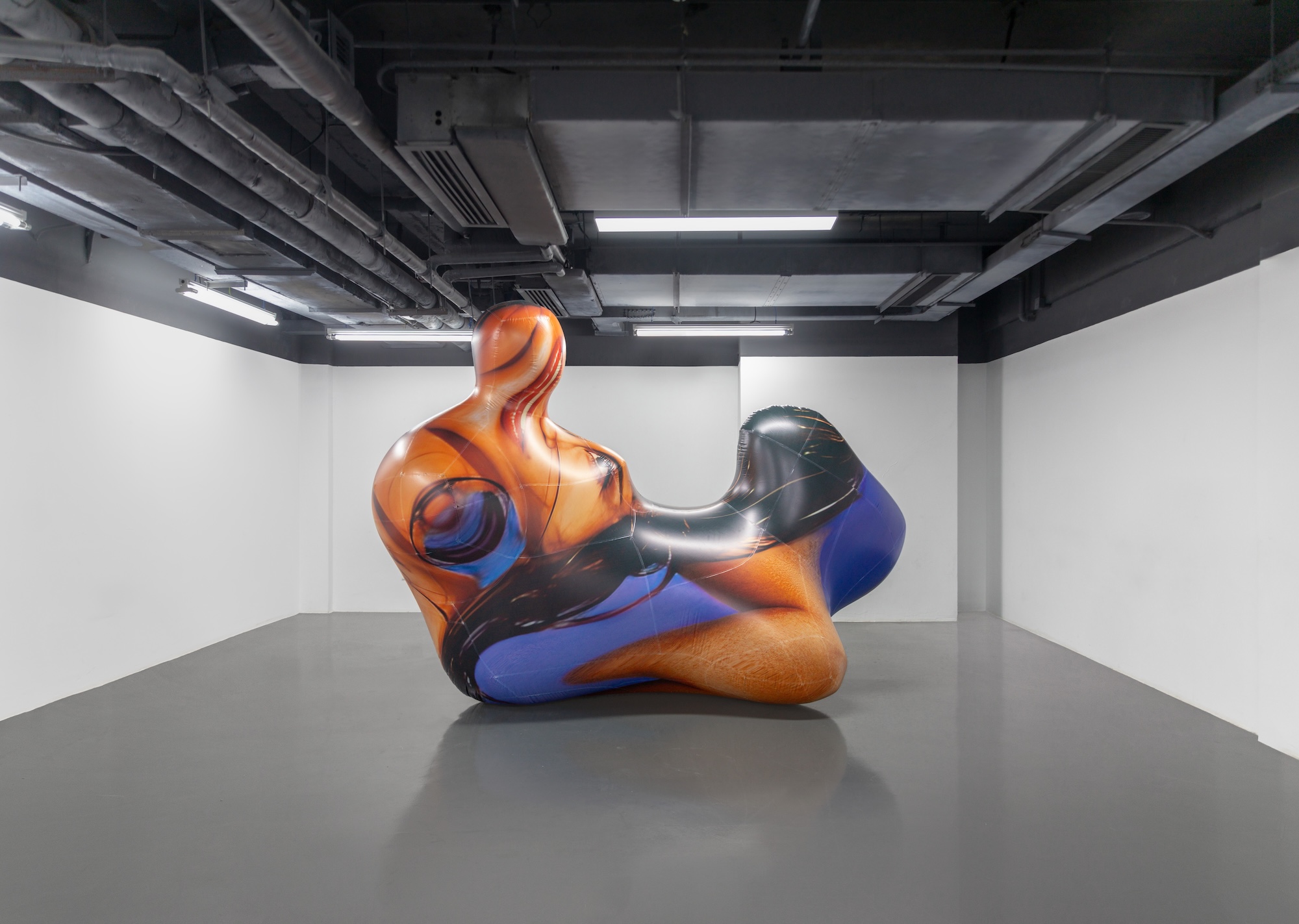
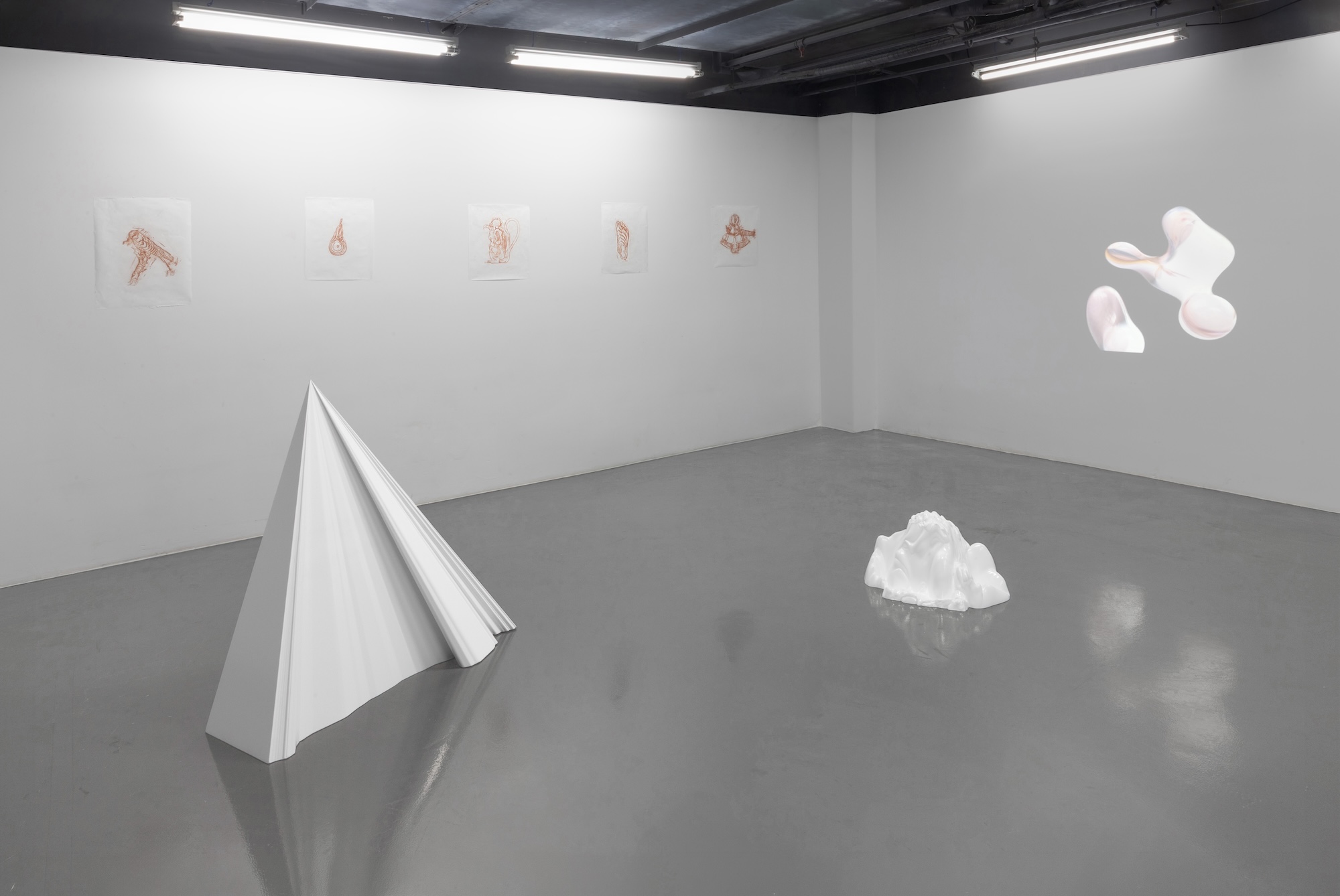
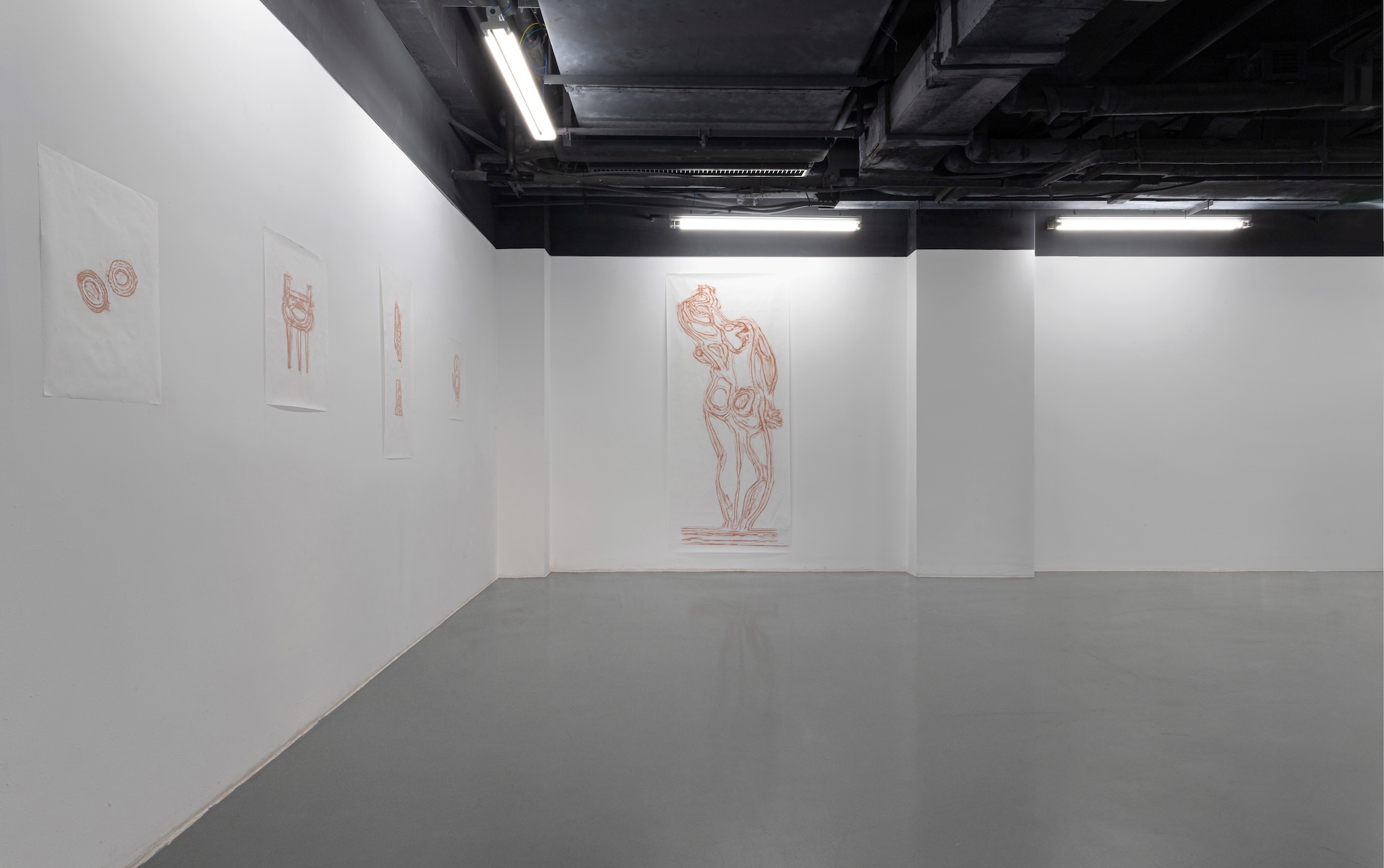
I hung the exhibition whilst the ideas were still unresolved. I had to be decisive and put thoughts into production almost in real time. It felt vital and exciting, and I think that feeling is visible in the show, with large drawings pinned directly to the walls, unframed, alongside an enormous inflatable that could be moved with a slight push.
I think I’m fairly unusual in the ease with which I slip between idea, screen and real-world object. I mean that both literally, because I started out as a hands-on maker, but also conceptually, as someone who revels in the notion of equivalents. An idea can be expressed in words. Those words can be spoken, handwritten, carved into stone, displayed on a screen or stored as bytes. A curve can exist as a drawn line or a mathematical equation; a photograph as an image or a set of numerical RGB values.
Likewise, my sculpture can exist as a sentence — “What would happen if I flattened Rodin’s Age of Bronze to 10mm?” — a digital model on a computer, or a CNC-cut piece of steel. For me, these aren’t simply stages towards a finished object. They’re different manifestations of the same idea. I think this slippage between forms and materials, between the virtual and the real, is at the heart of my practice.
After making monumental public sculptures, what drew you towards thin paper, air and moving images?
This body of work follows a sustained period of thinking about and making large public sculptures. That preoccupation with permanence is perhaps reflected in my attraction to the carved stones and archival material at Tianyi Pavilion, and to David: objects that carry an ambition to endure.
Yet the works in this exhibition are almost their opposite: drawings on very thin paper, an inflatable whose sculptural body is essentially air, and a video composed of images continually disappearing and being replaced. There is a reaction here to the weight, permanence and sheer material commitment of my public sculptures. After years of working in tonnes of steel, I find myself making things that barely weigh anything.
Did learning about the rubbing process, after seeing the original stele and rubbings at Tianyi Pavilion, change anything concrete in your digital workflow? Was it a shift in thinking, in technique, or both?
My studio exists almost entirely in the cloud, synchronised across devices, in a world of identical copies. With stone carving, there’s no undo button, and the file is considerably heavier.
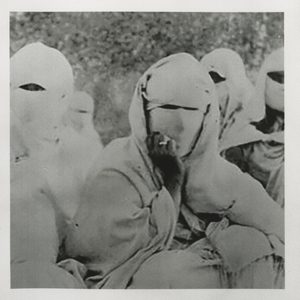
The traditional stone-rubbing process turned out to be almost the reverse of what I’d imagined. Thin paper is moistened and worked into the carved characters. It physically maps onto the form of the stone, pushed into the recesses. Once sufficiently dry, ink is dabbed across the exposed surface, leaving the paper inside the recesses white. The lettering appears through the ink it doesn’t receive. It’s almost an inversion of mould-making and casting, where positive and negative trade places. For a moment, the paper becomes a relief; afterwards, it is flattened back into an image. The temporary shape disappears, but the information survives.
I tend to trace the photorealistic image back to the innovations of perspective and oil paint. The Italian Renaissance gives us the mathematical geometry for inventing a believable space, and Dutch still-life painting demonstrates the other ingredient: the extraordinary capacity of oil paint to blend colour and tone so finely that the individual marks almost disappear, creating something seamless. In contemporary terms, I recognise something like vector geometry in the first, and RGB colour information in the second. One gives an imaginary world its coordinates; the other persuades the eye that its surfaces are real. Together, they let you invent something that has never existed and make it look as though it has been photographed.
I wanted to take those ingredients apart again. Rather than transfer what I saw in a Dutch still life directly onto paper, my sculptor’s instinct was to extract the objects, make them three-dimensional and then flatten them. So I isolated objects from Dutch still-life paintings, used AI to turn the images into 3D files, digitally flattened the resulting models and 3D-printed them as reliefs only about one millimetre high.
These became my rudimentary “steles”: I laid paper over these shallow textured surfaces and rubbed them with a rust-coloured Conté stick. The impressions are what I’m exhibiting as drawings. Intermixed with the Dutch still-life props are images from William Chambers’s engravings of Chinese architecture.
So, did it change my digital workflow? Yes — it’s a rather absurd route to a drawing: to produce the image, I first have to manufacture the object from which it can be copied.
Your stone-like block brings David together with the idea of a rubbing matrix. The exhibition text says reverence and irreverence operate together. How do you see turning David back towards stone: as a tribute, a deliberate misapplication, or both?
I have two rather incompatible relationships with art history. I love its stories. I have a certain nostalgia for the Gombrich-esque canonical fairy tale, in which one great genius hands the baton to the next. At the same time, I understand how selective and ideological that story is, particularly the assumption that art advances through a tidy sequence of breakthroughs. I can be completely moved by Michelangelo and suspicious of the mythology surrounding him in the same afternoon.
David concentrates that contradiction. It is an astonishing sculpture, not simply an exquisite representation of the body but a phenomenal physical object. Yet its image has been reproduced so relentlessly that it’s become a little naff: a trinket like a fridge magnet or keyring. Adding another reproduction to the infinite population of Davids seems, in itself, almost redundant. His outline is so familiar that it can take a lot before it loses its meaning.
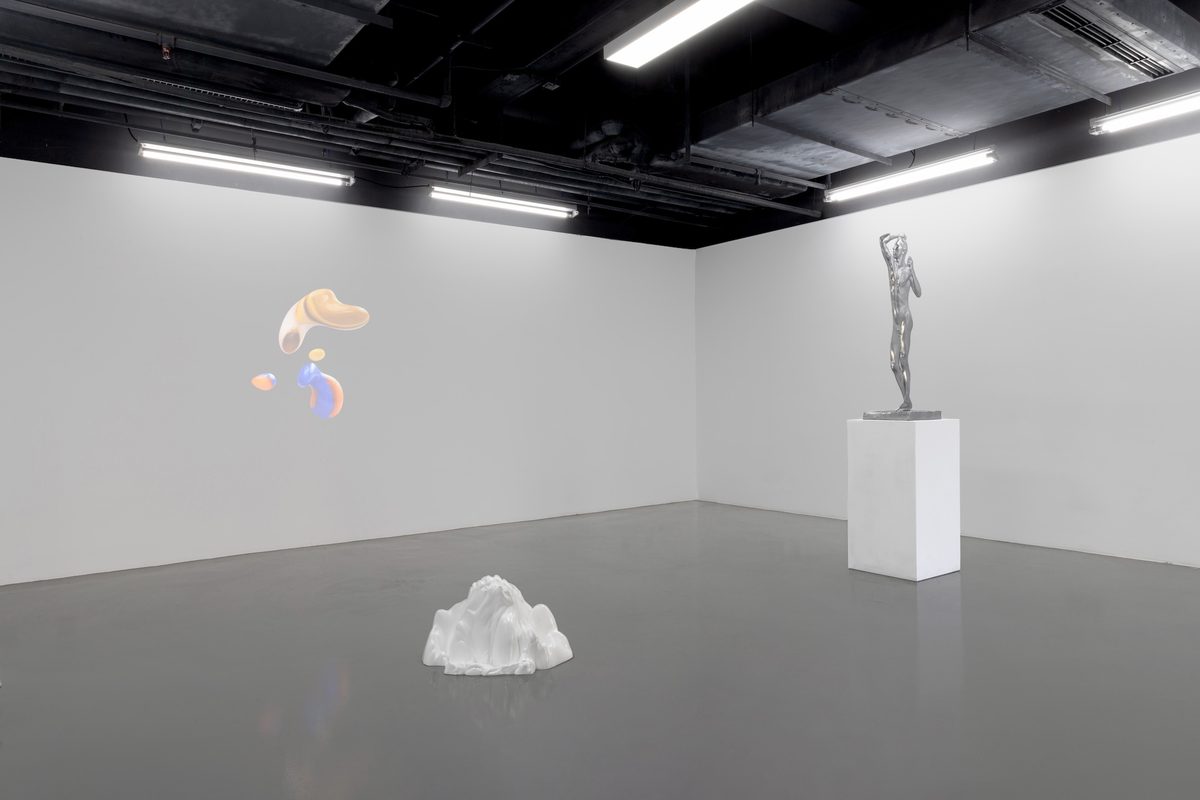
What fascinated me about the David in Ningbo was how different he looked. The bronze has acquired a patina that is almost black. Instead of the brilliant white marble figure I carry around in my head, I encountered something closer to a silhouette, a shadow or outline. Silhouette is one of the building blocks of my Intersection sculptures, so this wasn’t merely a change in colour. It was a different way of seeing a figure I thought I already knew. It made me conscious of how much of our supposedly direct relationship with a masterpiece is actually a relationship with the images we’ve inherited of it.
So turning David back towards stone is affectionate, but also deliberately perverse. I’m not trying to restore the original or rescue it from the indignity of reproduction. I’m adding another translation to a figure that has already travelled between materials, places and meanings. Copies are now part of what David is. If reproduction only diminished an original, this sculpture ought to have disappeared into insignificance centuries ago. Instead, every copy seems to make it more famous and, occasionally, more ridiculous.
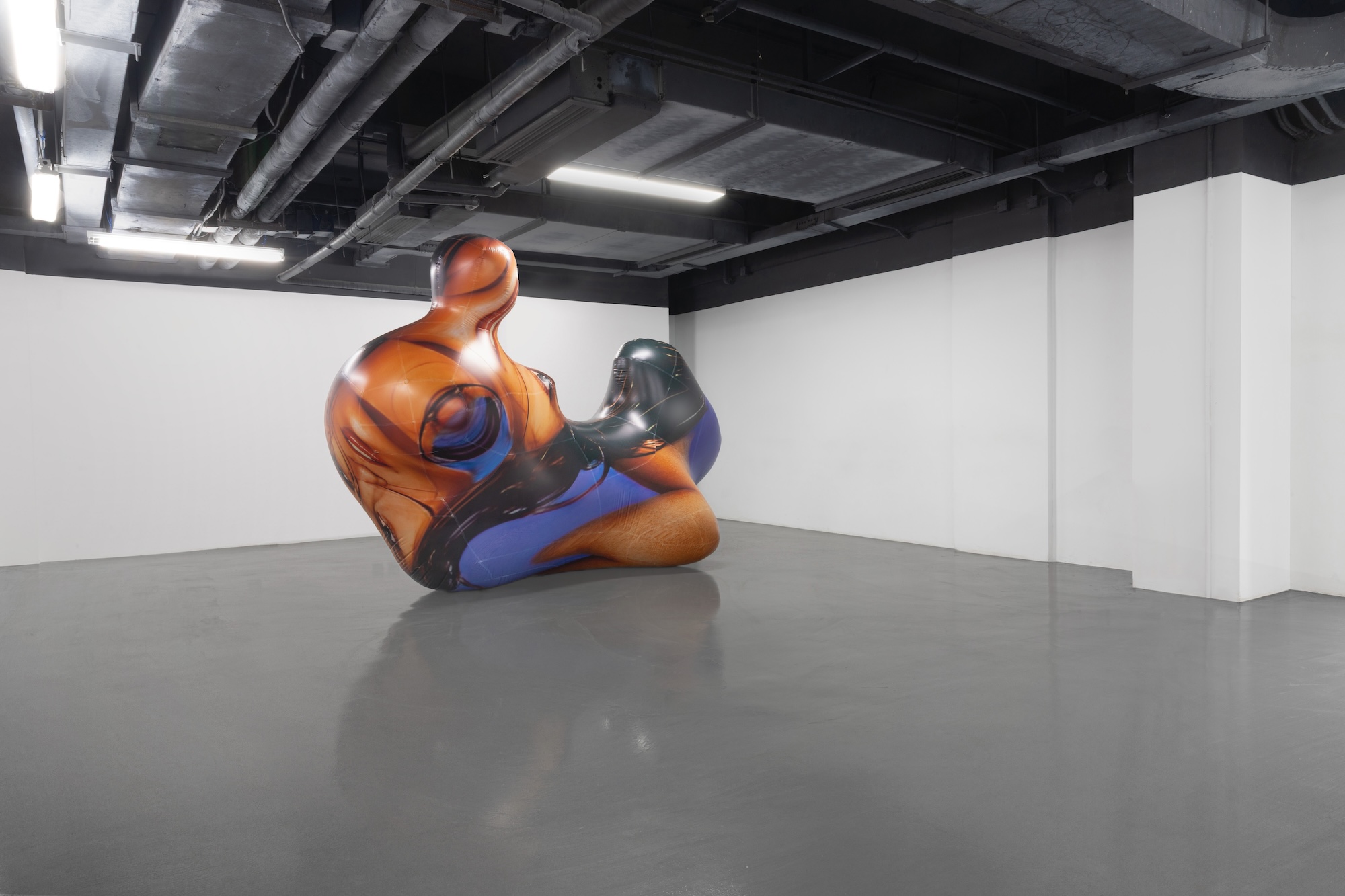
Why did you choose Cindy Crawford’s photograph, and what role does it play in the work?
I had that particular photograph of Cindy Crawford, in a gold swimsuit against a blue background, when I was a teenager at a Catholic all-boys boarding school in the 1990s. That’s probably a more truthful starting point than any art-historical theory I could devise afterwards.
The supermodels belonged to a curious moment in visual culture: an extraordinarily small group of women commanded an enormous proportion of the world’s attention. They were idealised, of course, but the physical ideal was quite specific. Cindy’s body was strong, athletic, almost muscular. There was unmistakable power to it, even as it was presented as an image of femininity.
The other presence in this work is Henry Moore, whose reclining women are among the most familiar forms in twentieth-century British sculpture. I’ve wondered whether his abstraction of the female body sometimes moves into a language we would conventionally describe as masculine: mass, muscle, weight, monumental authority. But I hesitate even as I say that. I don’t think I have a sufficiently precise vocabulary for femininity to turn this into a neat proposition, and I distrust neat propositions about bodies.
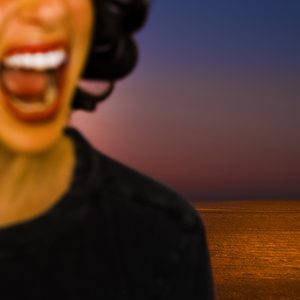
Instead, I’ve stretched that very controlled photographic image over an inflated, Moore-like reclining form. The sculpture rearranges Cindy; Cindy rearranges the sculpture. At times the photograph becomes almost illegible. It is distorted and difficult to settle into a single reading. Which is why I wanted to make an object rather than write an essay about it.
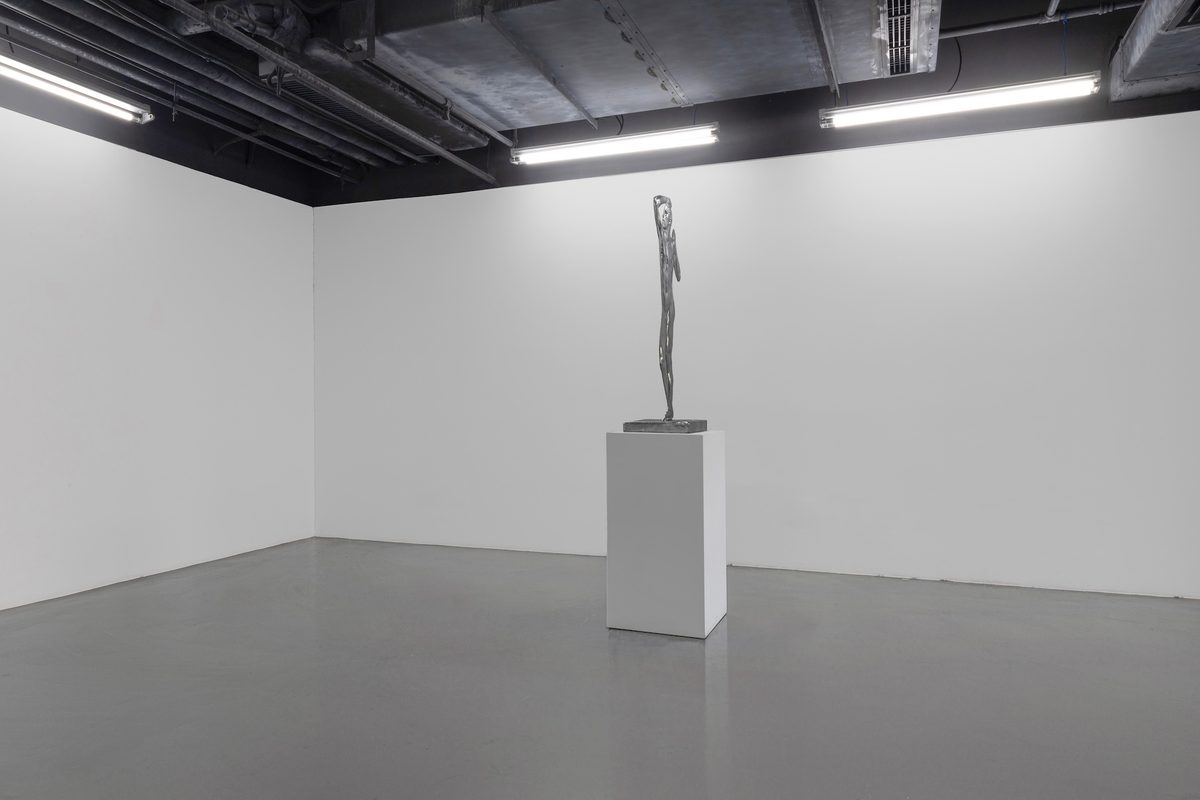
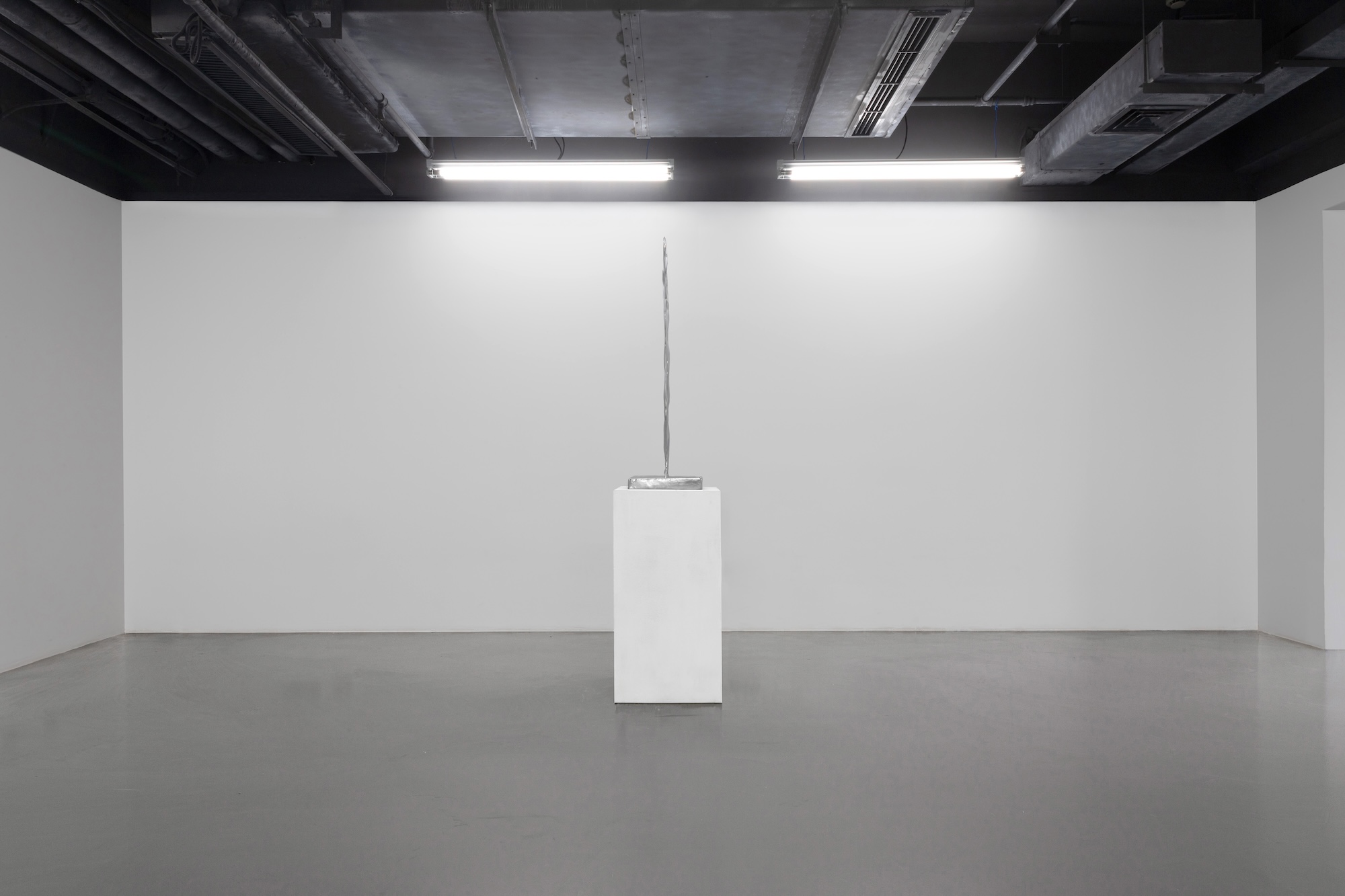
Chambers’s engravings were already a European translation of Chinese forms. Where do you see your work sitting in that chain, and how do you expect audiences in Ningbo to read it compared with audiences in the UK?
I’ve been in China for less than a month, so I’m wary of making pronouncements about Chinese culture. But I feel on much firmer ground discussing Chambers, because I understand the European context in which he was working.
In some respects, Chambers is a useful foil, perhaps even an alibi. His engravings give me a legitimate route into using architectural forms that are instantly recognisable as “Chinese”, sometimes almost to the point of cliché. I’m borrowing a European’s borrowing of China.
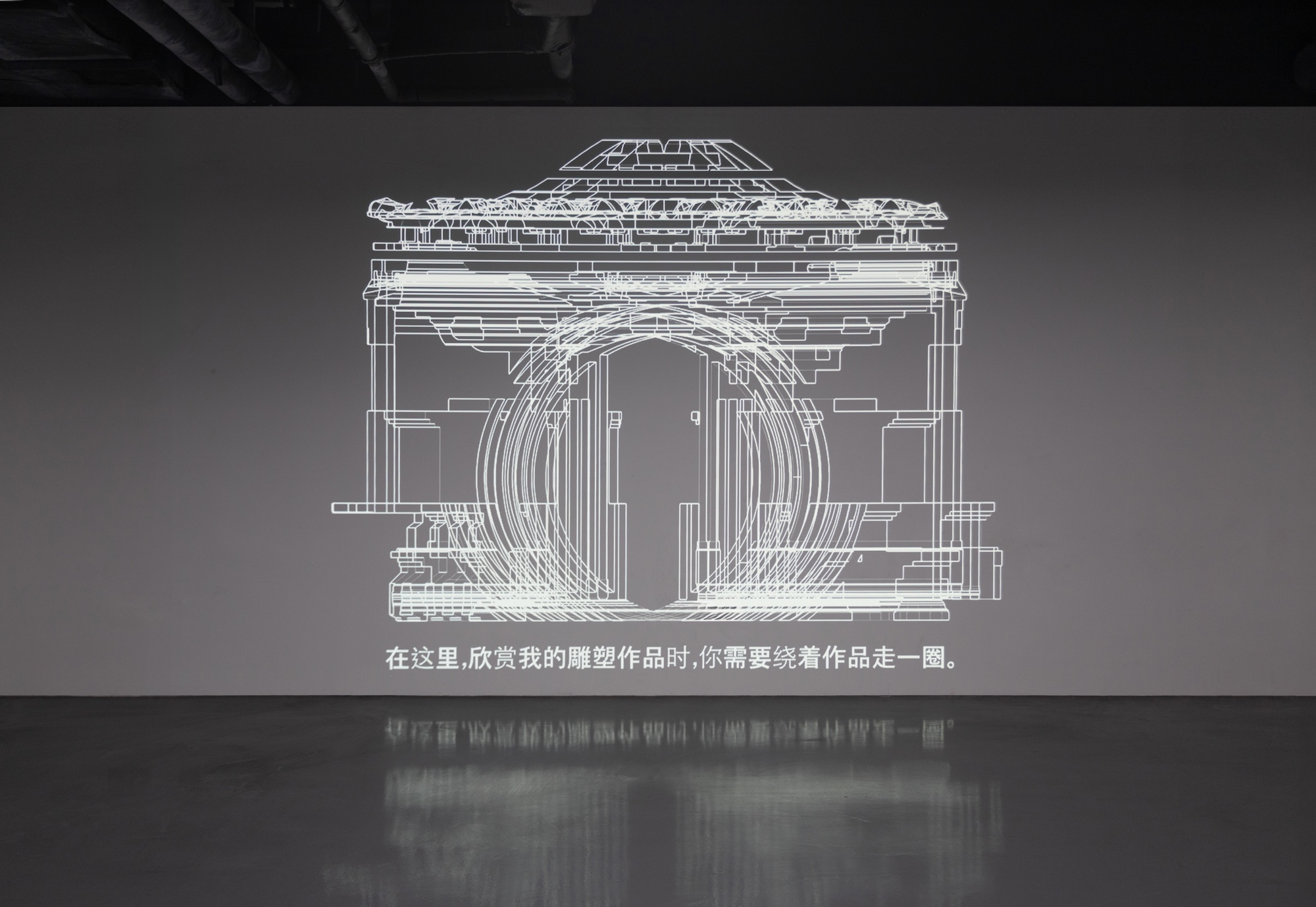
Chambers is not a transparent window onto China. His engravings tell us as much about the European imagination as they do about the buildings they describe. I enter that chain of translations rather late and, in a sense, make matters worse. I reconstruct his images as digital models, splice them with Western architectural fragments and set them in motion. Chinese buildings become European engravings, become computer models made by a British sculptor, and then return to China.
I imagine those translations will be read differently here. A British audience might see something broadly “Chinese”; someone in Ningbo might recognise something familiar rendered oddly foreign. I wouldn’t presume to predict their response. Perhaps the most interesting thing about a copy is how much it reveals about the person who made it.
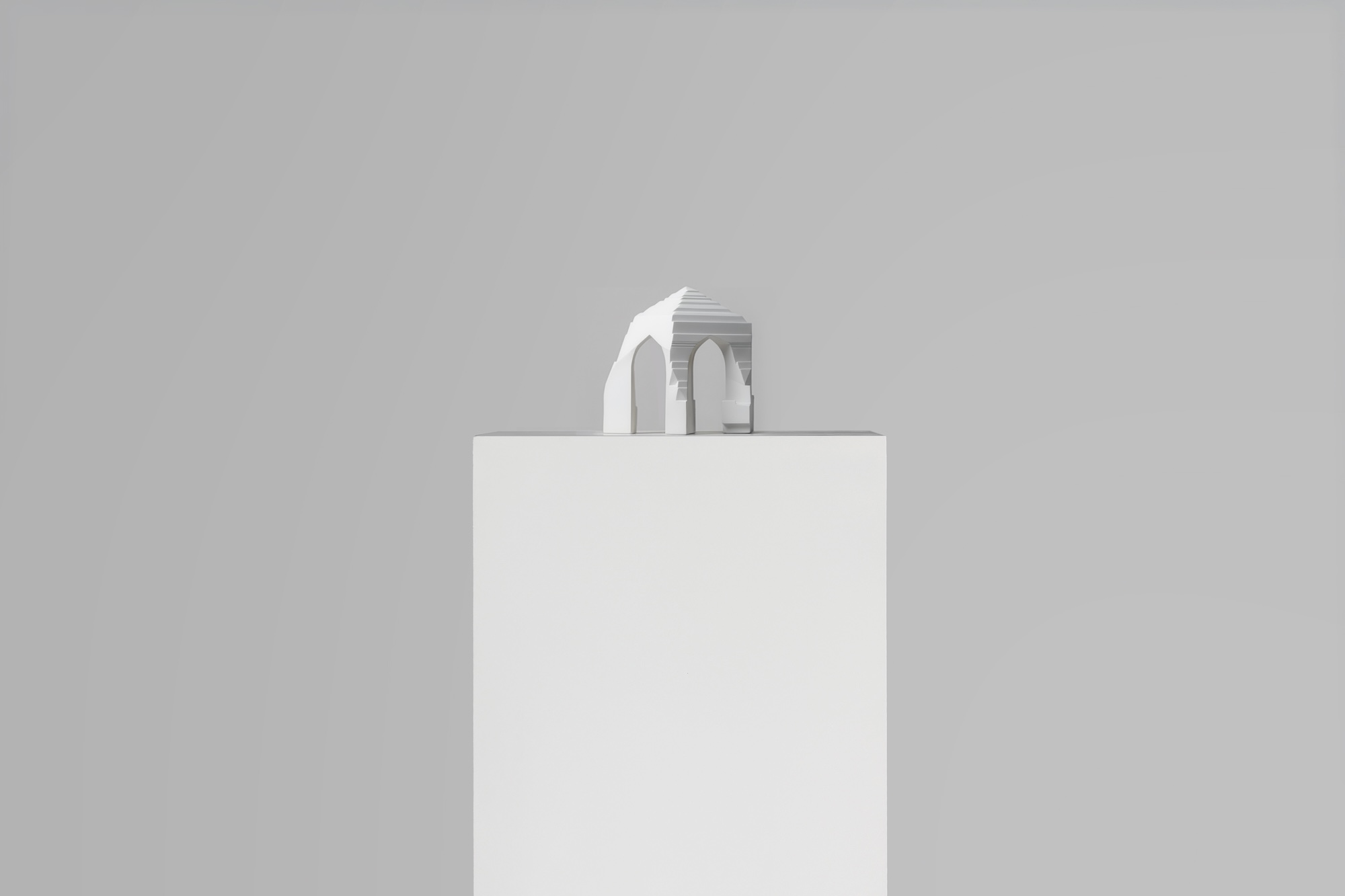
The inflatable appears to be both a sculpture and a frame from an animation. How do you think about the relationship between those two forms?
The inflatable is taken from a single frame of an animation projected in the adjacent gallery. In the film, a Moore-like object carrying Cindy Crawford’s image warps between biomorphic and abstract forms. One frame is extracted and made manifest, although what materialises is an air-filled plastic skin that arrives flat-packed. A sculpture that is also, in a rather literal sense, a paused image.
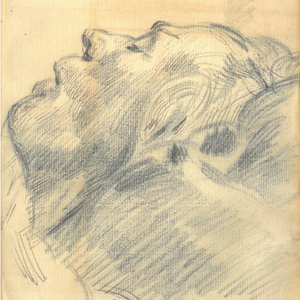
There are two bodies in the animation: one reminiscent of Moore, the other of Jean Arp. The Arp-like form carries an image of Joe, a tattooed model based in Los Angeles. One body becomes a surface; the surface is wrapped around another body; the moving digital figure becomes a stationary inflatable.
The forms keep crossing between conditions: flat and swollen, still and moving, skin and volume.
You have used flat outlines to build sculptures for fifteen years. What changes when flattening and inflating become subjects in their own right?
For fifteen years, I’ve been making three-dimensional sculptures using flat outlines as their building blocks. Flatness has been there all along, but largely as a means to an end. In COPY THAT, flattening and inflating become subjects in their own right.
I’m interested in whether flatness moves an object closer to the realm of the sign. A silhouette can be instantly recognisable while withholding almost everything about the object it describes. Give that outline volume and it acquires physical presence, but perhaps becomes less certain as an image.
In the Western logocentric tradition, speech has often been privileged over writing as being closer to meaning or truth. I wonder whether there is an equivalent hierarchy between an object and its image. What happens to meaning when I flatten something? Am I adjusting the degree of representation, the nature of signification, or the authority of the object itself? These are questions I’m only beginning to explore.
How do historical time and the time of looking meet in this exhibition?
There isn’t just one kind of time at work. Michelangelo’s David belongs to 1504, but the figure I encountered in Ningbo is a dark bronze gifted to the city in 2006. Chambers’s eighteenth-century interpretations of Chinese architecture return as moving digital models. Ancient methods of taking impressions meet AI and 3D printing. These histories don’t sit in a neat sequence. They occupy the same room.
Then there’s the time of looking. We call video time-based because the image changes while we watch. But sculpture is time-based too, even when nothing moves except the viewer. You walk around it, remembering one view as another comes into focus. In my Westminster work, the horseman becomes abstract only because you move. Nothing in the steel changes, yet the sculpture unfolds in time.
And the moment an image is sent is not the same as the moment it is received: the information may survive intact while its meaning changes entirely. Perhaps that’s the point of COPY THAT. Receipt is instantaneous. Understanding has a less reliable timetable.
Nick Hornby, COPY THAT, 20th October–20th November 2026, Ningbo Museum of Art, Ningbo, China