Words Xumeng Zhang
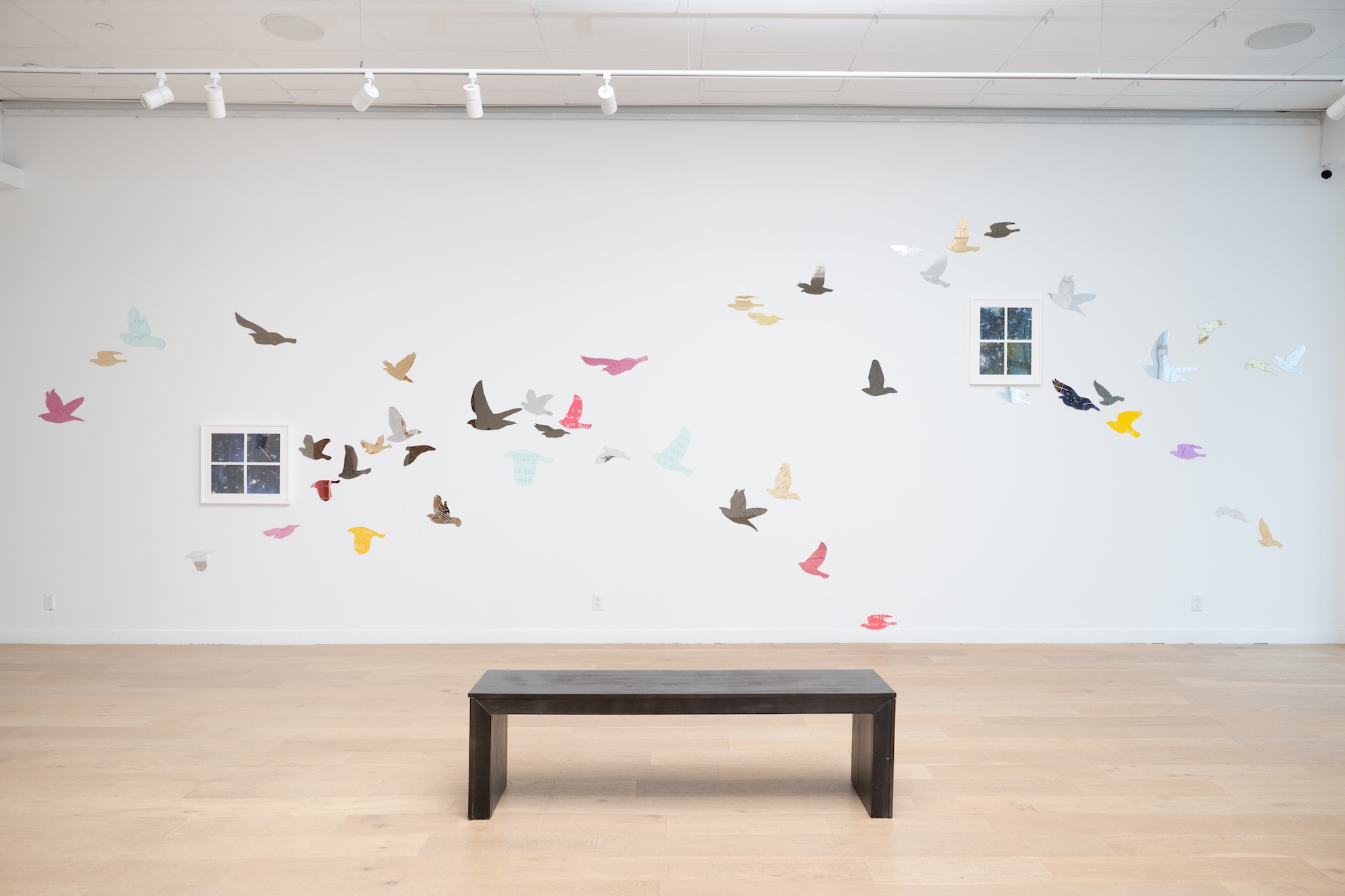
Stepping off New York’s crowded, polyglot streets and into THE BLANC, suddenly cut off from the noise outside, the audience’s first notice is a flock of birds spilling across the gallery like a tide. They stretch along the walls and hover before softly glowing windows, catching shifting traces of color and light; their surfaces seem to glimmer with fragments of a night sky. The flock has its own quiet rhythm. Some birds cluster together, while others drift toward the edges, as if a single frame had been lifted from a larger, constantly changing formation. The title of Jiaming You’s solo exhibition, Murmuration, names the phenomenon in which starlings gather at dusk in autumn and winter, circling through the sky in fluid, ever-changing patterns. Thousands of birds continuously adjust their speed and direction in response to one another, making the flock expand and contract almost as if it were breathing. You brings this fleeting spectacle into the white cube, turning collective motion into a spatial composition that unfolds across the space.
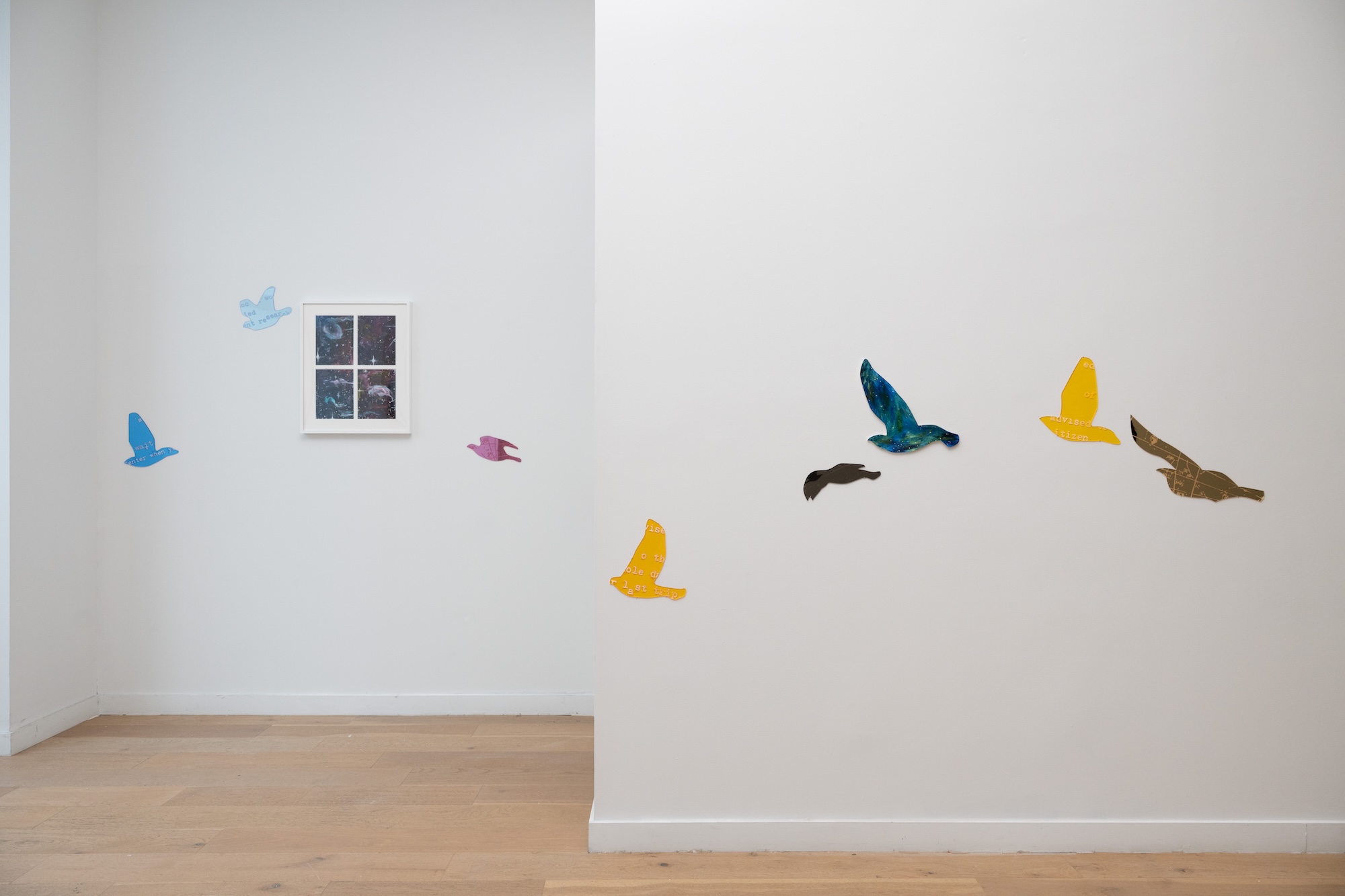
The sweeping flock first evokes familiar ideas of flight and freedom. Yet in You’s painted wooden birds, the desire to return home is pulled in two directions. For somebody whose life has taken shape across different cultures and places, “home” is rarely singular. It can mean the people and relationships that form the deepest sense of belonging, but it can also mean the place where a new daily life has been built. When You’s father suffered a sudden medical emergency, both meanings of home became urgent, while travel restrictions forced her to choose between them. The colors on these wooden birds are drawn from her father’s fMRI brain scans and layered with images of distant galaxies. At first, the two seem to belong to entirely different scales: one speaks to humanity’s desire to push farther into the universe, while the other is rooted in the deeply personal wish to return to a loved person. But once they meet on the surface of the same bird, the contrast becomes less absolute. Looking beyond Earth toward unknown worlds and leaving a familiar place to build a life elsewhere are, in very different ways, both acts of moving outward. Distance does not erase the idea of home. If anything, it can make the place left behind feel even more like a point of reference. This way of looking outward while thinking back toward home also carries a long resonance in Chinese poetic tradition. The sky has often served as a view toward the distant and a reminder of the place of origin. In You’s work, that familiar gaze is extended from the moon and night sky to NASA’s images of deep space. The scale has changed, but the emotional structure remains recognizable: the farther the eye travels, the more sharply the idea of where one comes from can return. By placing the image of her father’s body alongside distant galaxies on the same flying form, You allows exploration and remembrance to exist as two impulses within the same journey.
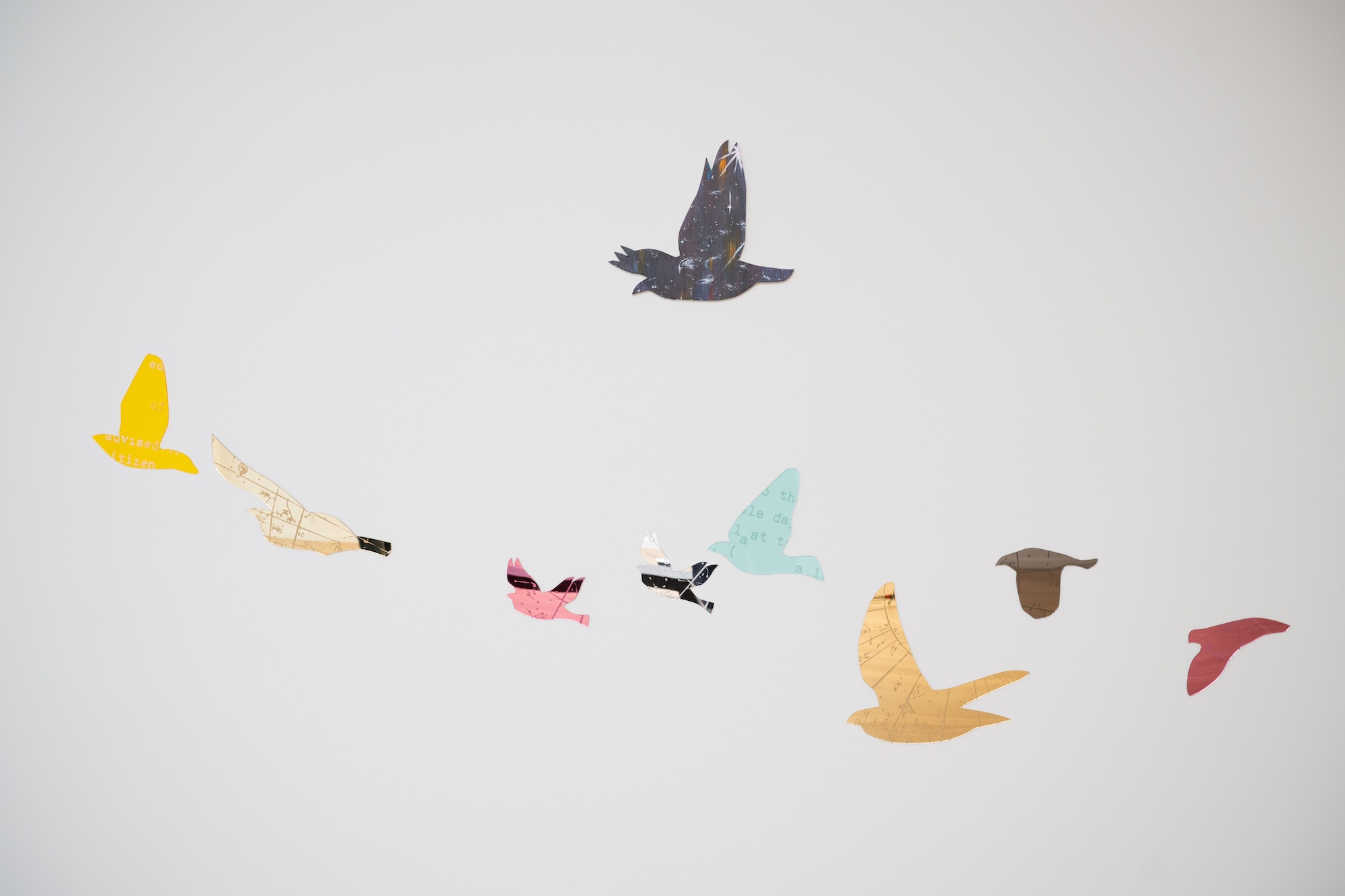
You often places personal experience within much larger historical and cosmic frames. The constant shift between spatial scale and historical depth gives these intimate materials a reach beyond autobiography, and has become one of her work’s recurring narrative strategies. The tinted acrylic pieces carry fragments of a 1975 letter written by Chicago social worker Bernie Lo to the city’s mayor, requesting that her visa be expedited so she could travel to Hong Kong to visit a critically ill family member. Living in the same city decades later, You recognized something of her own experience in Lo’s story, and treats the work as a gesture of acknowledgment toward an earlier generation. The mirrored acrylic birds incorporate fragments from a rubbing of the thirteenth-century Chinese celestial chart Tian Wen Tu, bringing an ancient system of orientation into her own reflections on migration and travel. The tinted acrylic carries an administrative text concerned with time-sensitive passage, locating the body within a system of permission; the mirrored works turn instead to a historical map of the sky, designed to establish direction across a far larger field.
From her father’s fMRI scans to Tian Wen Tu, You repeatedly returns to visual systems that locate the body in relation to different kinds of space. Medical imaging directs the gaze inward, while the celestial chart pushes orientation outward toward the sky. Bernie Lo’s letter shifts the question from location to passage. That distinction touches on what sociologist Mimi Sheller describes as “mobility justice”: the ability to move is shaped not only by whether a body can physically reach a destination, but also by the identities, institutions, and conditions that determine whether such movement is possible in the first place. In Murmuration, the circling birds seem never to lose their sense of direction; what remains unresolved is under what circumstances the people they come to evoke are able to depart, arrive, and return. Personal memory, historical archive, and cosmic imagery are woven tightly together, drawing experiences from otherwise distant contexts into near-continuity. These crossings between body, history, and the universe ultimately extend into the exhibition’s treatment of interior and exterior space.
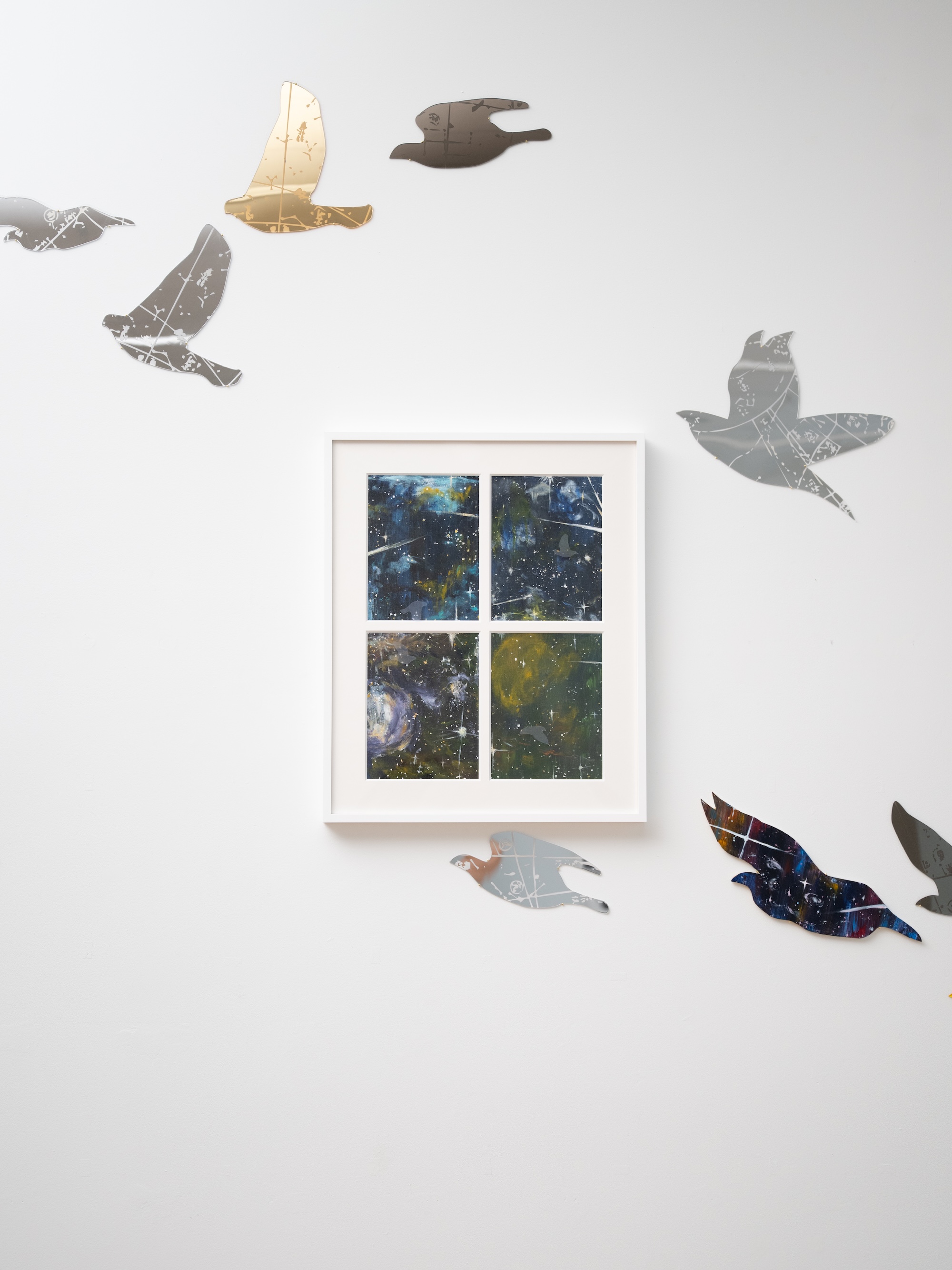
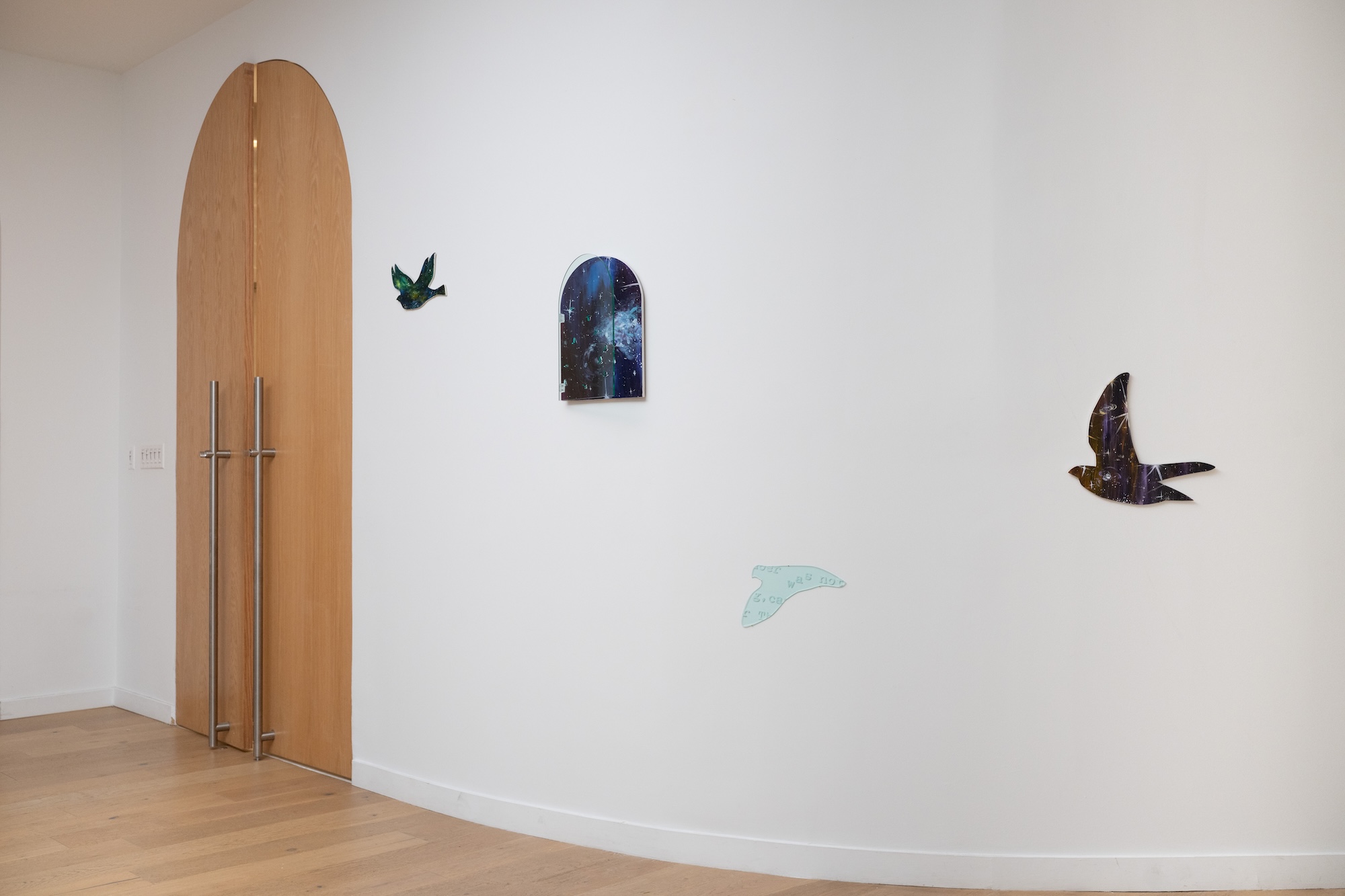
The exhibition’s spatial logic becomes especially clear in the window works. In everyday experience, birds belong outside: a window separates the room from the sky, allowing the distant to be seen without necessarily being reached. You reverses that relationship. The flock enters the gallery and circles around the viewer, while a series of luminous windows made from glass, bird-shaped cutouts, and images of nebulae draw the vastness of the outside world inward. The window shifts from a surface through which one looks outward into a frame that contains the distant within the room; what once belonged elsewhere is folded inward, opening onto a more introspective sense of expansiveness. This spatial reversal also reshapes the exhibition’s recurring motif of journeying. Birds, celestial charts, and archival texts continue to point toward departure, arrival, and return, while the windows turn that outward motion back upon the interior, giving the space a depth that unfolds inward. This form of “arrival” takes place first through vision: galaxies can be framed, folded, and brought into the room, while the body remains subject to the practical limits of borders and passage. A subtle tension emerges between how far the eye can travel and how far the body can actually go. In this sense, Murmuration’s vision of vastness is both seductive and ambiguous.
Returning to the circling birds that first greet the viewer, they ultimately come to suggest more than freedom alone. Murmuration keeps extending the scale of travel outward, yet holds onto a single point of reference: however far one goes, there remains the question of where one began, and where one might return.
Xumeng Zhang (b. 2001) is a curator and writer based in New York and Beijing. Her practice focuses on the intersection of contemporary art, mental health, and community-based collaboration.
All images: Murmuration, installation view. Courtesy of THE BLANC