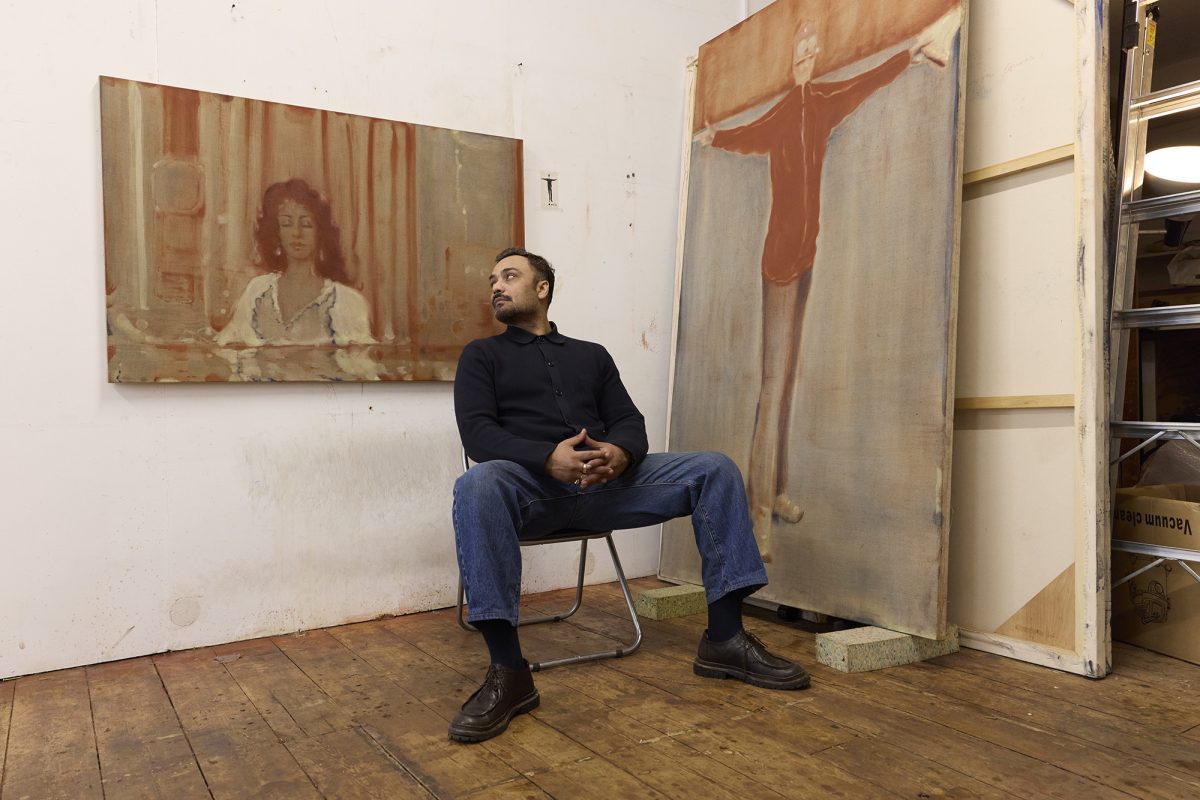
White Cube has announced the representation of Suleman Aqeel Khilji, coinciding with his first exhibition with the gallery currently on view at White Cube Paris (11th June – 25th July 2026). A new painting by Khilji will feature on the gallery’s booth at the 2026 edition of Art Basel Miami Beach in December.
Khilji was born in 1985 in Quetta, Pakistan, and now lives and works in London, where he completed a three-year artist programme at the Royal Academy of Arts in 2025. He is currently a permanent member of faculty at the National College of Arts in Lahore, Pakistan.
Characterised by a logic of accumulation and inheritance, Khilji’s paintings contend with the indeterminate nature of memory and the passing of time. Working on linen, found book covers and used cigarette packets, he treats recollection as provisional and composite, always subject to interference.
Khilji uses a subdued, earthy palette, and his deft handling of semi-translucent washes of pigment allows both figure and setting to resist sharp delineation. For the artist, the practice is ‘like excavating something’ – uncovering the latent content of a lived experience, a found photograph, a gestural memory or an imagined situation.
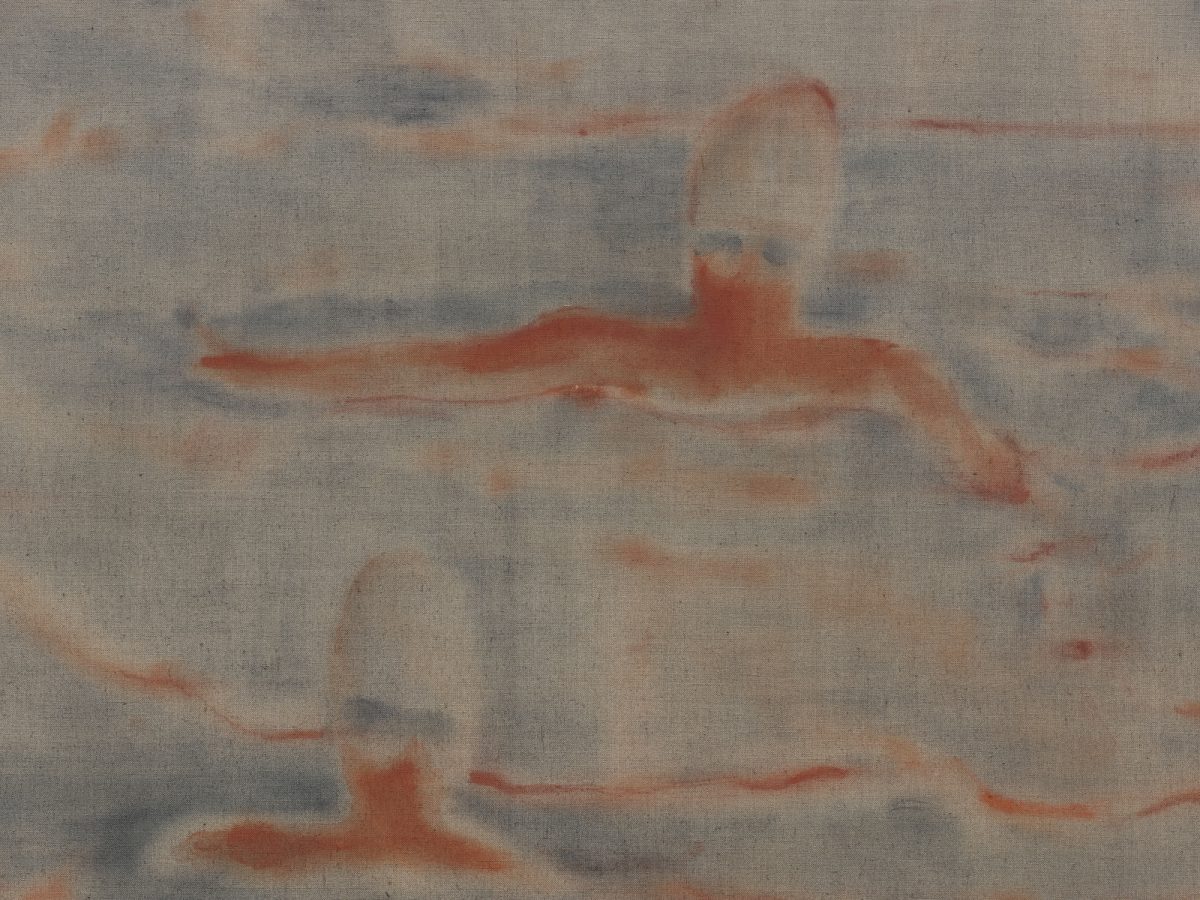
His subjects are uncanny composites, drawn from multiple sources such as sketches of strangers or images of writers and filmmakers that inspire him. Fragments of Nastaliq calligraphy surface within several works, functioning less as legible inscription than as lyrically rippling form – speaking to intergenerational transmission that language engenders.
Khilji’s introduction to painting in his formative years came by way of the cinema hoardings affixed to the back of rickshaws, which he saw on his commute to school in Quetta. ‘Those paintings were like moving galleries for me,’ the artist recalls. A later experience shaped his relationship to material: during his school days, he noted the cumulative effect of scratches and scuffs that the covers of his exercise books sustained throughout the year and was compelled to use these inadvertent marks as the basis of a composition. This instinct to use surfaces that already hold a dormant image persists in his works comprising book covers and cigarette packets as their grounds.
Khilji’s work is held in international public collections including Arts Council Collection, UK; Kistefos Museum and Astrup Fearnley Museum, Norway; Burger Collection, Hong Kong and the DIL Foundation, New York. In 2025, he was selected for the Edvard Munch Studio Foundation Residency, Oslo. In 2026, he was appointed artist-in-residence at Eton College, Berkshire, UK, and also received the Wolfson Royal Academy Schools Graduate Prize, with a subsequent exhibition currently on view at Wolfson College, Cambridge, UK, until 11 October.
Suleman Aqeel Khilji is jointly represented by White Cube and Standard Oslo, with the continuing support of Jhaveri Contemporary.
About the artist
Suleman Aqeel Khilji is a contemporary artist whose multidisciplinary practice explores memory, migration, identity and the evolving relationship between people, place and history. Working across painting, drawing, installation and mixed media, Khilji creates layered works that combine personal narratives with broader social and cultural questions. His practice reflects on the ways histories are constructed, inherited and transformed, often drawing upon architectural forms, landscapes and everyday materials to examine the intersections of individual experience and collective memory.
Born in Pakistan, Khilji’s work is informed by the cultural, political and geographical complexities of South Asia while engaging with universal themes of displacement, belonging and transformation. His compositions frequently juxtapose abstraction with recognisable forms, allowing fragments of architecture, pattern and landscape to emerge through richly textured surfaces. This balance between representation and abstraction creates works that invite contemplation rather than offering fixed interpretations, encouraging viewers to consider how memory is continually reshaped over time.