Working across performance, sound, textiles, and pedagogy, Sophie Seita approaches language not as a fixed system but as a living, sensuous material — something that can be worn, listened to, misheard, and felt. I first encountered her work at Strings Attached, a two-part group exhibition at Pipeline Gallery, curated by Bella Kesoyan, where artists were invited to select and respond to a book from the curator’s own collection. The exhibition offered a fitting entry point into Seita’s wider practice, foregrounding her interest in language, relationality, and embodied reading.
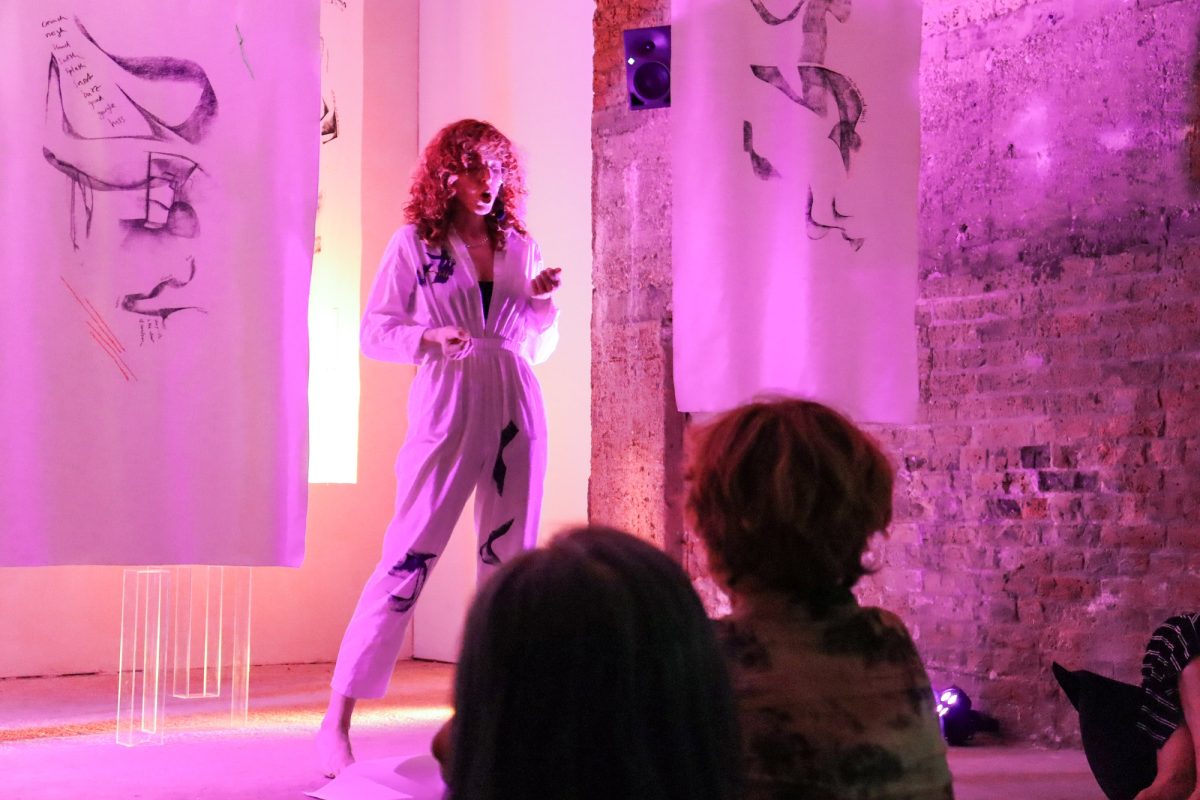
Rooted in queer and feminist thought, Seita’s work embraces difficulty, opacity, and attentiveness as political and aesthetic strategies. From garment sculptures and “talking textiles” to durational performances and community-driven workshops, her practice consistently resists hierarchy, certainty, and singular meaning. I met with Seita to discuss her relationship to language-as-material, the role of listening and collaboration in her work, and how art might train us to dwell productively in not-knowing.
JW: Your work often invites audiences into states of uncertainty or suspended attention. Why is difficulty — or not immediately “getting it” — important to you?
SS: I could answer this by gesturing to a long history of avant-garde or experimental art practices that believe in difficulty as a way to honour the agency of an audience in co-shaping the meaning of and response to a work, to resist its easy commodification or indeed the audience’s own manipulation, which is definitely part of my artistic upbringing, but I could also answer this by saying that I find difficulty actually very pleasurable. Having lots of associations, layers, references, complexities, ambiguities, and wild juxtapositions makes my mind fizz; it’s kind of my dopamine, so it’s quite an accurate representation of my imagination. I also believe that the work knows more than me, which is quite liberating. Lastly, given that attention is constantly monetised and weaponised, how we give and receive attention seems to me the ethical crux of relationality that exceeds any artwork.
Textiles appear repeatedly in your practice, often activated through performance or sound. What draws you to fabric as a site for language?
Textiles are a great extension or transformation of pages and so make great surfaces for inscription. I liked dressing up as a child; my grandmother had a big trunk of old clothes and ‘props’, so I’ve always known about the possibility of a garment transforming you into someone else. I think about texture a lot; I like touching materials, especially fabric. I feel similarly about the texture of words and sounds. Textiles make language wearable.
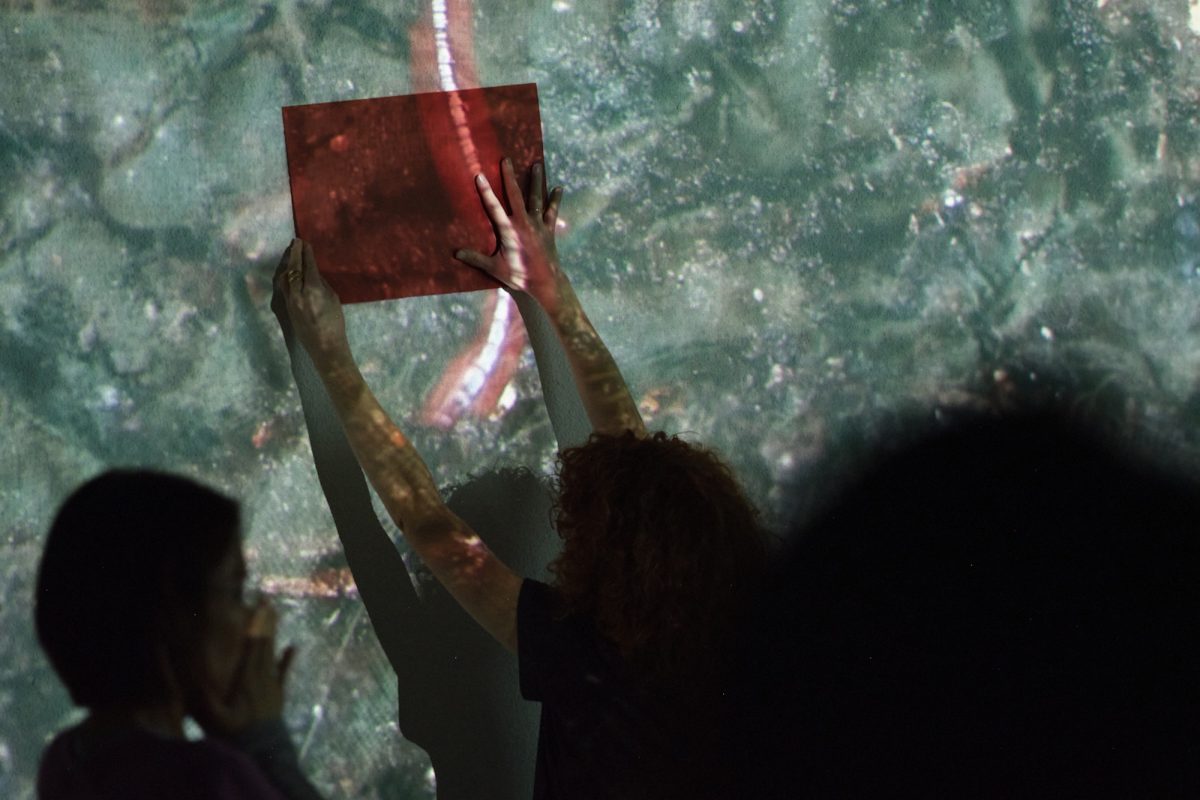
You often translate text into fabric, movement, or sound. What happens to language for you when it’s stretched across a body or turned into something wearable, as you say?
When language appears on objects it evokes the voice, or possible voicings. And therefore also a possible intimacy, if we nudge it closer to the realm of ‘expression’. At the same time, language can also be ‘information’, it can move closer to a ‘document’. So language stretched across a body or an object suggests there’s something to be learnt, something to be known, even if that knowledge resists us. Depending on how the language appears it might also suddenly seem much more visual than we usually give it credit for, but it is ultimately also a form of drawing, an abstraction we have learned to read.
When I encountered your work at Pipeline Gallery, it really foregrounded reading as something bodily and relational rather than purely cerebral. What stayed with you from working within that framework?
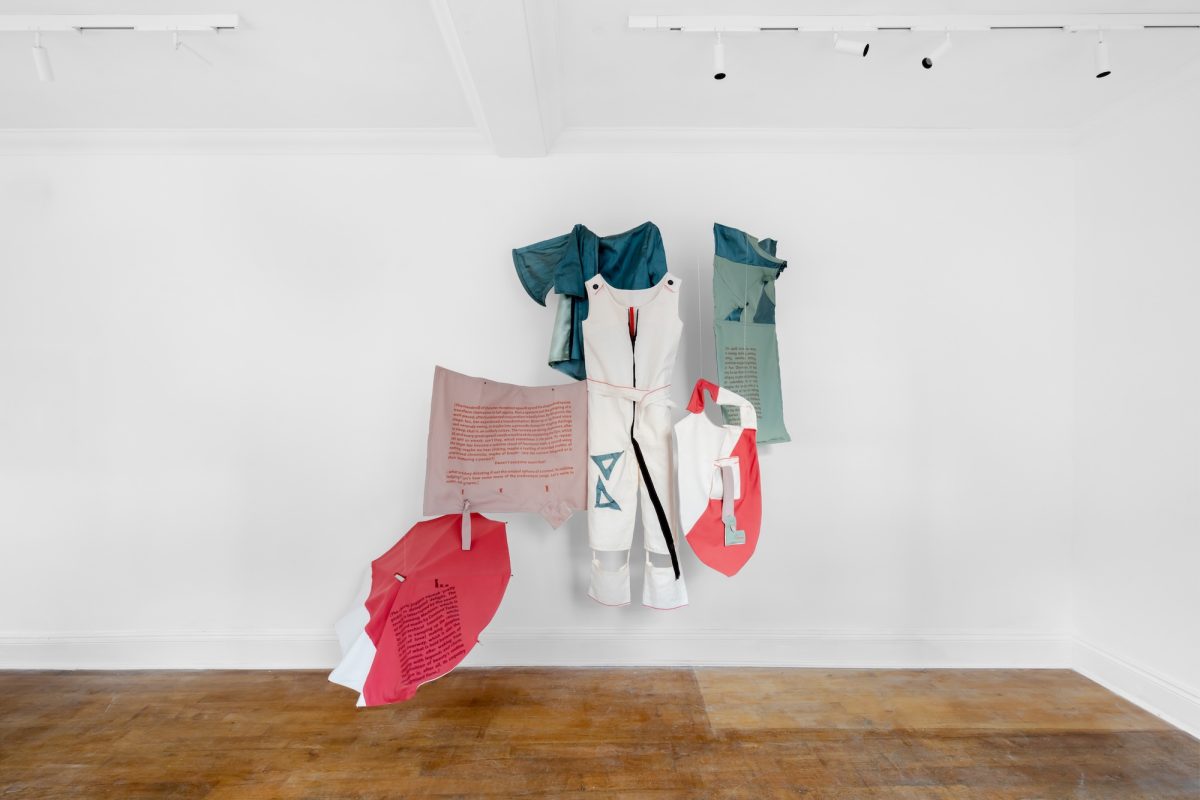
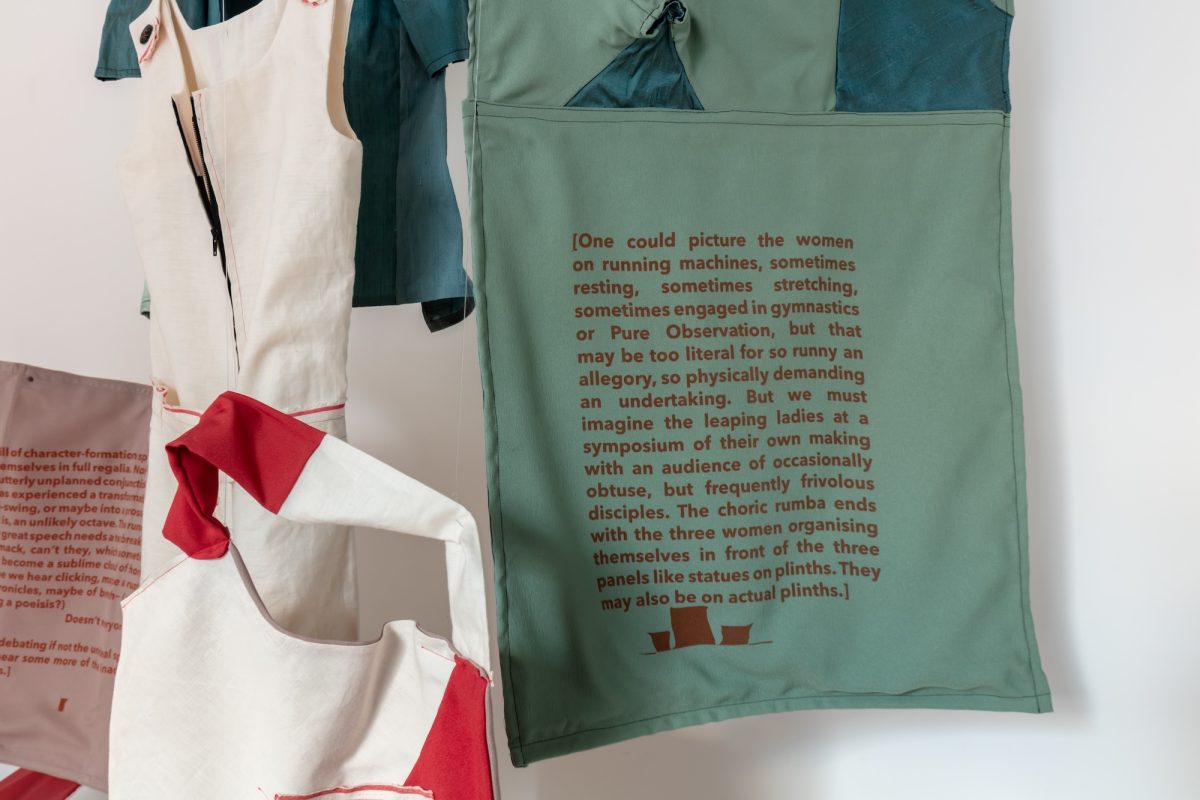
Pockets of Avoidant Attachment (2025) are arranged a bit like a sentence. We could consider the work an exploded garment-artist-book. The sound piece which is part of the installation and hidden within one of the textile pieces is really crucial and contributed to that feeling of bodily reading you describe—the garments are ‘speaking’ or ‘singing’ to us. They ask to be listened to. They’re also debating love at an imaginary banquet. It started off as a (queer & more personal) spin on Plato’s symposium, but then really became a piece about the theories of love and desire we trade with friends; the type of interpretation or reading that love interests and friends offer us. A lot of my work creates text out of various source materials, and text for me is always relational, a dialogue with other voices—whether past, present, explicit or implicit. In this piece, I also remix some lines from (former) lovers and friends, it’s a citational palimpsest, a fragmentation of the self, which is also mapped onto the garments which are really interested in parts, scraps, holes, the non-functional. The sound too is relational because everything is generated out of my voice, even the bits that sound more ‘musical’, they’re splinterings, layers, stretched or tweaked bits of my voice.
And looking ahead, are there projects or forms you’re excited to spend time with next — even if they’re still half-formed or speculative?
I’m going to be in a group show at Akademie der Künste in Berlin, which opens in March, for which I’ve made a performance and another textile and sound installation in the form of these hanging columns and a swing, both are covered in graphic scores and language, and I’m writing and recording a creative audio description for it, which will form part of the work.
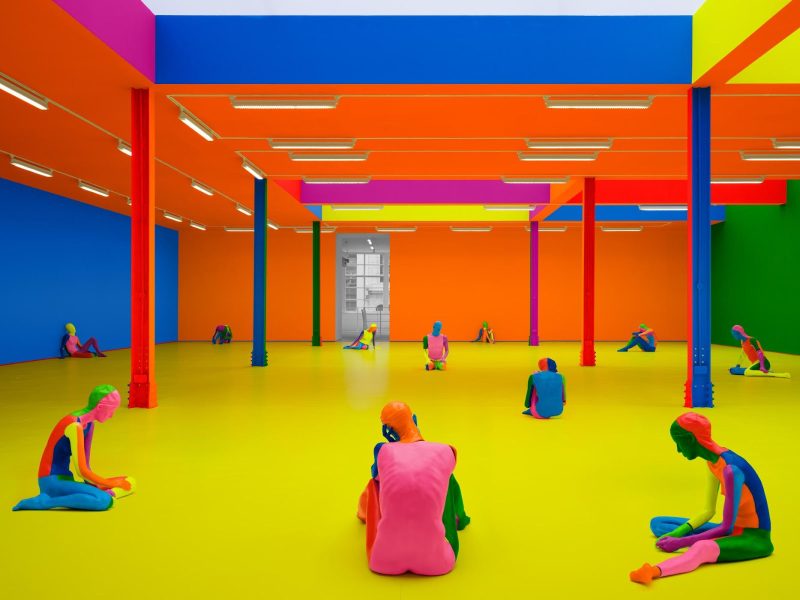
Aside from this and other concrete plans, I’m quite excited to do some drawing in the studio, just for the joy of mark-making and mapping. Last year, I made some limb-like Perspex vowels as part of my Studio Voltaire residency and included them in my performance plastic lip slot machine at Goldsmiths CCA (lead image), and I might want to return to them and make more; I also want to take more singing lessons, and I’m cooking up new sound and performance projects with two collaborators so that’s on the horizon too.
Sophie Seita is an artist who works with an expanded understanding of language, negotiating the presence or absence of the body or voice, and treating any material as a surface for inscription or occasion for listening. Recent work has been presented at Seoul Museum of Art (SeMA), Kafkárna (Centre for Arts and Ecology, Prague), Ruta del Castor (Mexico City), BAAD! (New York City), Cluster Festival (Winnipeg, Canada), TACO!, Nottingham Contemporary, Mimosa House, Grand Union (Birmingham), diffrakt (Berlin), ZK/U (Berlin), and Café Oto. She teaches in the School of Art at Goldsmiths, and recently held residencies at Akademie der Künste (Berlin), Studio Voltaire (London), Asortymentna Kimnata / Khata Maysternya (Ukraine) and Künstler*innenhäuser Worpswede (Germany) as part of Songs of Serpents: Ecopoetic Zones. Their latest book is Lessons of Decal (87Press, 2023), a meditation on reading and listening, on the things and experiences that leave an imprint on us in unpredictable, messy, and desirous ways. A lecture performance on backs is available through Texte zur Kunst.
MORE: @sophieseita