Li Shuangqiang’s practice was recently featured in a solo programme within SWANFALL ART’s annual exhibition Fables at Mall Galleries in London.
The title, drawn from Zhuang Zhou’s allegory of the “butterfly dream”, points to the instability of identity and the porous boundaries between reality and imagination. In the exhibition, Li assembles eight portraits into a constellation that spans disciplines and epochs – thinkers such as Nietzsche, Weber, Foucault, and Benjamin; writers Edgar Allan Poe and H. P. Lovecraft; filmmaker Andrei Tarkovsky; and the philosopher Zhuang Zhou.
Traditionally, portraiture has served as a medium of commemoration and inscription. Li Shuangqiang, however, reactivates this tradition through a visual grammar of uncertainty: at once an homage to intellectual legacies and a critique of their authority. Here, the image responds to the idea, and the idea unsettles the image. These works are not reconstructions of historical figures but interpretative images, generated through the artist’s sustained research and personal reflection – a rewriting of intellectual history. Li shapes his portraits in the form of thought itself, rendering the figures as embodiments of ideas rather than likenesses of appearance. Each portrait carries the temperament and resonance of a particular intellectual spirit: the grotesque detachment of H. P. Lovecraft, or the dark estrangement of Edgar Allan Poe. In this way, the figures are no longer passive subjects but the very materialisation of thought.
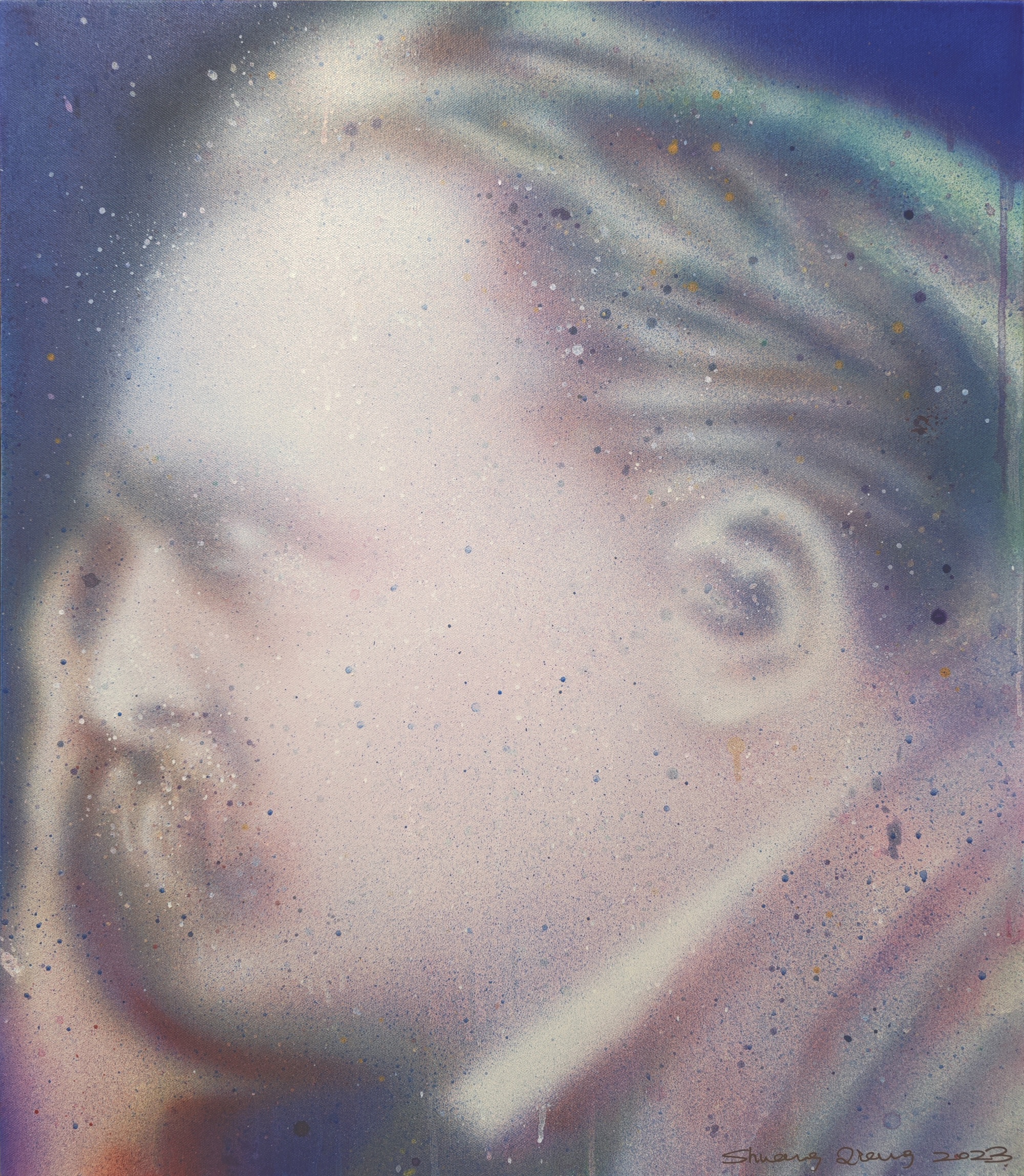
Through the blurring, ruptures, and drift produced by acrylic spray and watercolour, the figures waver between emergence and disappearance, embodying the continual generation, dissolution, and transformation of thought across history and personal interpretation. In this space, art and philosophy become mirrors of one another: thought is no longer confined to the written word but reanimated through visual experience; art, likewise, is released from the limits of formal rhetoric to become an extension and renewal of thought itself.
Practice Development
Contemplative Thinker, Rational Creator Li Shuangqiang’s artistic practice is rooted in a sustained exploration of medium and rigorous academic training. Moving from copperplate etching to watercolour and acrylic, he has gradually constructed a cross-media system of techniques while persistently seeking a homology between material and thought. In his work, technique is not merely a formal tool but a grammar that carries intellectual and emotional density. His practice thus unfolds a multilayered material logic: between slowness and acceleration, depth and drift, transparency and density – where thought is rendered visible in states of emergence, disappearance, and regeneration
Etching Phase | Thought Amidst Dust In 2012, Li entered the Central Academy of Fine Arts (CAFA) with sixth place nationally in fine arts. By 2014, in CAFA’s First Printmaking Studio, he had established intaglio as his core medium and established copperplate etching as his principal medium. The inherent resistance and slowness of the copperplate offered him a language aligned with the descent of thought into depth and shadow.
Etching (Technique) | The Point of No Return Intaglio is an art form that allows almost no mistakes. Marks left by a burin or needle on the metal plate are irreversible, requiring extreme precision and patience throughout the process. This irreversibility makes intaglio a stringent test of craftsmanship. During his undergraduate years, Li systematically mastered mezzotint, stippling, and drypoint, distinguishing himself through exceptional technical discipline. His prints embody strict control over technique, yet it is through the slow and meticulous process that his themes acquire intellectual depth and expressive intensity.
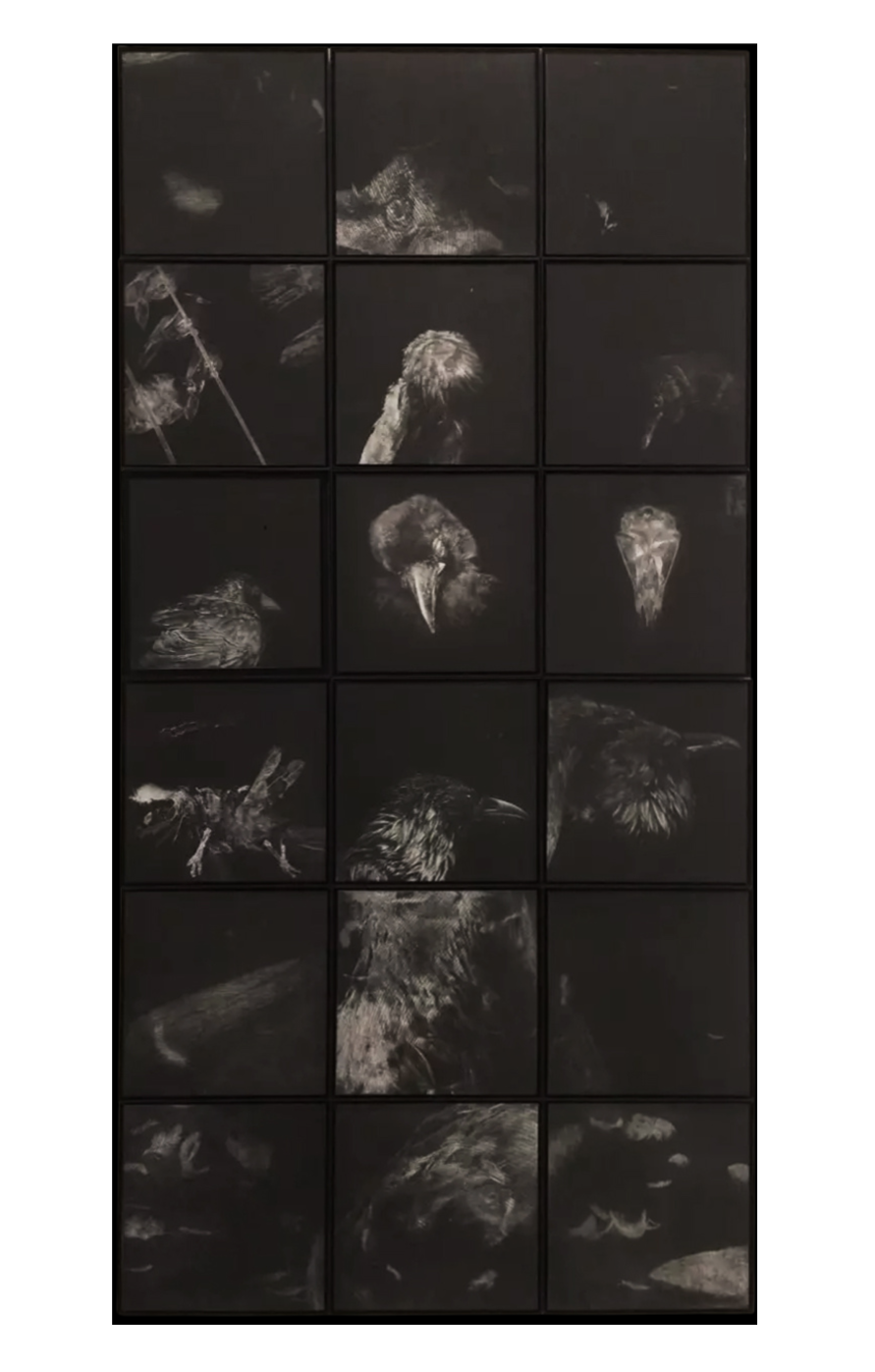
Li’s early representative work, Elegy of the Lost (2016) concentrates on the convergence of intaglio and modern image-making. Using mezzotint and light-based treatments, the works evoke the effect of a flash in the night. For its installation, Li arranged the pieces into eighteen units, simulating the brief life of a crow as it was replayed on eighteen monitors. Through inversion, the images resemble X-ray plates – at once coldly forensic, like surveillance footage, and resonant with the ephemerality of life and memory. This visual strategy evokes the symbolic presence of the raven in Edgar Allan Poe’s “The Raven,” weaving together themes of death, memory, and mediated existence. Ultimately, the series reveals how mediated perception shapes the very conditions of viewing.
The series not only demonstrated Li’s mastery of technique but also his acute response to contemporary social realities, earning significant academic attention at the time. ” Elegy of the Lost” was awarded the CAFA Undergraduate Excellence Award and is now held in the collections of the CAFA Art Museum and the Xuyuan Art Museum.
In 2018, Li entered CAFA’s postgraduate program in printmaking. The Limbo series marked a pivotal shift in his practice. Drawing on Dante’s Divine Comedy, the series adopts “limbo” as a metaphor for the dual collapse of reason and faith, translating it into a visual language. Fragmented religious icons and recurring hand motifs, rendered through copperplate etching, evoke a state of spiritual drift and displacement, addressing the anxieties of accelerated civilization and fragile memory. Here, the slowness of intaglio accentuates the sense of existential impotence, transforming the image into a record of spirit fractured from belief.
His graduation work, Limbo (2021), was acquired by the CAFA Art Museum and the Printmaking Department, and he received the Zhonghe Foundation Prize. The series was highly regarded within academic circles and further validated through institutional collections and foundation recognition, underscoring the professional weight and continuing impact of his trajectory. With this, Li’s exploration – rooted in thought and media experiment – gained wider acknowledgment, establishing his distinctive position among a new generation of artists.
During his postgraduate studies, while continuing his intaglio practice, Li Shuangqiang also actively explored new media in response to the demands of his themes. Driven by his interest in media theory, he began to incorporate digital glitch aesthetics into watercolour, developing a distinctive visual language that achieved notable recognition both academically and in the market. Unlike the resistance and slowness of intaglio, watercolour – with its transparency and permeability – provided him with a more flexible image-making process. Through layering, dislocation, and deliberate disruption, Li endowed the medium with a grammar of disorder, allowing the images to oscillate continually between revelation and distortion.
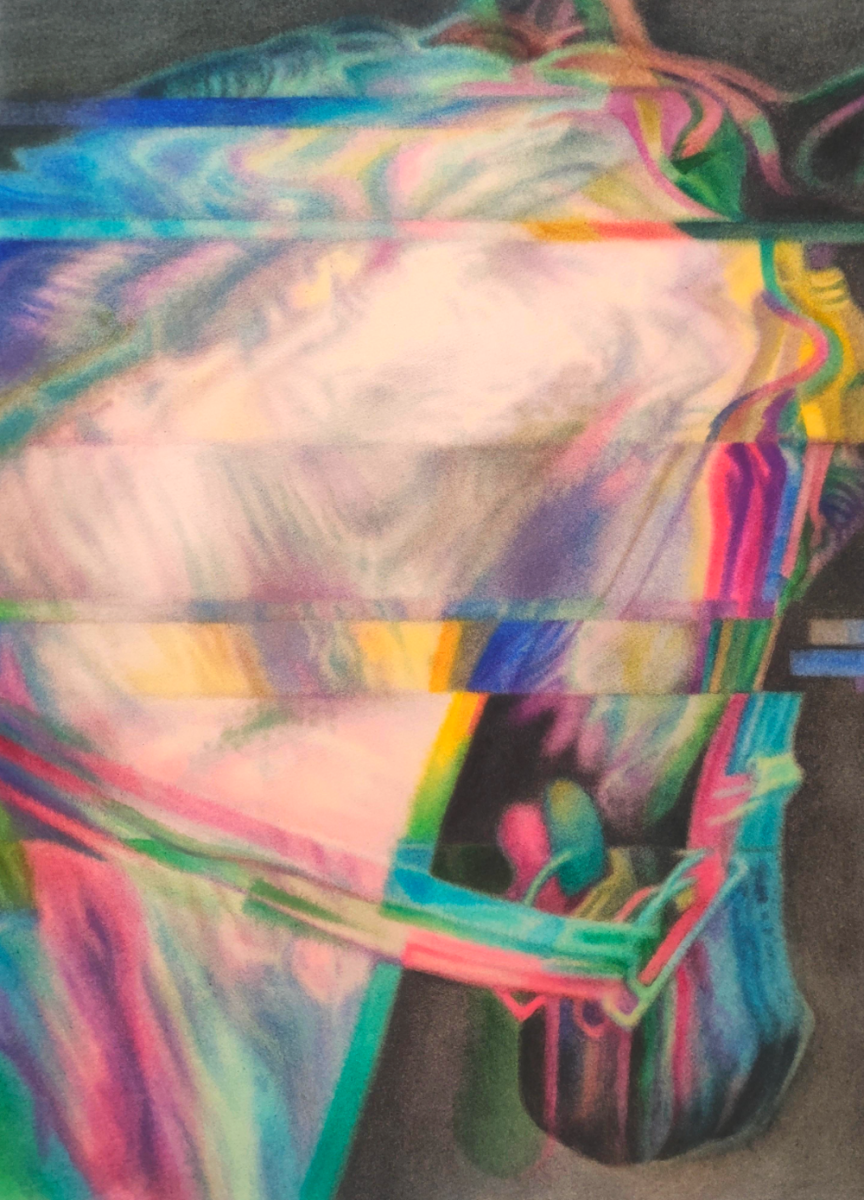
Among his most well-known works, the Turin Horse series draws on the story of Nietzsche in Turin. As recounted, Nietzsche once witnessed a coachman brutally whipping a horse in the street; he intervened, embraced the horse, and wept. In Ecce Homo: How One Becomes What One Is, Nietzsche wrote: “My formula for greatness in a human being is amor fati: that one wants nothing to be different, not forward, not backward, not in all eternity.” Nietzsche’s thought contains both an acceptance of fate and impermanence and an insistence on transcendence through the will to power and life itself. Béla Tarr’s film The Turin Horse similarly envisions an apocalypse beginning with a horse that refuses to serve as a tool, resisting human domination. In Li Shuangqiang’s Turin Horse series, the horse becomes a metaphorical figure. Through glitch aesthetics and seemingly illogical colours, he constructs an experience of dissonance and disruption, turning the image into a parable of fate, resistance, and the existential condition.
In 2023, Li Shuangqiang entered the doctoral programme in Thematic Art Creation at the Central Academy of Fine Arts, marking a new stage in both his academic and artistic trajectory. During this period, he not only continued his path of cross-media experimentation but also situated his work within the academic framework of thematic creation, further deepening his inquiry into the dilemmas of modernity and the complexities of spiritual heritage. Doctoral research provided him with a broader theoretical foundation, enabling his practice to extend beyond the level of visual experimentation and to engage more directly with discourses of ideas, society, and history
At this stage, Li’s work developed increasingly surreal qualities. Acrylic spray painting, characterised by atomisation, diffusion, and layered accumulation, produced images that hovered between appearance and disappearance. Clear contours were deliberately effaced, leaving forms in a state of drift and dislocation, continually generating and dissolving as if within an extended dream
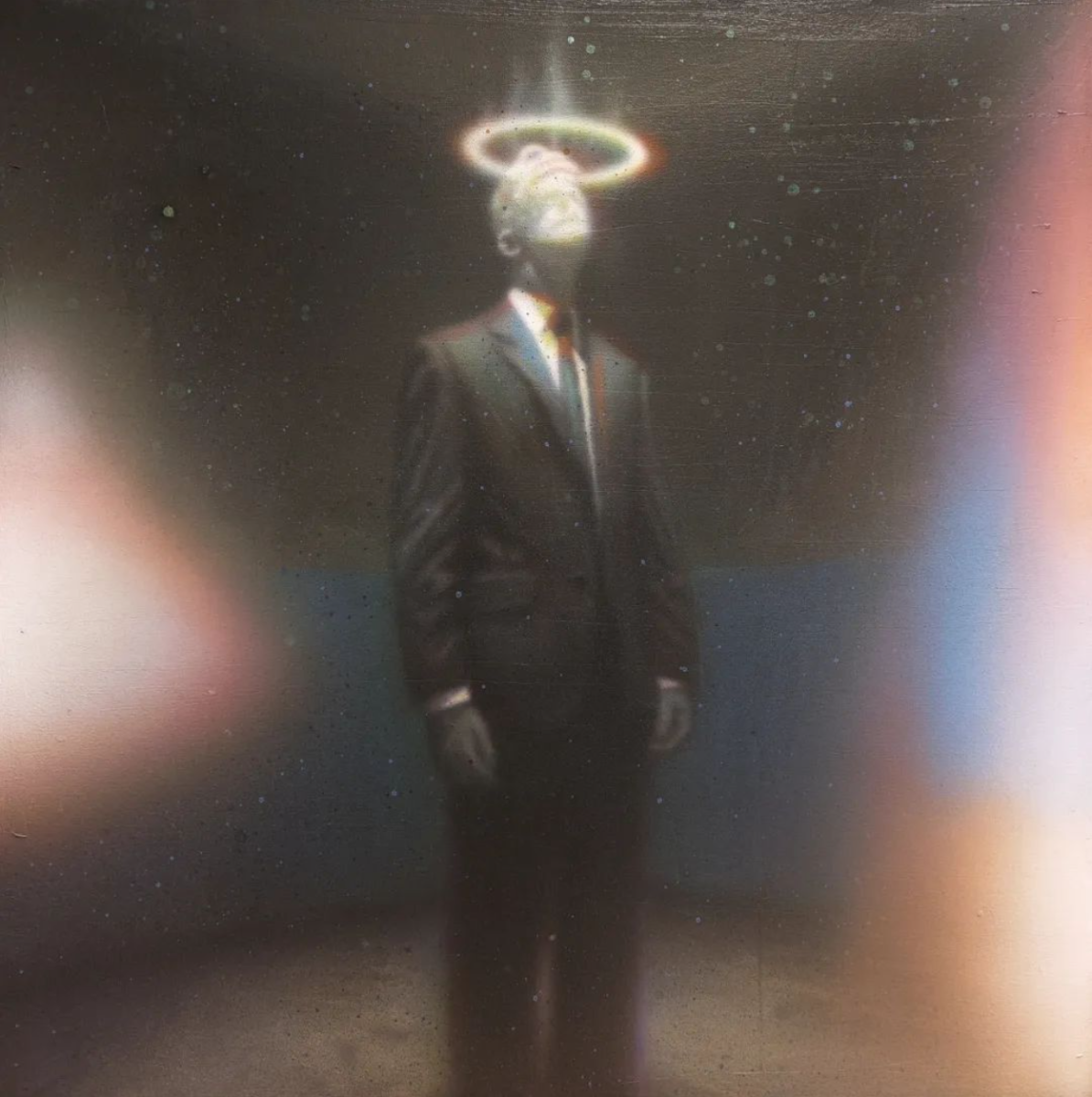
The Long Dream series probes the realm of the unconscious, where time is infinitely extended and the boundaries of past, present, and future gradually dissolve. Through acrylic spray painting, Li transforms the relation of time, consciousness, and image into a dynamic experience, drawing the act of viewing itself into a dream-like process of formation. In doing so, the series moves beyond figurative representation, opening a space between reality and fiction – at once familiar and estranged – within which a coherent worldview and narrative structure gradually take shape
About the artist
Li Shuangqiang (b. 1992, Dandong, Liaoning Province) is a Beijing-based artist and, since 2023, a represented artist of SWANFALL GALLERY. His practice spans multiple media, including copperplate etching, watercolour, acrylic spray, and oil painting. Far from being mere formal exercises, his works are grounded in systematic research and function as processes of translating thought into visual form.