In an art world dominated by rapid consumption and digital abstraction, Tingting Xiao’s textile practice stands as a countercurrent — tactile, slow, deeply rooted. Yet her work is anything but nostalgic. It is precise, considered, and alive with a quiet intensity.
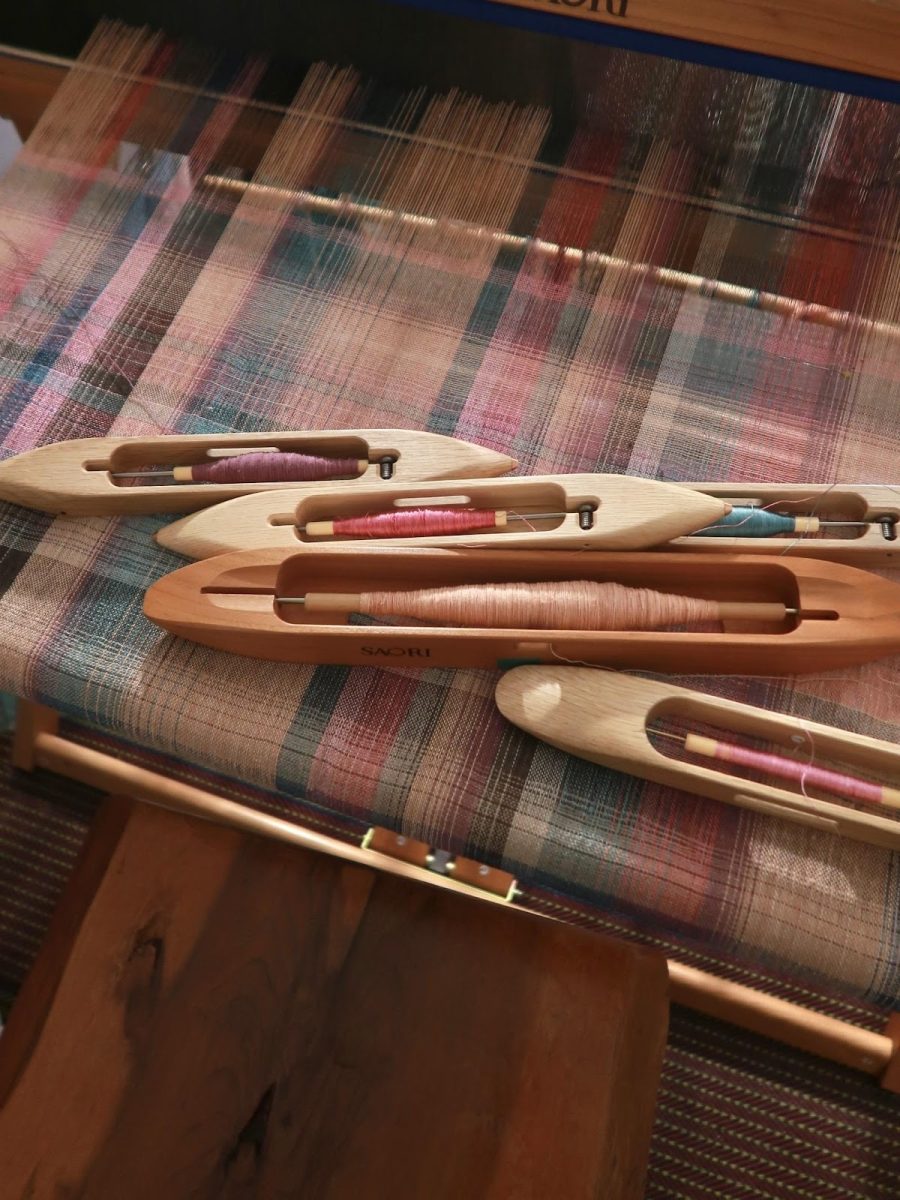
“The shuttle becomes my brush, the silk-filled bobbin my pigment, and the cotton warp my canvas.”
Born in Chaoshan, southeastern China — a region known for folk ritual and spiritual lore — Tingting was shaped by the invisible forces of belief and material. As a child, she was immersed in visual cues of devotion: the glint of altar silk, the geometry of paper talismans, the scent and softness of cloth used in religious offerings. These early memories would quietly anchor her later work.
She later worked in a private cheongsam atelier, where she became intimately familiar with how fabrics can contour the body and soothe the soul. More importantly, she absorbed the architectural logic of Chinese garment-making: how flat textiles become three-dimensional through rhythm and fold, how material follows energy lines of the body rather than resisting it. These foundational experiences — of hand-touch, of slowness, of ritualised making — became the bedrock of her textile philosophy.
This insight would later define her signature “Conceptual Woven Bag” series: objects woven in a single flow on the loom, folded into form without cutting or sewing. This method, inspired by traditional cheongsam construction and adapted through contemporary weaving, allows her to eliminate material waste while preserving structural elegance. The result is not only materially sustainable but spiritually coherent — reflecting a sense of internal continuity that Tingting believes should be felt both by the maker and the wearer.
Rather than positioning her work in opposition to technology or industrialization, Tingting leans into another realm altogether — one defined by tactility, spiritual resonance, and memory encoded in material. In this way, her practice doesn’t merely revisit heritage; it enacts it, slowly and deliberately, thread by thread.
Intergrade: Unfinished Migration (April 2025, Indra Gallery)
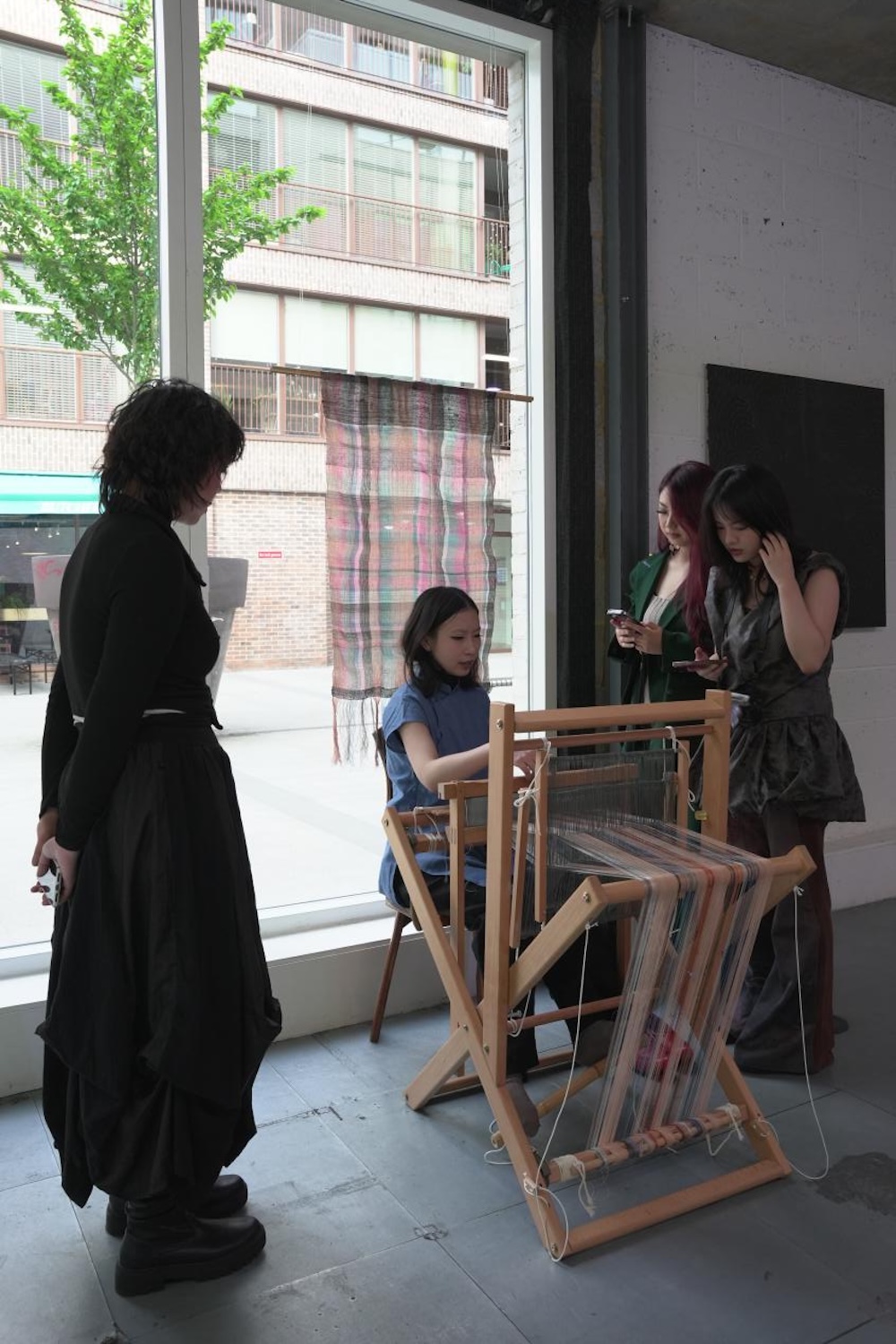
At Intergrade: Unfinished Migration, Tingting installed her full-sized loom directly into the gallery space. Towering yet humble, the loom stood as both a sculptural object and a working tool. During the exhibition’s opening days, Tingting occupied the space, weaving in real time. Visitors — many of whom had never encountered a loom, let alone a person actively using one — gathered, observed, and asked questions. For Tingting, this was more than presentation; it was presence.
“Weaving is meditation, The rhythm, the color transitions, the resistance in fiber tension — it aligns your thoughts.”
Tingting
In this context, the act of weaving became a public ritual of stillness. It was not performance art in the theatrical sense, but a quiet demonstration of patience and internal discipline. The repetition of movement, the slowing of time, the sound of shuttle against yarn — all contributed to an ambient, reflective atmosphere. One viewer described it as “watching someone think with their hands.”
The gesture also subtly disrupted common expectations within a contemporary art gallery. Instead of delivering a finished product for static consumption, Tingting introduced a durational process — slow, evolving, and somewhat unpredictable. The loom became a temporal device, recording time in cloth, offering viewers a momentary suspension from the image-driven pace of the world outside. More significantly, it served as a reminder that making can be a form of being.
The Softness Outside of Me (May 2025, London Craft Week, 19 Beak Street)
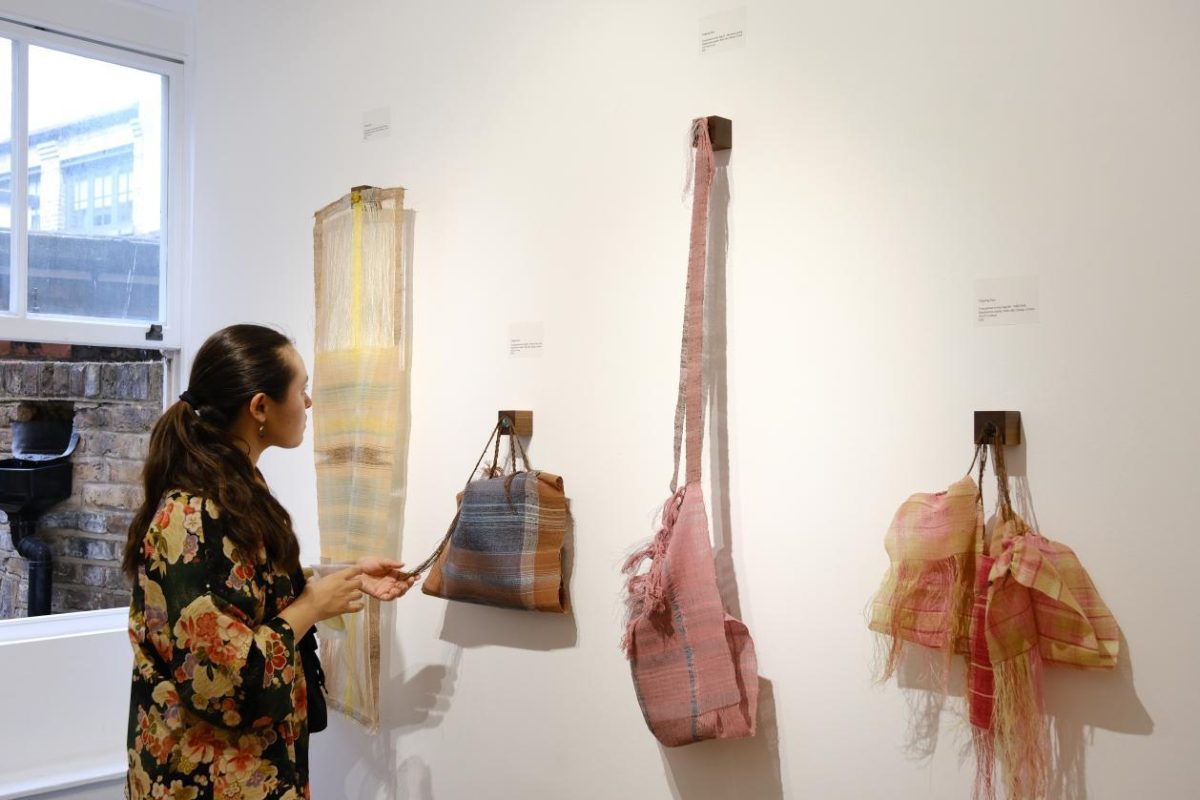
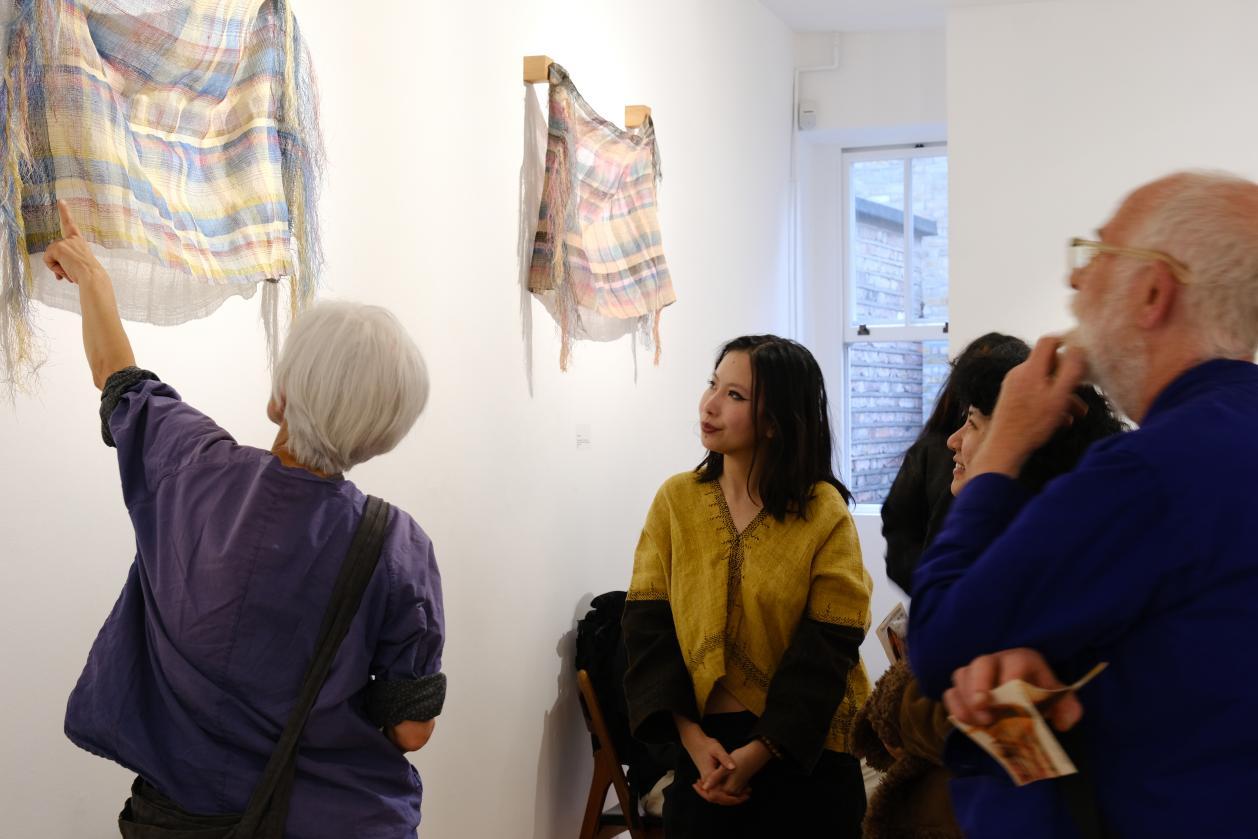
In her solo exhibition The Softness Outside of Me, part of London Craft Week 2025, Tingting shifted from performative process to visual atmosphere. Installed in a narrow, skylit gallery in Soho, her hanging textiles moved gently with the ambient air — an unintentional but poetic activation of their lightness. Audiences described her work as “delicate,” “translucent,” and “otherworldly.” One noted: “It felt like breathing with my eyes.”
Unlike many textile works that emphasize density, structure, or narrative imagery, Tingting’s pieces hovered like breath — neither fully abstract nor strictly ornamental. Their visual impact resided not in force but in attenuation — the way fine threads caught and diffused light, how subtle tonal transitions seemed to shimmer across the woven surface.
Tingting attributes this distinct aura to her use of Asian natural yarns, including handspun raw silk hemp, and cotton sourced through small artisan networks in Thailand and southern China.
“These materials have a different rhythm,”
she explains.
“They carry the hand of their maker, the climate of their origin. They behave differently on the loom. And I try not to control them too much.”
Crucially, she invited touch. Unlike many contemporary textile exhibitions where “Do Not Touch” signs are ubiquitous, Tingting encouraged viewers to interact. “Look closely, but also feel it,” she told them. The shimmer of silk, the tension between warp and weft, and the way color subtly shifted across the plane were all part of what she calls a visual experiment — not in the scientific sense, but in the experiential: designed to elicit emotion and presence through visual texture.
By engaging both sight and touch, Tingting’s work collapses the distance between viewer and object. Her textiles refuse to be merely looked at — they ask to be felt, entered, and remembered.
Resonance: Echoes of Material and Memory (May 2025, London Craft Week Deptford Market Yard)
In Resonance, a group show curated alongside several senior textile artists, Tingting took a more sculptural turn. She presented three vessel-like forms — at first glance, they suggested traditional basketry or coiled hand-knotting. But closer inspection revealed a quiet innovation: each form had been woven entirely on 4-shafts loom without any hand-stitched.
This approach was both unexpected and conceptually rich. “Most people assume those shapes must be hand-built,” she notes, “but I wanted to see if I could achieve them on the loom — to translate softness into structure.” The result was a trio of forms that challenged preconceived boundaries between woven flatness and three-dimensionality.
Material again played a key role. Tingting used raw hemp handspun by Thai women artisans, whom she met during a previous residency. By incorporating these materials, she established a transnational collaboration that honored local knowledge while reframing it within a contemporary aesthetic context. “It’s not just using their yarn,” she says. “It’s carrying their rhythm into another space.”
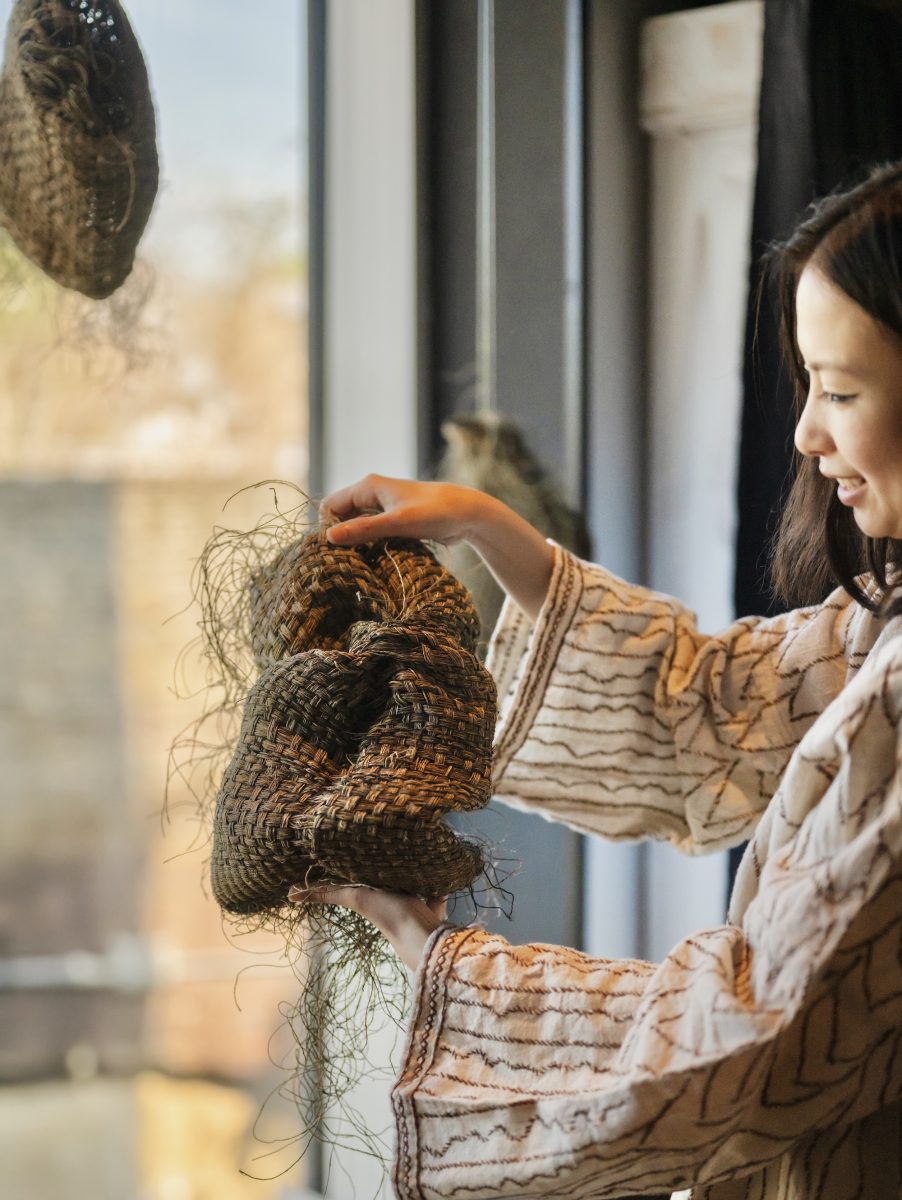
The response from professionals was immediate. “She’s changing how structure is imagined on the loom,” noted one curator. “It’s subtle, but it’s a conceptual leap.”
While the average viewer may not have detected the technical departure, those within the textile field understood the risk — and the reward — of such experimentation. For Tingting, it was also a political gesture: inserting voices, materials, and techniques from the margins into the fabric of contemporary exhibition culture.
Tingting Xiao is not reproducing tradition. She’s translating it — thread by thread, tension by tension.
Her work doesn’t clamor for attention. It refuses spectacle but embraces presence. She offers slowness as a gift, texture as language, and craft not as an aesthetic category but as a mode of sensing, remembering, and healing.
In a time when touch is often mediated by glass and speed is fetishized, Tingting’s textiles invite us to pause, breathe, and feel — not just with our fingers, but with our full attention.