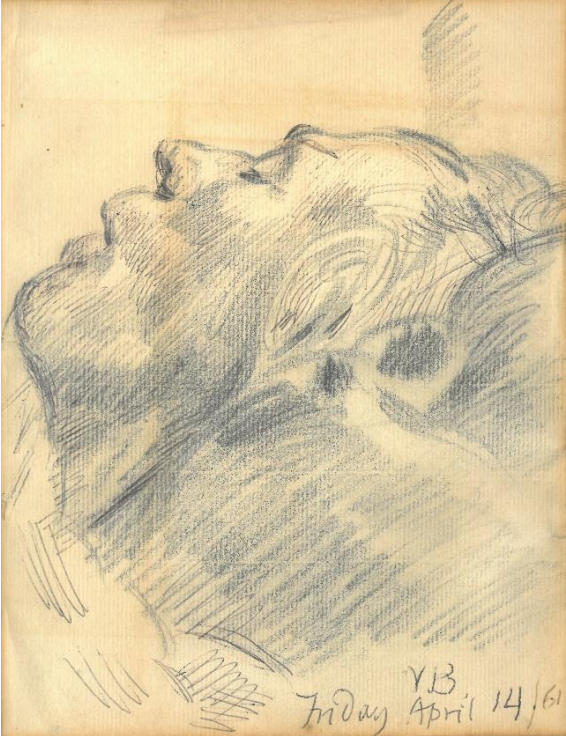
A previously unknown drawing of Vanessa Bell by Duncan Grant has been discovered at Charleston, believed to be the final portrait he made of his lifelong friend, artistic collaborator, companion and sometime lover.
The intimate drawing came to light during preparations for Tate Britain’s forthcoming exhibition Vanessa Bell & Duncan Grant: Inside Bloomsbury and had been unknown to scholars, having remained among family papers for more than 60 years.
The family has now donated the work to Charleston, where it will enter the permanent collection as part of the museum’s 50 for 50 campaign, which aims to secure 50 major Bloomsbury works for the collection by 2030.
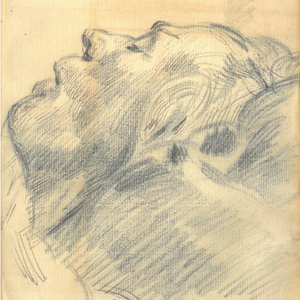
Made in soft pencil and biro on paper, the drawing shows Bell lying with her eyes closed, viewed from the side and slightly below, as though Grant were sitting beside her bed. Far removed from the colour, pattern and decorative exuberance associated with both artists, just a handful of lines describe Bell’s face at rest.
Grant returned to Bell as a subject throughout their lives together, producing numerous paintings, drawings and studies. Important portraits are held in national collections including the National Portrait Gallery, while Charleston itself holds several major examples.
In 2019, a full-length portrait of Bell painted by Grant in 1915 was accepted for the nation through the Acceptance in Lieu scheme and allocated to Charleston. Painted near the beginning of their intimate relationship, it records the start of a remarkable shared life. This newly discovered drawing appears to document its end.
Bell died at Charleston on 7th April 1961, aged 81, following a short illness, and was buried at St Peter’s Church in nearby Firle. Grant continued living and working at Charleston until his death in 1978 and was buried beside her.
There is, however, one intriguing complication. Although the drawing appears to have been made at Bell’s bedside, it is dated 14th April 1961, two days after her burial.
Dr Darren Clarke, Head of Collections and Research at Charleston, believes Grant may have added the date retrospectively.
“We know that in Duncan’s later years he and friends spent a great deal of time going back through the huge body of work in his studio, identifying and dating pictures so that they could be recorded, exhibited and sold. Those dates are not always reliable. What seems very likely here is that Duncan knew this drawing had been made around Vanessa’s death and later added a date from memory. He got remarkably close, but apparently not quite close enough. Everything about the drawing itself – its viewpoint, its intimacy and its extraordinary economy – suggests someone sitting quietly beside Vanessa’s bed and drawing the face he had known for half a century.”
Artists have drawn those closest to them at the end of life for centuries, creating images that sit somewhere between portraiture, personal record and an act of grief. Among the best-known modern British examples are Maggi Hambling’s drawings made beside her dying father and later works depicting family and friends after death.
Although the drawing was identified while preparing Vanessa Bell & Duncan Grant: Inside Bloomsbury, it will not appear in the Tate Britain exhibition itself, though a small reproduction is expected to feature in the accompanying catalogue.
Charleston is the exhibition’s largest lender, with its centrepiece recreating Duncan Grant’s studio. The studio’s entire contents are being loaned to Tate while Charleston undertakes a £470,000 conservation project to safeguard the historic space.
The newly donated drawing will remain at Charleston for documentation and conservation before going on public display in the house for the first time in May 2027, coinciding with the reopening of Grant’s studio.
Nathaniel Hepburn, Director and CEO of Charleston, said:
“I found this drawing deeply moving when I first saw it. We know Duncan’s drawings of Vanessa so intimately, made over the course of their long friendship, that the discovery of a previously unknown work is remarkable in itself. But there is something incredibly poignant about imagining Duncan sitting beside Vanessa, drawing her after her death. It is a very important addition to our ‘50 for 50’ campaign as we approach 2030, the fiftieth anniversary of the saving of Charleston and the founding of the museum.”
Artwork details: Artist: Duncan Grant (1885–1978) Sitter: Vanessa Bell (1879–1961) Title: Portrait of Vanessa Bell
Date inscribed: 14th April 1961. Medium: pencil and biro on paper
Vanessa Bell & Duncan Grant: Inside Bloomsbury runs at Tate Britain from 12th November 2026 to 11th April 2027. Organised by Tate Britain in collaboration with Charleston, the exhibition brings together more than 300 works and includes a recreation of Vanessa Bell and Duncan Grant’s studio at Charleston in Firle.