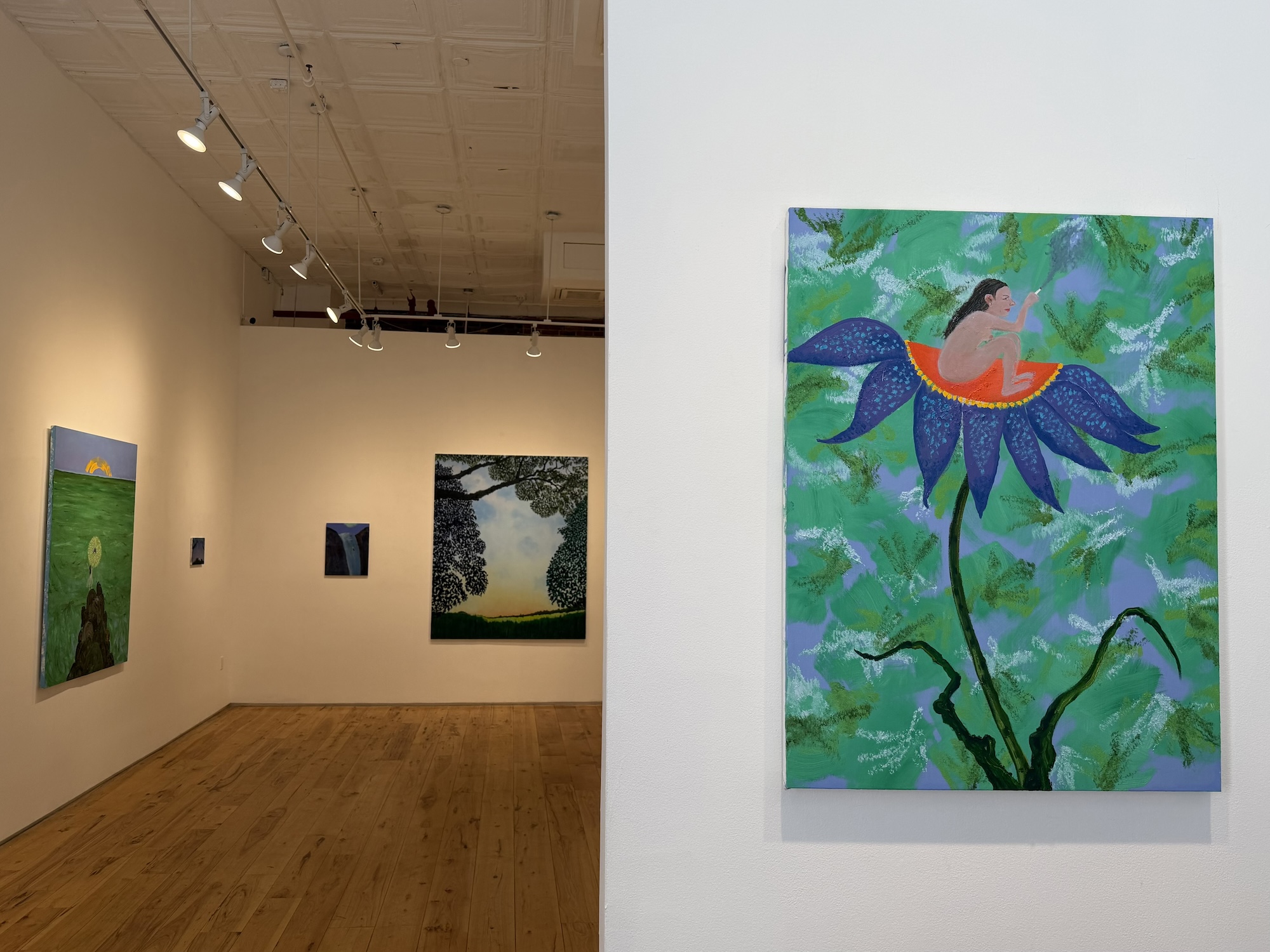
Mary DeVincentis’s solo exhibition at Freight + Volume, Like a Star at Dawn, speaks to the fleeting visibility of a star about to fade into the approaching morning sky. A star at dawn is a near-impossible miracle, made possible by the limits of physics, the balance between opposing forces, and opportune timing. On the one hand, the star is found and rising. On the other, the increasing number of photons enveloping the sky threatens to erase it from the view of those admiring it.
The “star at dawn” is, in fact, part of the famous closing gatha, or verse, of the Mahayana Buddhist scripture known as the Diamond Sutra. It speaks of the impermanence of all things and the illusion of form that makes the world appear “real,” when in fact it is constantly changing, evolving, and disappearing.
Perhaps that is the contradiction — or irony — of painting: to slow down this change and make permanent the impermanent phenomena, dreams, and memories.
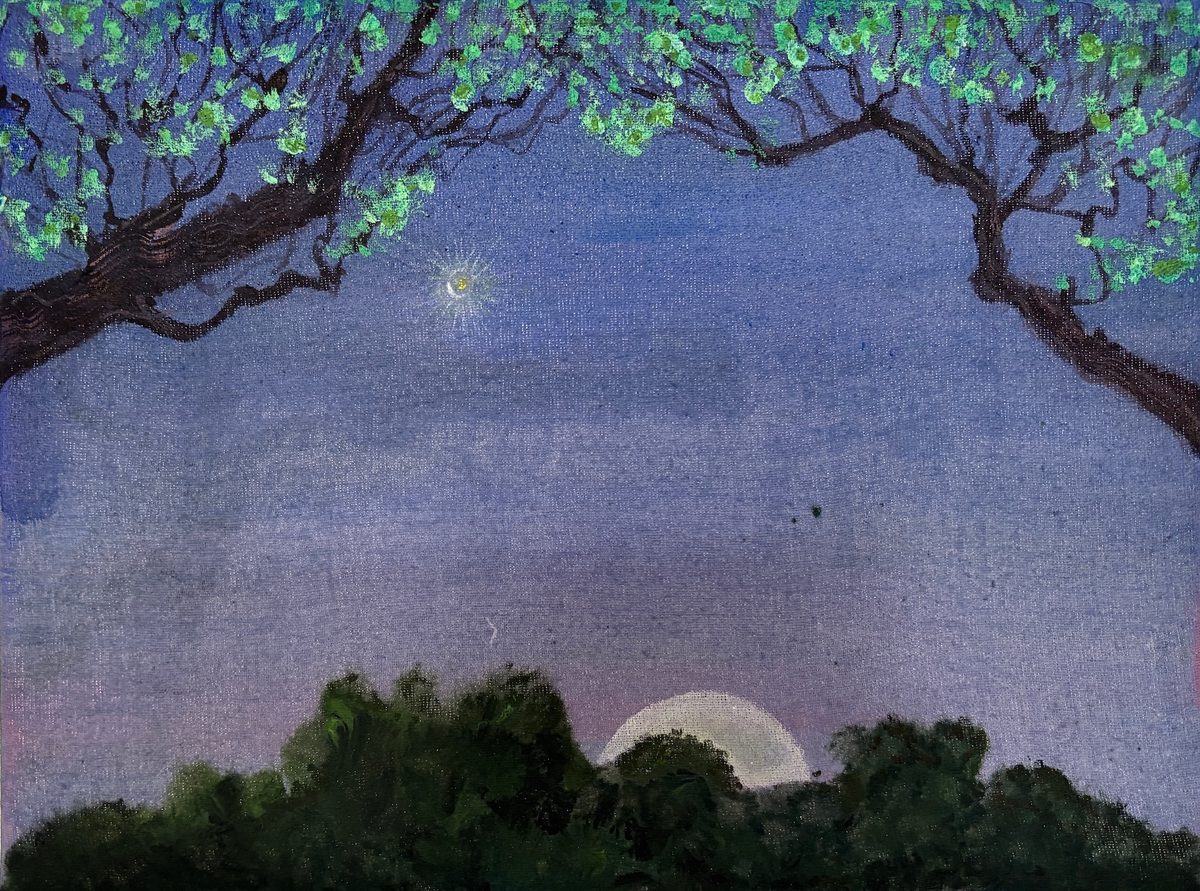
Faith in the Morning Star (2026) may refer to Venus or Mercury appearing in the east before sunrise, or Sirius undergoing heliacal rising — the astronomical phenomenon in which a star becomes visible above the eastern horizon shortly before sunrise.
It could also refer to Aurvandil, the Morning Star or Rising Star of Germanic mythology; Jesus, described as “the bright Morning Star” in the Christian Bible; John the Baptist, called a “bright morning star” in Eastern Orthodox hymnology; Lucifer, whose name derives from the Latin name for the Morning Star; Mary, mother of Jesus, called “morning star” in the Litany of Loreto; the Morning Star of Slavic mythology; or Phosphorus, the Morning Star in Greek mythology.
Perhaps the particular cultural or historical context is less important to understanding the painting than its visual, connotative, and symbolic significance. As mentioned earlier, a morning star — or a star at dawn — is a near impossibility, an oxymoron that manifests at the very limits of what is possible.
DeVincentis does not, however, engage in nearly impossible painting on a technical level. Her paintings appear effortlessly brought to completion, with the casualness or leisureliness of a modern painter. This should not be confused with laziness, which would be poisonous for any painter. Rather, something new can emerge from a less stressful approach to painting.
DeVincentis’s handling of paint varies from surface to surface and space to space. In Faith in the Morning Star, for example, the sky and star are glazed and layered with thin washes, while the tree branches and leaves are dry-brushed in thicker paint.
Where DeVincentis pushes painting forward is through metaphor and meaning. The result is a wonderful and mystical body of work with an inquisitive, curious, and dreamlike sensitivity.
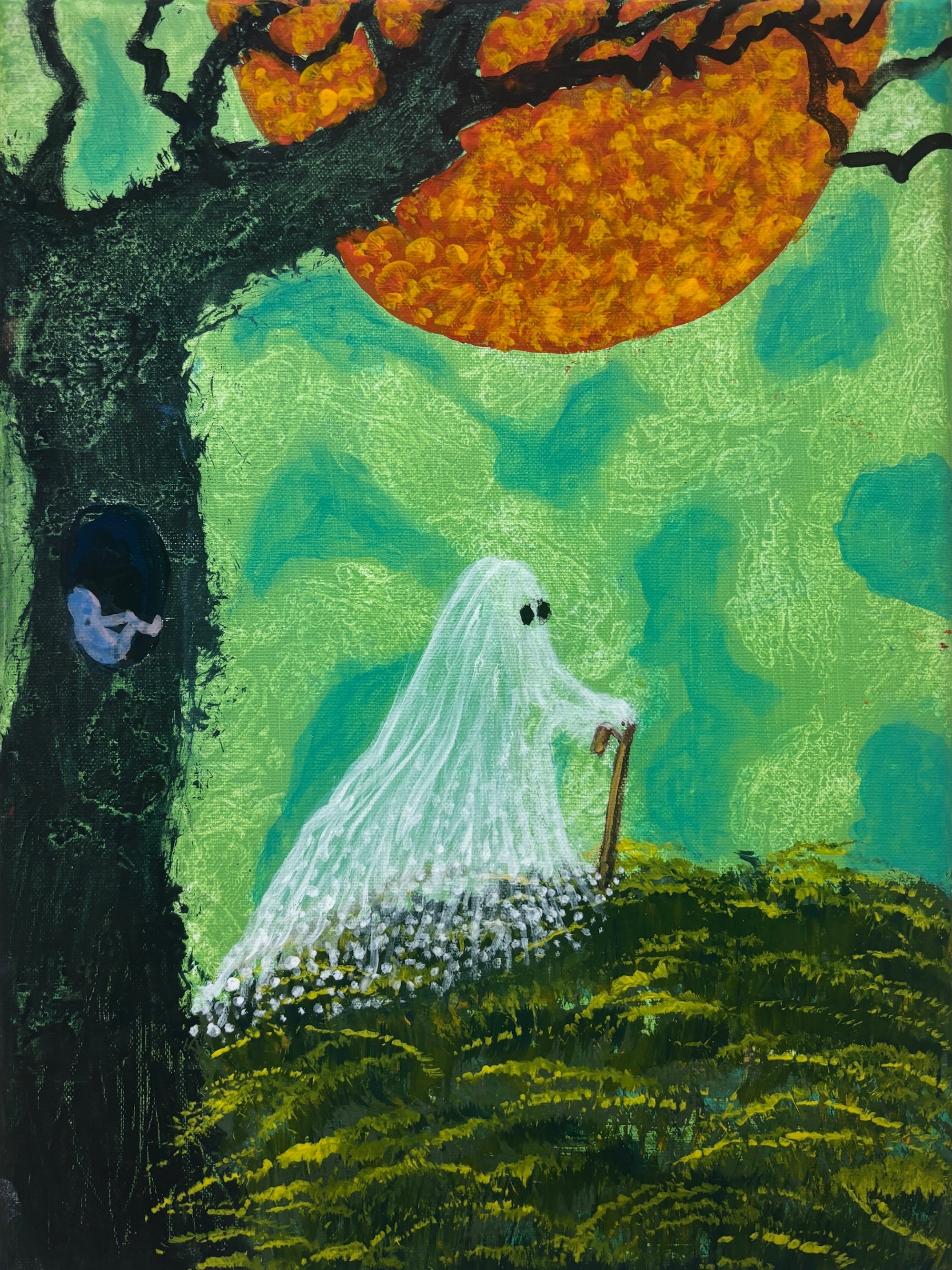
Sunrise, Sunset (2026) also relates to the concept of the morning star, visible just before sunrise, while other stars begin to appear after sunset. In the painting, however, no star is visible. The only two figures are a baby nestled inside the hollow of a tree and a ghost-like elderly character.
The painting is akin to a time machine capable of skimming through multiple iterations of the day, week, month, and year until an equilibrium — or stasis — is reached in the sun’s position in the sky, making it difficult to tell whether the sun is rising or setting.
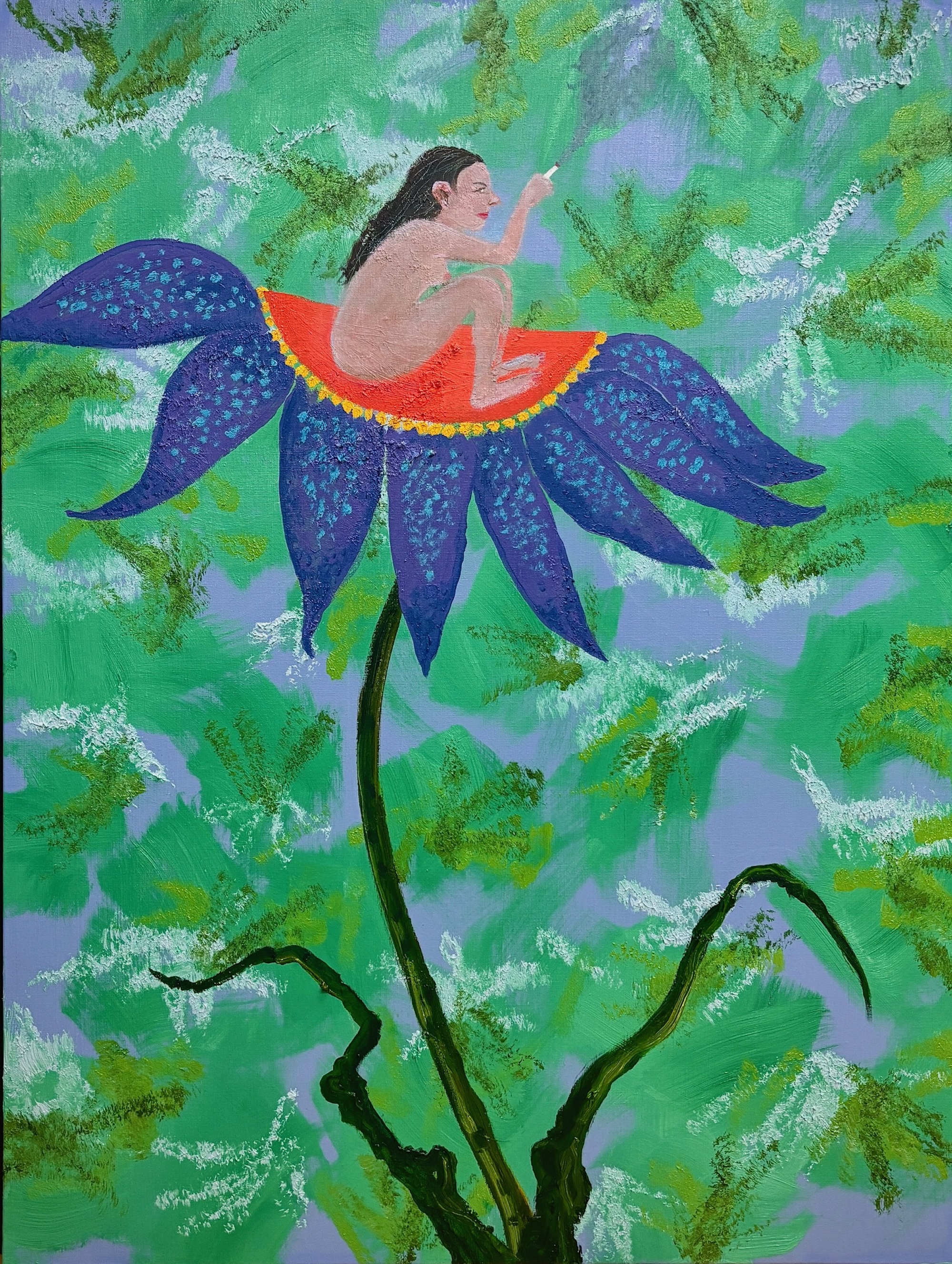
Thinker (2026) depicts a woman in a thinking pose reminiscent of Auguste Rodin’s The Thinker (1880), but with one hand holding a cigarette that produces a minuscule cloud of smoke like a thought bubble. She wears lipstick, but she is not there to please any man.
She is neither idealized nor “pretty” in the conventional sense. The homunculus, nymph, or fairy-like figure is truly a woman looking at herself without considering anyone else’s gaze. It is a form of self-gaze and self-acceptance by a feminist warrior tired of fighting the patriarchal system and the scrutiny of the masculine gaze.
The figure sits atop an orange and blue flower. It is not a lotus, but it introduces another twist: it resembles a sunflower with blue petals rather than yellow ones. The painting resists a dogmatic way of thinking within a closed system by presenting the impossible or unexpected as entirely natural.
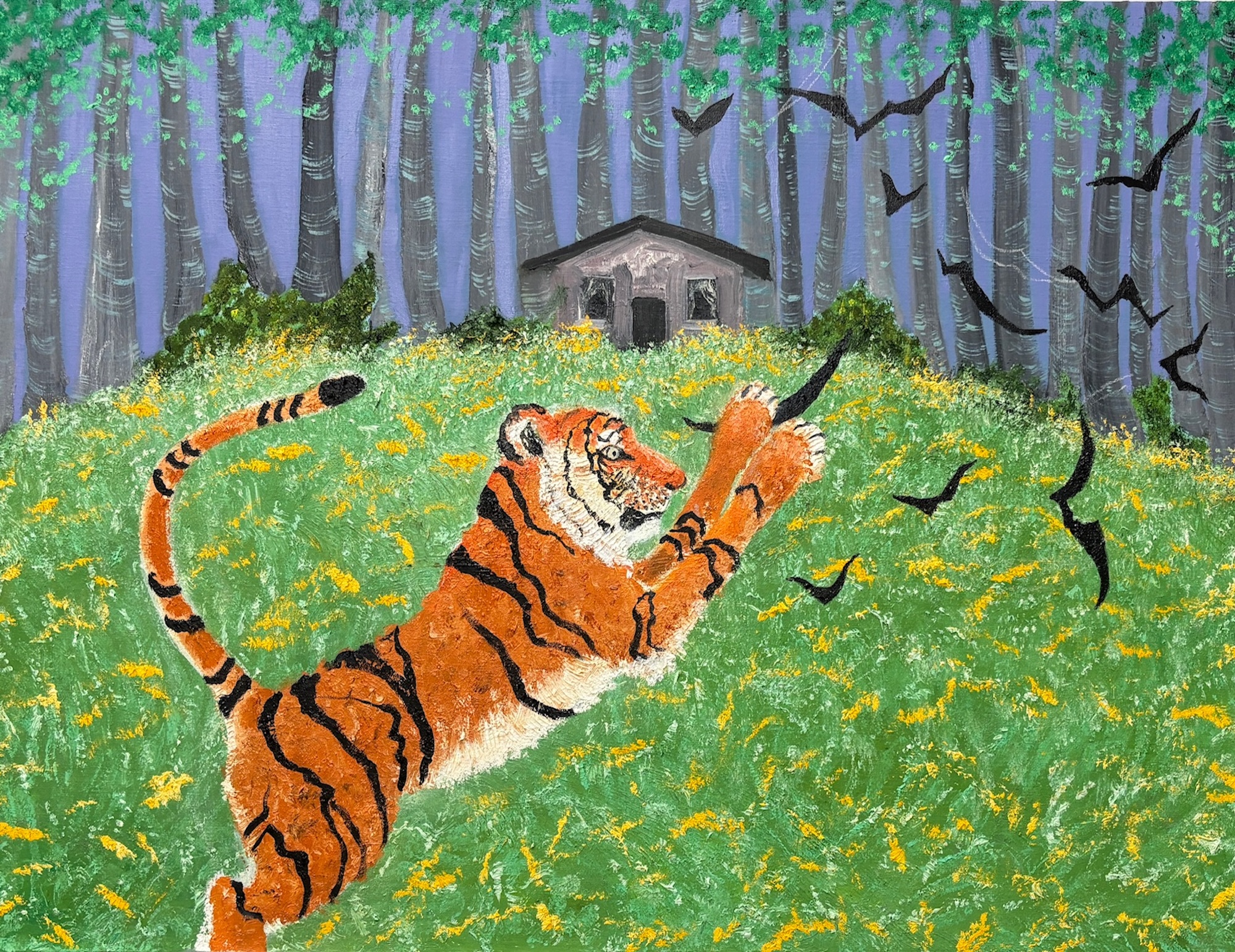
The Chase (2026) may refer to one of Vincent van Gogh’s last paintings, with crows flying above a field and a path that stops short.
The tigress is the artist: a fighter and a queen who will not give up because she wants to live and prosper. Unlike the story of van Gogh, DeVincentis is making it happen in real time — her life, her career, and her paintings containing her battles, scars, and victories on the pictorial plane.
One of the crows, which seemed destined to remain virtual and “not real,” is caught by the brave and cunning tigress. The act confirms the reality of the supposedly fleeting illusion.
Yes, perhaps Buddhism is correct to call the world an illusion. Yet within this illusion, material and existential reality — as well as our dreams and wishes — may persist as “real,” in the form of truth standing against falsehoods and propaganda.
So the idea that reality is an illusion may itself be another form of illusion, evidence of which only the best and brightest — like the tigress — can catch.
Elsewhere, DeVincentis painted Contemplation of the Improbability of Existence (2024), which was not officially included in the exhibition but remained within the gallery for its duration.
The painting depicts an anthropomorphized butterfly beside a giant spider web hanging from a cherry blossom tree. The world is outrageously beautiful, yet simultaneously lonely and dangerous.
This is the ludicrous and impossible nature of human existence and reality. Everything in the universe seems capable of killing us, and we are all mortals with a limited duration on Earth. Yet here we are, furnished with the provisions and know-how for life by our parents, ancestors, and friends.
The artist emphasizes the importance of gratitude: cherishing every moment of life despite its downs and ups, because the only way to encounter what comes next is to remain thankful for what is already here.
It may sound clichéd, but this is an important lesson, conveyed through one of the most beautiful metaphors the artist could conjure.
The Darwinian idea of survival of the fittest becomes, here, another illusion — one that rewards the “winners” and justifies inequality within societies and between nations. Had the universe decided to kill us all, and had we been dealt the equivalent of a dinosaur-killing asteroid, there would be little room to debate who was fitter and who was weaker.
The idea of strong versus weak, man versus woman, predator versus prey, and the just versus the criminal may all be illusions created by systems that use language to divide and subjugate, manipulating reality itself.
In fact, the strong may be weak and vice versa.
The hunter who kills the tigress with a gun is not stronger than the tigress. The gun and the act of killing conceal the fact that the tigress is physically stronger than the hunter, who “cheats” the rules of engagement by obtaining a weapon.
The hunter’s tale of victory over the tigress, and the translation of that victory into superiority, becomes propaganda and linguistic gymnastics — just as the “victor” erases and rewrites history and its narratives.
Painting, like the paintings of Mary DeVincentis, may be one way for us to see ourselves in the mirror and reckon with the mirage-like danger language poses when it manipulates rules, outcomes, and history itself.
A good painting never lies.
We can lie with words, but we cannot lie to ourselves while looking at a good, honest, and sincere painting that disarms us and makes us question those lies.
A good painting needs to please no one. It searches for a truth that exists as a fundamental layer of reality — something we might try to plaster over with lies, but cannot.
Once a painting reveals that truth, we can no longer cover it up in quite the same way. The painting penetrates deeply into the psyche, hurting us with the truth and liberating us at the same time.
Mary DeVincentis, Like a Star at Dawn, September 9th – October 17th, 2026, Freight + Volume